Sunday, November 18, 2007

The End?

I’m writing this on the last day of my trip as I speed towards Tokyo on the Shinkansen, which is perhaps my favorite train in the world. I’ve spent the better part of the last 300 days traveling from Sydney to Tokyo, a total of ten countries and dozens of cities, posting more than 100 blog entries and 3,000 photographs. That I'm going home hasn’t completely sunk in. I’ve been taking this trip one day, one week, one city at a time, and the end has crept up on me. So it is with mixed feelings that I return to Tokyo, where I’ll spend one more night before boarding a trans-Pacific flight (my least favorite form of travel) back to the U.S. of A.

I’m excited to return to familiar territory, where I speak the language and I am well versed in the customs. I’m looking forward to seeing family and friends, to eat my mother’s cooking and watch late-night cable television. But I’ll miss the freedom of the open road, the expected pleasures and unexpected impediments that make for open-ended travel. I’ve got an itch (no, not that kind of itch), formed early in life, that leaves me restless. It will lead to more travel in the future. For now, it's time to reflect on 2007 and look to 2008.

As a final installment of Packmonkey: Asia (leaving the door open to Packmonkey: North America and Packmonkey: Europe), I offer a short summary of the good, the bad and the in-between. This is hardly a recap of my entire ten months on the road, merely a short trip down memory lane. I plan to offer a little more reminiscing once I'm back in Los Angeles.


Everything Australian: I spent nine weeks in Australia in February and March, traveling overland along the southern and western coasts from Sydney to Broome, then into the Outback on a 4WD trek from Adelaide to Alice Springs. Australia is a beautiful country. The interior is desolate, stark and remote, the coasts rugged and wild. As a whole, it is a challenging, rewarding and breathtaking place to travel. I will never forget sleeping under the stars in the Painted Desert or swimming in sea lions in the Eyre Peninsula. I also made some lasting friendships in Oz: Bernie and Kate, Dean, Elizabeth – keep in touch! Australia raised the bar for all subsequent destinations. The time I spent in Australia amounted to the trip of a lifetime. Had I returned home after the Outback, I would have been satisfied.

Monkeys and Mountains in Malaysian Borneo: I arrived in Malaysia with low expectations. I left in love with the country. The Malaysian people were some of the friendliest I encountered - always a smile for the wandering Jew in their midst - and the food unexpectedly satisfying. The three weeks I spent in Malaysian Borneo sealed the deal: encounters with the orangutans, proboscis and langur monkeys, Uncle Tan’s jungle camp and the trek to the summit of Mt. Kinabalu, which left me exhausted but marked two of the best days of the whole year.

Backpackers’ Laos: Backpackers flock to Southeast Asia, so it’s no surprise that there’s a backpacking culture in this part of the world. My time in Laos, from my arrival at the border with Thailand to my departure from Vientiane, was the ultimate backpacker’s experience. The country itself is wonderful, remote and rural, yet unspoiled by the tourism you encounter in Thailand and Vietnam or the tragic history of Cambodia. Laos had been described to me as Thailand of 20 or 30 years ago. Ten short days in country showed me the Southeast Asia I dreamed of visiting.

What made my time in Laos really special was the friendships I made. Two days floating down the Mekong solidified a bond with my French amis, Guillaume and Emmanuelle. We spent the evenings in Luang Prebang at a sidewalk bar laughing over glasses of cloudy pastis, the days meeting the young monks at the city’s temples or swimming at the tranquil waterfalls outside of town. In Vang Vieng I met Mitzi and her daughter, Miksa, from Hawaii. We explored caves and rented bicycles for a trip to the local market. At night we relaxed over cheap food and beer at the backpacker cafes. Miksa and I even found time for a marathon afternoon watching "The Simpsons." Traveling friendships are short and intense, and one of the joys of travel.

Food, Food, Food: Who doesn’t love to eat? Everywhere I traveled there was something new to taste: kangaroo sausages in Outback Australia, blue rice in Malayasia, chicken rice in Singapore, khao soy in Northern Thailand, even deep-fried tarantulas in Cambodia. There were also some old favorites to devour: sushi and ramen in Toyko, curry and pad thai in Thailand. Somehow, I still haven't tried durian.

Indonesia Headaches: I arrived in Indonesia with high hopes. Two weeks later I couldn’t leave get out the country fast enough. From the touts and taxi drivers oozing desperation in Bali to the scam artists in Java who took me for a ride, I was overwhelmed by the amount of ill-will I felt in Indonesia. I’ve heard reports from other travelers about good times in Bali and Java, so I will not say the country is filled with bad people and bad times. At least I left with two good memories: sunrise at Mr. Bromo and an afternoon spent wandering the ancient Buddhist temple at Borobudur. These two places almost make up for all the aggravation I experienced everywhere else in Indonesia.

Tourism in Thailand and Vietnam: Thailand and Vietnam are two of the most popular destinations in Southeast Asia. They were also, for me, two of the most disappointing destinations on my trip. In the island of Southern Thailand, I encountered hoards of westerners traveling from one beach to another. It seemed that the locals in sight were either serving the foreigners beer and food or cleaning their rooms. There was also the terror of the night of the flying termites. The beaches are nice enough, but crowded and dirty. Were it not for the energy of Bangkok or the charm of Chiang Mai, I’d have to write off Thailand as a loss.

In Vietnam, the tourism treadmill also operates at full speed. Perhaps it was because I’d been on the road for six months, or perhaps it was because I was exhausted from a whirlwind tour of Cambodia. Whatever it was, I found Vietnam to be hectic in all the wrong ways. From the overcrowded and polluted streets of Ho Chi Minh City and Hanoi, where even the act of crossing the street was hazardous, to the constant haggling over prices, Vietnam was a downer.

Life and Death in Cambodia: I only spent 10 days in Cambodia, but those days contained some of the best and worst times of my trip. On the positive side was an extraordinary tour that took me into the Cambodian countryside and introduced me to the real Cambodia of today. The tour also resulted in a few of those backpackers’ friendships that I mentioned earlier. I loved drinking late into the night at a small bar in Kampong Cham and on the beach at Sihanoukville with Sally and Renee, nurses from Adelaide, Australia. And Kathe, a university student from Holland, turned into a close and unexpected friend.

On the down side was a bus accident that left two Cambodians dead and exposed the utter corruption and poverty of Cambodian society. I refer you to the impassioned blog post I wrote on the afternoon of the accident.

Return to Tokyo: I knew that I wanted to end my trip in Japan, to return to a place I lived for 18 months in the early 1990s. I did just that and I am now reminded of that old adage about not being able to go home again. In the years since I lived in Tokyo, I’ve changed, Japan has changed and the world has changed. I love the country and the Japanese. I loved taking Japanese lessons and exploring the country again. But in the end I could have done with less. I’d been on the road for most of the year and was tired, wanted to do little more than curl up with a good book and a glass of whiskey. So I spent most of my time in Tokyo enjoying solitude and rest.

My time in Tokyo was good for the spirit, but perhaps something of a missed opportunity. Perhaps what it taught me is that the next time I take off and travel the world, I’ll impose a six-month limit. For me, that seems just right.

So on the eve of my return to the U.S., I look forward to reuniting with family and friends, to starting a new chapter in my life that builds on everything that’s come before.

Some people say travel changes you. I think that’s a big fat myth. I’m still the same person I was when I started this trip. What I have now that I didn’t have before is a greater understanding of the world and my place in it. I think I’m more humble. I’m definitely more aware of how fortunate I am. My place in this world is small, but my future is unlimited. The end? I don't think so. Just another beginning.

A HUGE thanks to everyone who checked in and supported me over the past ten months. I will see you all very soon!
Labels: , , , , , , , , , , , , , , , ,

Friday, July 13, 2007

Monkey Mania

It's been weeks since I was in Borneo, but it's never to late to write about monkeys. My latest dispatch for Tripmaster Monkey ("Home of Yellow Journalism") is about my stint as a Monkey Tourist. It's chock full of simian antics and heartwarming anthropomorphism. I hope you'll give it a read, and click on a few ads when you are done to support the fine folks running the show at TMM.

Previous: Singapore, Indonesia

Labels: , , ,

Sunday, June 10, 2007

Lazy Sunday

I've been quite the slacker since climbing Mount Kinabalu, first recuperating in Kota Kinabalu and then whiling away a few days in Penang, an island off the northwest coast of Malaysia, with a stack of paperbacks ("The Quiet American," a few Lee Child mysteries) and DVDs ("Star Wars," "The Quiet American," "Old Joy," "10 Items or Less"). After four months on the road, a little downtime is a good thing.

It's Hot! Time for an Iced Coffee. Mmmmm....

It's now a lazy Sunday in Georgetown, the capital city of the state of Penang, the streets are quiet and I'm in my hotel room planning my next move. I have been looking forward to visiting Thailand for a long time. I will leave Malaysia on Tuesday morning and head to the Andaman Coast. Where I end up depends on the weather - the rainy season has arrived. I plan to work my way up the coast, skirting the tourist mecca of Phuket while hitting islands and beaches, then passing through Bangkok en route to trekking in the north. Anyone with knowledge of Thailand is encouraged to send along recommendations and suggestions.

I feel like I've completed another chapter, that I've wrapped up the second leg of this trip and am ready for more. The first leg was nine weeks in Australia. Over the last eight weeks I've toured Indonesia, Singapore and Malaysia. The next leg, call it my summer swing, will take me through Thailand, Cambodia, Laos and Vietnam. I plan on continuing this crazy adventure into the fall with visits to China and Japan, though I remain flexible and plans could change. In each country I've experienced ups and downs, made friends and come to know more about myself. There's nothing like travel to challenge, enlighten and entertain. I know this will end someday, but for now I'm riding it with everything I've got.

I've created a new Flickr photoset of highlights from Indonesia, Singapore and Malaysia. These are my favrote pictures from the past two months, a mix of travelogue, people and places. Enjoy!

Hey! Check out the Photoset!

Labels: , , , ,

Thursday, June 07, 2007

Rocky Mountain High

I’ve been to desert, ocean, city and swamp. I’ve swum with sharks and sea lions, encountered deadly snakes and wrangled with disingenuous locals. I’ve climbed a bridge, visited temples and photographed skyscrapers. I’ve downed delicious tropical juices and devoured mounds of Chicken Rice. What’s a traveler to do next? How about climbing a mountain?

Mount Kinabalu in Malaysian Borneo is thee tallest mountain between the Himalayas and Papua New Guinea. At 4,095 meters (13,435 feet), Kinabalu can’t compete with the world’s great peaks. It’s not even half as tall as the five highest peaks on the planet. Kinabalu doesn’t even rank in the top 100. It’s a runt in a land of giants. But I’m a hiker, not a climber, and 13,435 feet is a noble challenge.

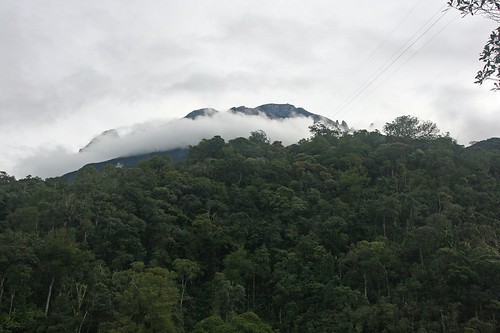
Mount Kinabalu Obscured by Clouds
(As Seen From Kinabalu National Park Headquarters)


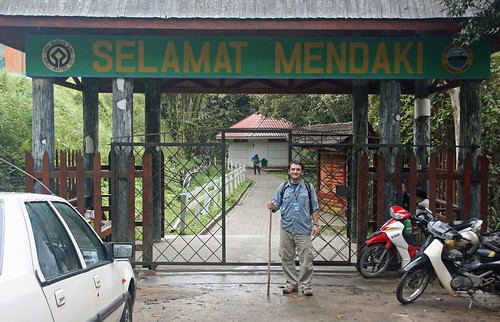
"Selamat Mendaki" (Happy Mountaineering)

The trek takes two full days. I would stay in a hostel in Kinabalu National Park, at 1,564 meters (about 6,000 feet), then wake early for a day of hiking from Timpohon Gate to the resthouse at Laban Rata, a distance of six kilometers and 5,000 vertical feet. I would then spend the night in a hut at 11,000 feet, waking up at 2 a.m. to tackle the summit, a climb of 2.7 kilometers and an additional 2,500 feet of elevation. Numbers are all well and good, but don’t tell the whole story.

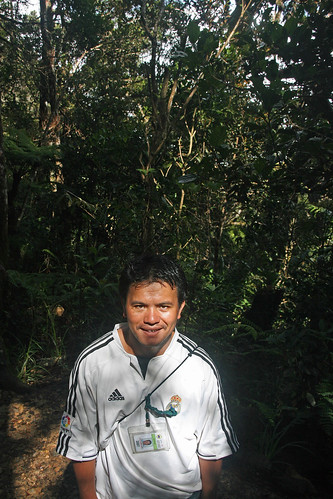
Everyone who climbs Mount Kinabalu must hire a guide. My guide was Julius, a deceptively reserved local who has spent his entire life within ten kilometers of Mount Kinabalu. He started working as a porter when he was 14. Now, at 28, he doesn’t know how many times he’s climbed to the summit. He does, however, estimate that he could make the 18-kilometer round-trip in about five hours. Life all the porters and guides I encountered on the mountain, Julius was strong as an ox and modest as a wallflower.

Julius was an excellent guide and climbing partner, never pushing me to go beyond my own pace, and happy to point out flora that I would otherwise have missed, like the carnivorous pitcher plants that trap their prey in a cup of sticky syrup. He was also good for conversation, delivering a string of out-of-left-field questions like “Do you know Chuck Norris?,” “Do you like women with big breasts?” and “Do you believe in black magic?” These moments of absurdity help me immensely and I thank Julius for his offhand take on the world. He was also my unofficial photographer, though he could use a lesson in composition and the importance of a level horizon.

Julius, Master of the Mountain


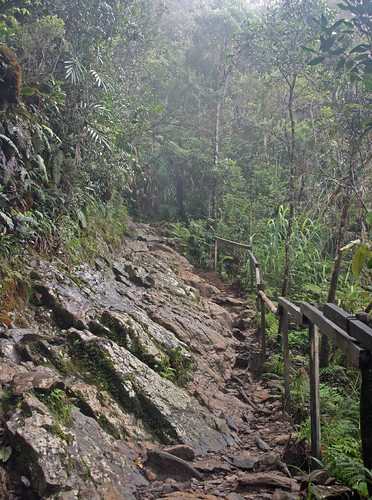
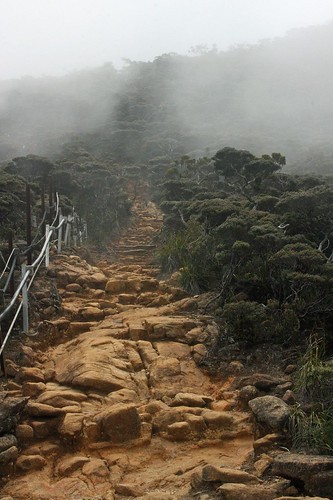
I’ve done my share of hiking, and wasn’t concerned about the climb itself. Other travelers said I’d be sore in the days to come, but that seemed par for the course. What I discovered soon after passing through Timpohon Gate, however, is that Mount Kinabalu is more climb than hike. There’s nothing subtle about the trail; it is rocky, steep and treacherous. Well maintained, yes, but challenging. About 20 meters out 8.7 kilometers is on level ground. The rest is incline, over rocks and roots, up steps, around boulders and across rock faces. The steps are tall, consistently up to my knee and sometimes up to my thigh. Even with the walking stick, I often struggled to find my footing and had to pay attention to every step.

The Summit Trail...


...It's a Walk in the Park

Within the first hour of the climb I started to feel fatigue. But Julius gently urged me forward, telling me, “You are a very strong man,” and I soon found a comfortable pace. We covered the six kilometers to Laban Rata in four hours and forty-five minutes, arriving at 1:30 in the afternoon. I was the fourth climber of the day to make it to the camp, and I entered the empty resthouse exhausted and happy. Still, I was unable to eat, unable to do anything but rest my head on a table and wish for unconsciousness. I checked in at registration and dragged myself another ten minutes up the trail to my hut, where I found a comfortable bunk and two warm blankets.

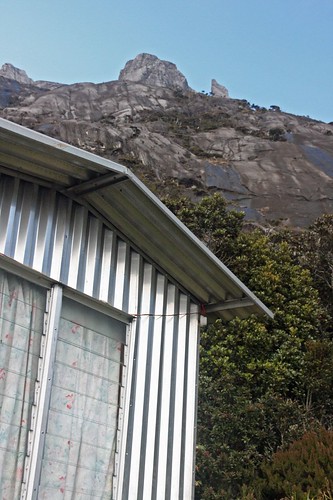
Panar Laban Hut

I awoke three hours later feeling rested and alert, and returned to the resthouse for a meal. What had been an empty hall in the early afternoon was now crammed to the rafters with climbers. There was tempered excitement in the air. Everyone in the room had climbed up the mountain; we were equals in this endeavor whether the climb had taken four hours or fourteen (the average is about six hours). We were a collection of weary faces and slumped postures, but we were now some of the highest people in Southeast Asia.

I retired to my bunk at 7:30 an settled in for a few hours of sleep. Julius woke me at 2 a.m. After snatching a quick cup of weak coffee at the resthouse, I gathered my supplies (headlamp, gloves, hat, camera, energy snacks, multiple layers of clothing) and set out to conquer the summit.

Julius and I had hiked through rainforest most of the previous day, and had spent the night in an alpine zone of stunted trees and sparse shrubbery. Now we would cross the timberline and hike cross a great slopes of bare granite. The air was thin, but at least the terrain was fairly even.

We set out at 2:40 and within a few minutes passed a young woman vomiting by the side of the trail, a visceral reminder of the situation. Anyone can climb Mount Kinabalu – it doesn’t require mountaineering skills and can be accomplished in a sturdy pair of walking shoes. The climb is, however, very strenuous and without a moderate level of physical fitness you will suffer. And there’s the unpredictability of altitude sickness –even the strongest of athletes can be hobbled by elevation.

I was aware of the altitude, and decided to take my time. If it took five hours to hike 2.7 kilometers, so be it. As I trudged up the mountain, my progress slowing as I gained more elevation, I thought of every National Geographic special I’d seen about Everest, recalling how climbers would take one step, then rest, another step and another rest. And here I was crossing 12,000 feet, taking a few steps at a time, and resting. I was walking slow, slower than I’d ever walked in my life, slower than a tourist on Seventh Avenue or rush hour traffic on Santa Monica Boulevard.

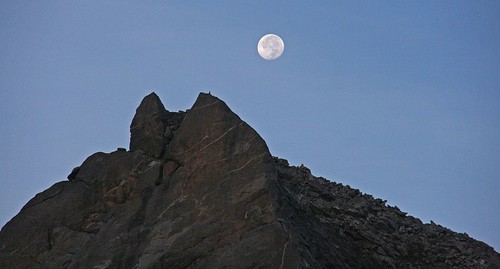
I pushed on, following the thick white rope that guides climbers up the naked rock to the summit. The full moon had passed a night or two earlier, and I was able to turn off my headlamp and hike by moonlight. Jagged peaks were outlined against the starry sky. Perhaps it was the exhaustion, or the realization that willpower was propelling me closer and closer to my goal. Perhaps it was the elevation. Whatever it was, I couldn’t think about reaching the top without experiencing an upswell of emotion, tears of joy threatening to erupt at any moment. But I kept my emotions in check and set my sights on the only thing that mattered: the summit.

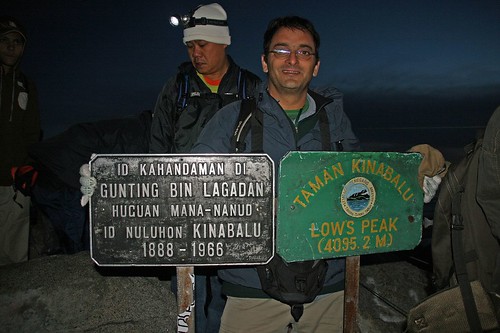
Low's Peak (4,095 Meters)

My legs felt great, but I was acutely aware of my lungs and my heart rate. Passing 13,000 feet, I’d push myself 10 or 20 feet and have to stop, gasp for a few breaths while my heart thudded in my chest. It took me an hour to cover the last 500 meters. I covered the final 100 meters at a slow crawl, using hands and feet to clear the jumble of boulders below the summit.

Meanwhile, Julius was like a kid at the playground, jogging up and down the slope behind me and bouncing up and down for warmth. I should have hated him, but was inspired by his enthusiasm. Even after 14 years and countless ascents, he displayed an impish glee at being at the top of the mountain. I’m sure Julius earns a paltry salary for his efforts; he deserves much, much more.

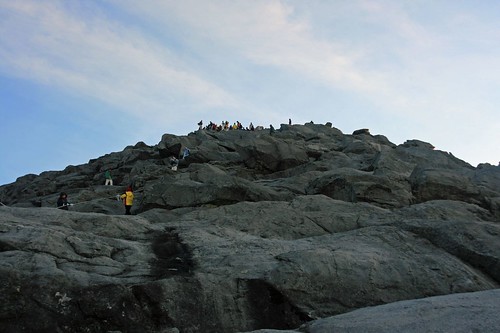
There’s an old saying that the journey is the reward, not the destination. I reached the summit, asked an older Japanese man to take a few pictures of me and was quickly ready to start climbing down. The sun was about to break the horizon, and there were dozens of climbers clamoring for space on the narrow summit. Also, I felt a sudden surge of nausea and didn’t want to vomit on the expanse of Southeast Asia that lay below me.

The Summit

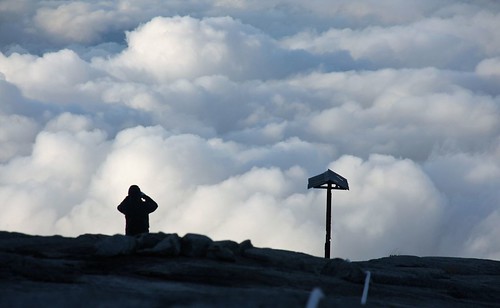
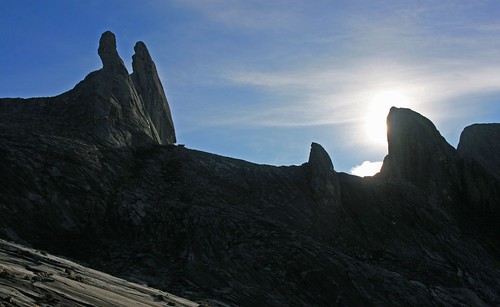
With the rising sun illuminating the slopes, I took my time on the descent, photographing the peaks that were only outlines an hour before. A cottony layer of cloud covered the land, perhaps a thousand feet below me. I realized that no birds were singing, no frogs croaking, that plant life was stunted and wispy, clinging to the crevices in the rock. I was tired, so tired, but still in awe of the scenery, appreciating every moment I had earned with hard work and perseverance. I was reminded of my love for the Australian Outback and the American Southwest, for the harsh spaces where only the hardiest of species survive. Beaches and forests are great, but for me there’s real beauty in the barren. I wonder where that comes from?

Moon Over Kinabalu


View From the Top


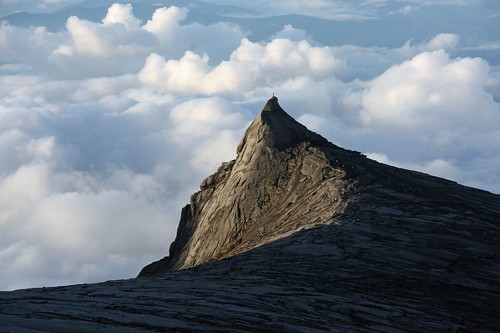
South Peak


Sunrise Over Kinabalu


Two hours later I was back at Laban Rata, eating a breakfast of ramen noodles and ready to complete this adventure. But Kinabalu National Park had one more surprise in store for me. The park is in a rainforest. I had been lucky the previous day and climbed without encountering one raindrop. On the descent, however, the rain never let up. It never poured, just a steady mist and drizzle that increased the difficulty of the trek. All those steep slopes, the rocks and roots were now wet and slippery.

On the hike down, we encountered the next day’s climbers making the ascent. I urged them on with words of encouragement, telling them the summit was worth the effort. Around kilometer two an elderly Australian man asked me if the climb got any easier. I should have said it was a piece of cake, but told him the truth, that no, it really doesn’t get any easier, that it’s a slog from start to finish, both going up and coming down. He seemed put off by my answer, but asked me if I’d do it again. Without hesitation, I said “Yes.”

I surprised myself with this quick response. Mount Kinabalu was the toughest climb of my life, a challenge for mind, body and spirit. I loved every terrible minute.

Mission Accomplished!

Labels: , , ,

Tuesday, June 05, 2007

Welcome to the Jungle

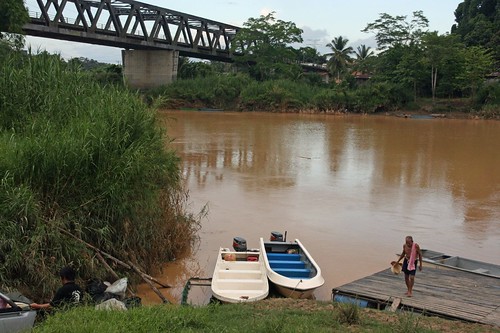
First get yourself to Kuala Lumpur. Then fly two and half hours to Kota Kinabalu, a city on the island of Borneo, then travel for six hours by local bus to Sandakan (or fly 45 minutes, your choice). Sixteen miles outside of Sandakan, register with Uncle Tan Wildlife Adventures. After a 90-minute drive through palm oil plantations and countryside, they will deposit you on the banks of the muddy Sungai Kinabatangan. An hour of speeding downstream in a small boat overloaded with tourists and luggage will bring you to a collection of huts in the jungle. You are at Uncle Tan’s, where it’s all about nature.

Express Boats to Uncle Tan's

I first heard about Uncle Tan’s while flipping through the pages of my Lonely Planet guidebook. “It’s not hard to spot someone who’s been to Uncle Tan’s,” says Lonely Planet, “they just can’t stop raving about the place.”

Yeah, right! Too good to be true. I made a mental note and moved on.

But when I arrive in Kota Kinabalu, I met a Frenchman at the Akinabalu hostel who had just returned from Uncle Tan’s. He had a wistful look in his eyes, a look that said you just have to experience it for yourself. So I bit.

But what did I have in store for me? What exactly is a jungle camp?

I learned a little more when I was handed a packet of information at the company’s ramshackle headquarters 16 miles outside of Sandakan.

“We would like to remind visitors that the Camp is not exactly the HILTON! Facilities are Spartan in nature, but we do our best under ‘circumstances of wilderness’ to make your visit enjoyable and comfortable. The Camp is situated in a jungle environment. It is in an old riverbed by some beautiful ox-bow lakes. Insects and mosquitoes will be there… The floodwater may rise. Part of the Camp may be under water. Toilets may be under water. It can be inconvenient.”

At least they are honest. And droll.

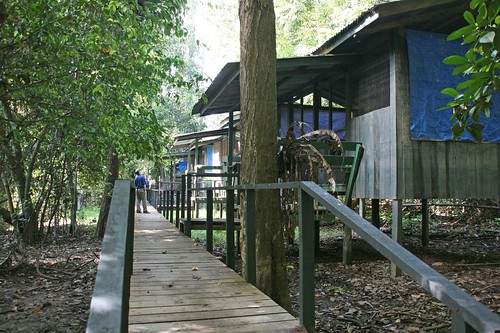
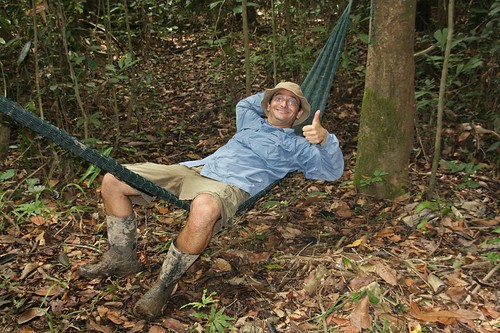
But I’m not about to tell you a story of hardship in the jungle, of mud, tears and bitter memories. The 38 hours I spent at Uncle Tan’s were wonderful, filled with new friendships, exotic creatures and a little bit of that thing we like to call “getting back to nature.” Yes, the conditions were spartan, there was rain, mud and mosquitoes. We slept in wooden huts on foam mattresses; generators supplied electricity in the evening hours, but there were outlets recharging batteries; water was pumped from the river to the camp, for the pit toilets (surprisingly clean and not at all stinky) and any washing campers might want to do.

Sleeping Quarters

All supplies, including new mattresses, water, food and beer, were brought in daily by boat. There was a clean kitchen with a full-time cook who turned out an astonishing array of Malaysian dishes, all of them healthy and tasty. Every meal was augmented by slices of fresh fruit to cleanse the palette. The staff of young men, all of them healthy and strong from living in the jungle, was welcoming, friendly and enthusiastic. In the afternoons and evenings, they would lay in hammocks or lounge in the common area playing Malaysian rock songs on battered, out-of-tune guitars. Annoying at first; endearing in the long run.

Who needs the Hilton when you’ve got Uncle Tan’s?

You can stay at Uncle Tan’s for as long as you want, but the usual package is three days and two nights, which means you arrive in the afternoon on day one and leave in the morning on day three. Yes, you spend two nights sleeping in the jungle, but you are really only on site for about a day and a half.

My group of 11 was a mix of two Americans (both from California!) and nine Europeans. We met over lunch at Uncle Tan’s HQ and quickly bonded, sharing the information that is the stock and trade of travel: where are you from, where have you been, where are you going? From there connections are made and other subjects come up. It’s the same story whenever travelers get together, and it’s really the best way of getting information on the road. By the time we arrived at the camp, we were old friends.

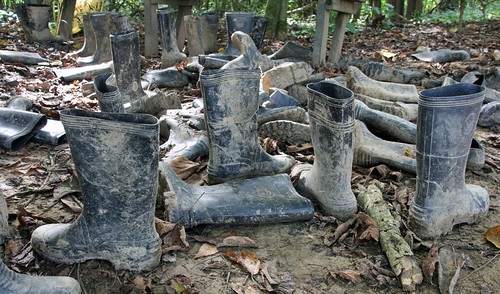
Mud Boots: A Necessity for Jungle Trekking

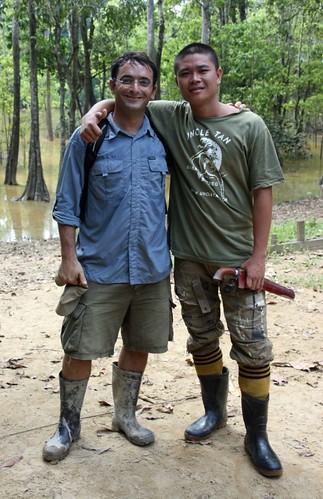
Over the next day and a half, we took three boat rides up and down the Kinabatangan River and through a series of ox-bow lakes, and two treks into the jungle, one during the day and one at night. The purpose of the camp is to view wildlife. Suzi, a Californian in Borneo after a stint of volunteer work in the Philippines, and Stin and Cynthia, a Belgian couple that left their kids at home, were keen on cataloging the animals, keeping a running list and hashing it out each time we returned to camp. The rest of us – a Dutch couple, Tim and Margriet, who displayed good humor and a sense of irony that I appreciated very much; professional travelers Nikki and Tom, Brits who met in India and never looked back; Angela, an ex-pat teacher living in Brunei, a land of plenty after two years in Saudi Arabia; Leah, from Ireland but living in New Zealand (she went on vacation and never went home); and Martina, a traveler from Germany – were just happy to see the creatures.

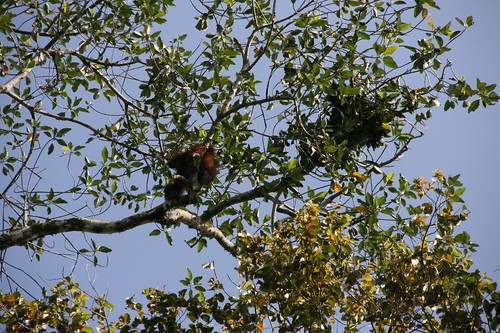
Yes, there were monkeys and apes, crocodiles, birds large and small, frogs of all colors, bugs and more bugs, scorpions venomous and harmless, monitor lizards, bearded pigs, leeches, butterflies, and a few hairy tarantulas. A mama orangutan and her baby perched in the trees above the camp, plucking fruit and dropping peels onto the huts below. Campers were atwitter over a tender moment between mother and baby, but I missed it and cannot verify this instance of animal kinship.

That Orange Blob? Mama Orangutan.

And we had to keep a keen eye out for the pesky macaque monkeys at mealtime – they are thieves and will take advantage of any lapse in vigilance. They had recently learned how to open the containers storing coffee, tea and sugar. It seems the macaque monkeys on the Lower Kinabatangan have a taste for Milo.

On our afternoon boat tour, our guide, Tan, who with eleven years at Uncle Tan’s has likely seen everything, stopped the boat and asked for a pair of binoculars. He scanned the trees, paused, then raised his arms and let out a whoop. “A gibbon,” he shouted. We were lucky to see this ape for a few seconds as it swung with lanky arms from one tree to another, a dark outline among the green foliage. Gibbons are rare in this part of the jungle, only appearing two or three times a year. Tan’s enthusiasm was catching and we all returned to camp full of good humor and boasting about the great gibbon in the trees.

Matt and Tan

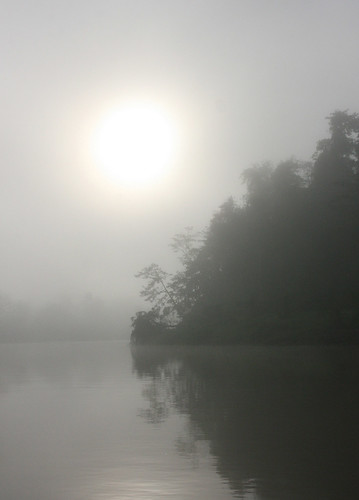
I could go on and on about all the animals, but I’d bore myself to tears. And what I'll remember about Uncle Tan’s is not really the animals. I will remember just being in the jungle, far from civilization where there are animals, yes, but also moments of utter tranquility. We woke at 6 a.m. for a boat ride to see animals, but my memories are of a rising sun obscured by heavy mist, a haze that turned an ordinary river cruise into my own (quite fictitious) journey into the heart of darkness. Imagination is a wonderful thing.

Sunrise Over Sungai Kinabatangan

A nighttime trek through swampy jungle revealed a world of nocturnal creatures – frogs and spiders mostly, but a few venomous scorpions and a hairy Blue Tarantula. At one point our guide, Loi, told us to wait as he ventured waist-deep into the swamp, the beams of his torch bouncing off the fans of the Mangrove trees. Enveloped by dark night, under a protective canopy that blocked out the light from the moon, I had a fleeting thought of nightmares, that what I was seeing is the stuff of dreams, bad dreams, and if I weren’t having such a good time I would probably cry out in terror and beg someone to take me home.

When it was time to leave Uncle Tan’s, we were given handshakes and hugs by the staff and sent on our way. We spent a minuscule amount of time in the jungle, but all of it was memorable, ranking as a highlight on this extensive tour of mine. In fact, back in Kota Kinabalu, I found myself trying to describe the place to another traveler, a wistful look in my eyes and a head full of jungle fever.

Good Times!

Labels: ,

Thursday, May 31, 2007

O-Town

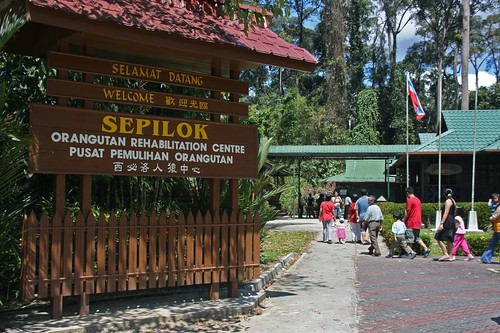
I first heard about the Sepilok Orangutan Rehabilitation Center, one of the most popular tourist attractions in Malaysian Borneo, from an episode of the television program “Globe Trekker,” a British production in which affable hosts journey to exotic locations. They show is geared toward adventurous travelers, the ones with backpacks who don’t mind public transportation and a little dirt on their dungarees. (i.e., budget) travelers. The episode included a trip to Sepilok and the host, serious Justine Shapiro, was treated to a one-on-one encounter with a young orangutan. As part of the paying public, my visit was much less personal and ultimately disappointing.

Sepilok Orangutan Rehabilitation Center

At one time, visitors to the center were allowed to interact with the orangutans. With outbreaks of SARS and the Asian Bird Flu in recent years, the apes and humans are kept apart; visitors can now only observe the apes from a short distance during twice-daily feedings.

The Sepilok Orangutan Rehabilitation Center is a stop on the tour bus circuit. You’ll know you’ve reached a tour bus destination when large groups of people are speaking the same language and are wearing clean, light-colored clothes. Also look out for a lot of sandals and compact cameras.

I don’t think there is anything wrong with tours (I spent a few weeks in Australia as part of organized tours and found it an affordable and convenient way to see the country. I even considered joining a tour of Borneo, but opted to remain independent). There are few surprises, delays or “what the?” moments. But there is also a lower probability of leaving the crowds behind, of discovering that you’ve arrived in somewhere outside your comfort zone, that time and place that makes the challenges of independent travel rewarding.

In my last post, I wrote about my visit to the Labuk Bay Proboscis Monkey Sanctuary. There were about a dozen visitors at the morning feeding, certainly more monkeys than humans. Why are people passing up the proboscis monkeys and traveling in droves to see the orangutans? Proboscis monkeys aren’t as sexy as orangutans, nor as popular in the imagination. The proboscis sanctuary is also difficult to get to – 15 kilometers on an unpaved road – and there is no public transportation to the front door. Lastly, the entrance fee is twice that of the orangutan center. The bottom line, however, is that orangutans are popular creatures, gentle, endearing and easy to love. So I was not surprised to find tour buses and a crowd of more than 100 people at the orangutan center.

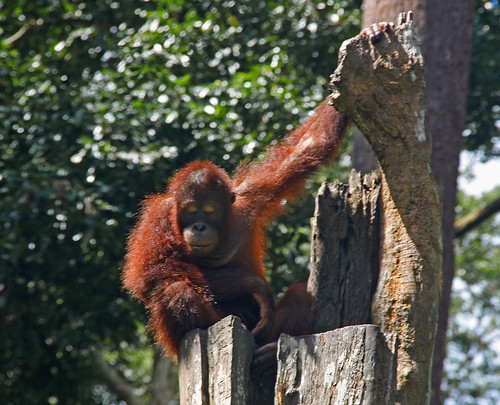
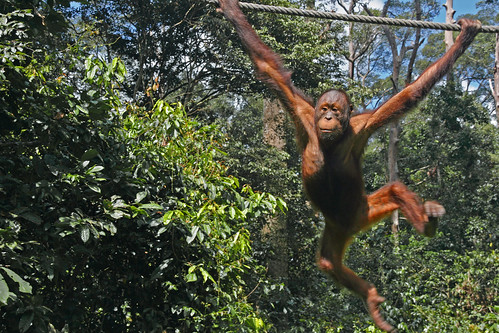
The morning feeding delivered exactly what it promised: orangutans, up-close and personal. About half a dozen creatures showed up to munch on bananas. They used hands and feet to traverse a rope to a feeding platform; they climbed pillars; they scowled, screeched, hooted and bared their teeth. One young ape hung from the rope, bucking up and down before launching himself into the foliage below. This last bit of apery elicited a great roar of approval from the crowd. The show lasted about 15 minutes before the apes withdrew into the forest.

So why did I feel the visit was a disappointment? Was it the sideshow atmosphere? The sight of intelligent and interesting animals on display? Did I expect something more personal, more serene or less orchestrated? It was a little of everything. I’m glad I went, elated that I got to see orangutans from a few feet away; I just wish it had been less of a circus and more of an education.

The orangutans were fascinating, however, and deserve a few photos. Enjoy!

What Are You Lookin' At?


Hanging Around


Old Lady Orangutan

Labels: ,

Monkey Eat, Monkey Do

My second piece for Tripmaster Monkey ("Home of Yellow Journalism") went live this week. It is a short version of my culinary tour of Singapore. If you've been reading Packmonkey you know I went overboard on the food. What can I say? I get excited sometimes by new flavors. Click through if you care to revisit chili crab, chicken rice, grilled stingray and the deliciousness known as fish head curry.

Previous: Indonesia

Labels: , ,

Monday, May 28, 2007

Monkeys and Mayhem

Before I hit the road, Borneo was a mystery to me. Is it a country? An island? Are there cannibals? Is it safe? Is it even possible to visit? Well, no, yes, maybe, most of the time and definitely.

Borneo, the third-largest island in the world, is not a country in and of itself. Indonesia and Malaysia share most of the real estate. The Malaysian states of Sabah and Sarawak cover the northern third of the island; the Indonesian state of Kalimantan covers the south. The tiny sultanate of Brunei has carved out of a sliver of land on the north coast roughly between Sabah and Sarawak. The name Borneo was applied by the Dutch during a period of colonization and it has stuck in Western minds.

I came to Sabah to climb Mount Kinabalu, the third-tallest mountain in Southeast Asia (13,435 feet). The parks department regulates the number of climbers who can be on the mountain at any one time, requiring climbers to reserve space in advance. I'm a fly-by-the-seat-of-his-pants traveler these days and didn't make arrangements before arriving in the city of Kota Kinabalu. Still, I was able to secure a spot on the mountain next weekend. That left me with six days to fill.
Tourists come to Sabah to climb the mountain or to see wildlife, both on land and below the sea. Probably the most famous inhabitants of the animal kingdom are the orangutans at the Sepilok Orangutan Rehabilitation Centre, 25 kilometers outside the town of Sandakan, which for me was a winding seven-hour bus ride from KK (the return trip will be by airplane). The orangutans are a must-see for me, but they will occupy one morning. A little research turned up another interesting monkey species, the Proboscis.

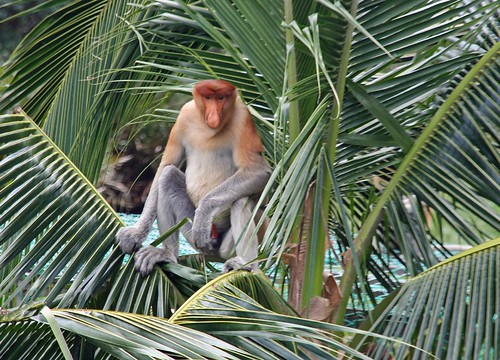
The Proboscis monkey is a an endangered species. There are only about 7,000 of them in the world and only in Borneo. As the name suggests, the monkey is distinguished by its huge schnozz. Actually, only the males have big noses. The females have dainty, pointy noses. I'm unable to decide if the creatures have unique features worthy of admiration or if they are just plain ugly. Buddy Ebsen and Mr. Magoo come to mind.

The Proboscis Monkey Sanctuary outside of Sandakan is not an easy place to get to. A visit would require either an overnight stay at an overpriced lodge in the jungle or an expensive taxi ride from the city. I settled on something in between -- I hired a driver for the day. We would visit the proboscis monkeys and then a memorial to a tragic chapter in world history.

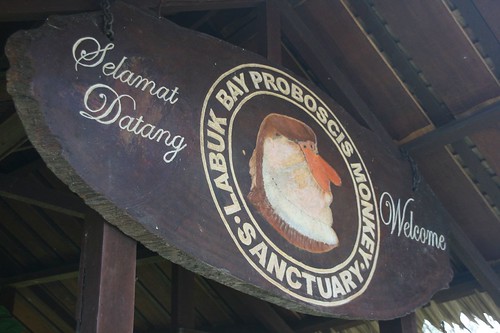
Labuk Bay Proboscis Monkey Sanctuary

Sonny, a local with little space in his brain for anything other than women, was living at the same waterfront hostel I'd booked into. We set out in the morning for the 90-minute trip. After 19 miles of paved highway, we turned onto a dirt road for a rough 15-kilometer ride into the jungle.

We arrived at the sanctuary about 45 minutes before the morning feeding. I killed the time watching a documentary about the monkeys, learning about their characteristics and behavior. Proboscis monkeys live in small groups, either based on a dominant male with a harem of females and offspring, or a bachelor group of young males who would vie for the females' attention. The

What makes this fairly common group dynamic interesting -- and if you don't find this interesting, get your head checked -- is that the size of the dominant male's nose plays some part in the attractiveness of that male monkey. The girls like the big beaks. The bigger than better.

Dominant Male

What's more, the dominant male's purpose in life, other than defending his territory (and females) is producing as many offspring as possible. To this end, the dominant male sports a constant erection, a red tower of power out there in front for all to see. This state of constant arousal is even depicted in a painting at the sanctuary. Check out that photo above one more time. Click on it to go to Flickr, then click on "All Sizes." You'll see clear evidence of his dominant stature

The proboscis monkeys in Sabah acted much like other monkeys -- fighting for scraps, leaping from trees, tumbling in the foliage and squawking and screeching at regular intervals. The addition of that fantastic nose meant I couldn't take my eyes off of them.

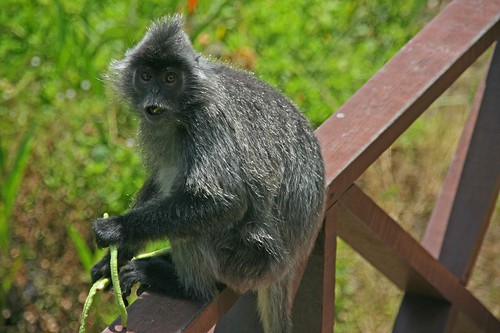
I also saw silver-leaf langurs, mudskippers and a few hornbills. None of them could compete with the proboscis monkeys.

Silver-Leaf Langur

On the way back to Sandakan, Sonny and I stopped at Sandakan Memorial Park. I realized when I read about the park that one of the unexpected themes to emerge in my travels is the Japanese presence in the south Pacific during World War II. It started when I was in Darwin, Australia, where I read about the sinking of an American warship by Japanese bombers. During a visit to a Buddhist temple in Singapore, I heard about the occupation of the city by Japanese forces. Somewhere in the back of my brain I knew Borneo played a part in the war. I just never knew how awful it was.

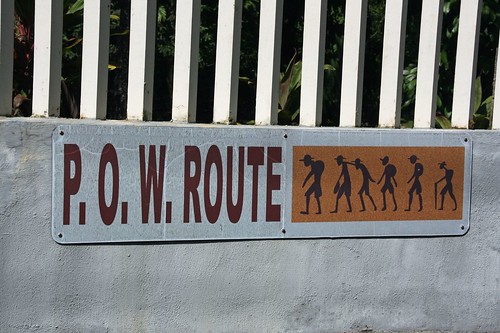
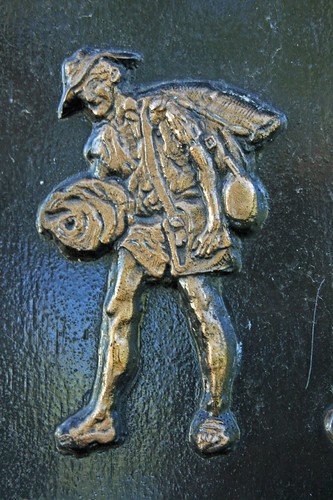
The Japanese occupied Borneo in 1941, and soon thereafter created a few camps for prisoners of war. In Sandakan, Australian and British prisoners were forced to build an airstrip. The conditions were acceptable at the beginning, as acceptable as an prison camp could be, I assume. But as the war progressed, conditions worsened and the treatment of the prisoners turned brutal. With the Allies on the offensive in 1945, the Japanese marched their prisoners 250 kilometers through the jungle. Of the 2,400 prisoners interred at the Sandakan camp, only six survived, and only those because they escaped.

Entrance to Sandakan Memorial Park

Sandakan Memorial Park is situated in a quiet grove off the main road. There is a small exhibition hall with a model of the camp and a series of panels explaining the history of the camp as well as others with heartbreaking quotes from survivors. It is a wrenching tale of cruelty and survival.

I took a short walk through the shady grounds after visiting the center, wondering how those terrible acts could have happened on this peaceful plot of land.

Plaque Detail Depicting POW on a Death March

The route from Sandakan to Ranau has been turned into a hiking trail. Tackling this trek may bring me back to Borneo someday.

I visit the orangutans tomorrow morning. I will then spend the next two nights in a jungle camp -- huts and mosquito nets, watch out for the crocodiles in the water -- next to the Kinabatangan River. I hope to see pygmy elephants and smell a rafflesia flower while I'm there.

I return to Kota Kinabalu on Friday night and will do my best to post an update before heading up the mountain.

Labels: ,

Sunday, May 27, 2007

Cave Man

Anyone who watches the reality television extravaganza "The Amazing Race" would recognize one of Kuala Lumpur's most famous attractions, the Batu Caves. "The Amazing Race" is a scavenger hunt/endurance contest in which teams of two travel around the world in pursuit of a million dollars in cold hard cash. Fans watch the show for the scenery, sure, but most of the fun comes from watching couples, friends, siblings and partners squabble with one another while scheming how to screw over the other teams. It's really all about rivalries and bitchiness.

In the latest season of the great race, "Amazing Race All-Stars" -- which I was unable to watch but followed through updates from friends and the Internet -- the 'round-the-world sprint took racers to Kuala Lumpur and to the Batu Caves. The caves are accessible via a very steep staircase comprised of 272 steps. The contestants, I assume, were captured in all their sweaty, panting glory as they raced to the top of the staircase to receive instructions about their next task or destination.

Halfway to the Caves

The Batu Caves are more than just a scenic location for American television. However, knowing I was covering the same ground as the Beauty Queens, the Midget and Team Cha-Cha-Cha made the excursion more special.

The Batu Caves are a series of caverns in a limestone hillside seven miles north of the city. The caves were discovered, legend has it, by an Indian trader sometime in the 1800s. They were made famous after an American naturalist re-discovered them in 1878. In the late 1800's the first Hindu temple was built inside the largest cavern. Today, there are numerous temples and shrines. The largest and most famous cavern, called Temple Cavern, is open the public and accessible via the aforementioned 272 steps.

Temple Cavern

The interior of Temple Cavern is impressive, with a 100-meter-tall vaulted ceiling and numerous holes letting in light. Still, there is a dankness, a fetid atmosphere with hints of an open sewer, that turned me off as soon as I stepped inside. Nevertheless, the temples and shrines, and the Hindus worshiping there, were enough to take my mind off the stench and keep me interested.

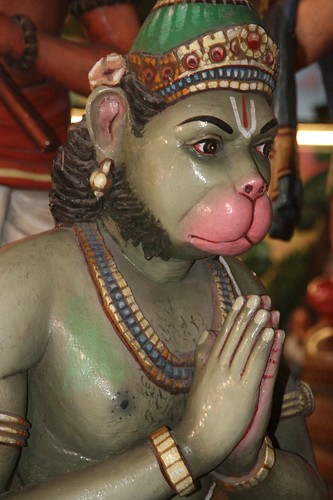
Another series of caverns open to the public is called The Art Gallery. These caverns are lined with paintings and statues depicting Hindu deities. When I visited, there were hundreds of people in Temple Cavern and only a handful in the Art Gallery. Those visitors who passed up this smaller cavern missed out on a psychedelic experience. A multitude of gods is depicted in vivid colors; it's as if Disney's "It's a Small World" had been transported to South Asia, the cute citizens of the world replaced by multi-headed snakes and blue-skinned Krishnas. There are multiple monkey-faced Hanumans and Ganesha the Elephant sits regally at the entrance to the gallery.

Hanuman, the Monkey God


Shiva? Vishnu? Can Anyone Tell Me?


I think the Batu Caves are a worthwhile destination for anyone traveling to Kuala Lumpur. I enjoyed the temples and the artwork, and the caves themselves are an impressive natural phenomenon. But what I will take away from my visit is the number of people who seemed like they were going to expire while climbing those 272 steps.

I walk a lot, especially when I'm in a new city. Sometimes I'll wander for 6 or 8 hours in a day, seeing where my feet take me and stopping when something catches my eye or I get tired, hungry or thirsty. I assume I'm in some kind of shape, my cardiovascular system attuned to the rigors of travel. Also, after about eight weeks in the tropics, I hardly notice the heat and humidity.

I'd heard about the 272 steps and thought it would be a challenge to ascend to the temples. Yet when I reached the top, I was barely winded. Meanwhile, I'd passed a number of people, young and old, clearly suffering from overexertion. Some, I knew from the red and white numbers painted on the staircase, had to rest before reaching 100. One man, he couldn't have been more than 30, lay on the ground, his chest heaving while a friend fanned his brow -- for what it's worth, I think he was putting on a show.

Suck It Up, Dude.


I'm in Malaysian Borneo now, in the state of Sabah. I'll be visiting some real monkeys this week, orangutans and proboscis monkeys to be exact. Next weekend I climb Mount Kinabalu, the highest peak in Southeast Asia. Then we'll see how tough I really am. Stay tuned.

Labels:

Thursday, May 24, 2007

Joy Juice Deconstructed

Sometimes when I'm browsing in a grocery store (or a 7-Eleven even) I stumble on a product that stops me in my tracks. It can be something utterly unappealing (see: Sweet Corn Ice Cream), a product so mysterious I'm unable to begin to guess what it is, or, as was the case today, something that brings a huge smile to my face.

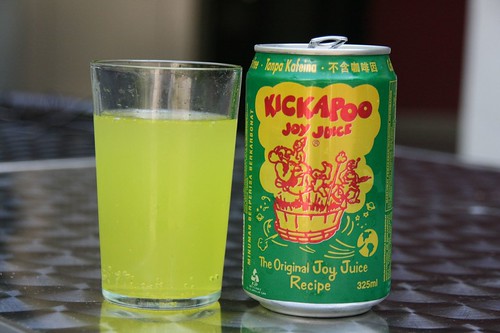
I was checking out the selection of cold drinks at the Japanese superstore Isetan this afternoon. What I really wanted was a can of soursop juice, but when I saw the words "Kickapoo Joy Juice" I knew I'd found something special. The can even said it was "The Original Joy Juice Recipe." I didn't know there was more than one.

I had to try it. How bad could something called "Joy Juice" be? I know, it could have been truly terrible, a blend of unknown ingredients aimed squarely at the Asian palette.

The Original Joy Juice Recipe

As you can see from this photo, Kickapoo Joy Juice is the color of radiator fluid. It is a carbonated citrus drink that contains a hint of ginger. It's sweet and syrupy, but I was quite happy to drink the whole can.

Where did this beverage come from? And why is it called "Joy Juice"? A quick Google search provided some answers. (What did we do in the days before Google?)

Kickapoo Joy Juice is manufactured by the Monarch Beverage Company, based in Atlanta, Georgia. The drink is only distributed in Malaysia, Brunei and Bangladesh -- talk about niche marketing!

I dug a little deeper and found a connection to American cultural history. In the comic strip world of Dogpatch, home of Al Capp's "Li'l Abner," there was a concoction called "Kickapoo Joy Juice," a "liquor of such stupefying potency that the hardiest citizens of Dogpatch, after the first burning sip, rose into the air, stiff as frozen codfish."

It gets even better. Another search revealed that Capp probably based Kickapoo Joy Juice on a nineteenth century patent medicine called "Kickapoo Indian Sagwa," the product of a snake oil manufacturer Kickapoo Indian Medicine Company of Connecticut. According to Bottlebooks.com, the concoction was a mixture of "Soda Bicarb, Gentian Root, Mandrake Root, Cubebs Rubarb Root, Senna Leaves, Aniseed Red Cinchona Bark, Yellow Dock Root Dandelion Root, Burdock Root, Sacred Bark, Licorice Root, Aloes, Alcohol Glycerine, and Water." Mmmm.... alcohol glycerine.

That's a long way from the ingredients of "Kickapoo Joy Juice," which, according to Bevnet.com, are "carbonated water, sugar, permitted food conditioners, flavoring, perrservative and color (tartrazine)." Mmmmm.... tartrazine.

What a long strange journey! Who knew a can of soda could bring so much joy?

Labels: ,

Tuesday, May 22, 2007

Bigger Is Better

I like skyscrapers, the taller the better. The Empire State Building is the grandest of them all, in my opinion. It stood as the tallest in the world for more than 40 years, an astonishing reign. The boxy Twin Towers were ugly as sin but I found comfort in their straight lines and powerful presence. Standing between the towers and looking up was an unparalleled New York experience. The Chrysler Building is as beautiful as any work of art ever created.

I hope to visit all the world's tallest structures in my lifetime, both the skyscrapers and the towers. So it follows that my visit to Kuala Lumpur would include the Petronas Towers (1,483 feet), the world's second-tallest building, and the Menara KL (1,381 feet), the fifth tallest tower on the planet.

I've wanted to visit the Petronas Towers since they were completed in the late 1990s. Like the World Trade Center, it is a complex with twin towers rising into the sky. Unlike the World Trade Center, the Petronas Towers are gorgeous. César Pelli, an Argentinian architect, based the design on Muslim motifs, lending its surface a patterned complexity that is utterly modern while retaining very traditional elements. I don't know anyone who doesn't agree that the Petronas Towers are pleasing to the eye.

I have yet to enter the towers themselves (only limited access is granted to the footbridge between the towers every day), but I spent a very pleasant evening photographing them. Taking photos is easy when your model is so obliging.


The Menara KL (KL Tower) is rather bland when compared to its sexy cousin across town. But I think the Menara KL has its charms, rising as it does from a patch of green land in the middle of the city. I've used it as a landmark to guide me through the tangle of city streets without a map.

The design is also based on Islamic motifs. I'm no scholar of Islamic art, but instantly recognized the influence when staring up the tower head.

According to Wikipedia: "The touristic building is adorned with designs that reflect the Malaysian Islamic culture. The main lobby of the upper ground floor is decorated with exquisite glass-clad domes that sparkle like giant diamonds. These domes were designed and arranged in the form of the Muqarnas by Iranian craftsmen from Isfahan."

I could read that a hundred times, but without a few pictures it means nothing to me.


Labels: ,

Going Solo

The question I’m asked the most is “Where are you from?” The second is “Are you traveling alone?” After answering this for the hundredth time, I got to thinking about the vicissitudes of being a solo traveler. Whether it’s better to travel alone or not is a debate I will leave for others -- the pros and cons are quite obvious, and neither method is "better." For me, however, going solo is the only way to travel.

Since visiting Kuala Terengganu, I’ve been to a few places where the pros and cons of independent travel were brought into stark relief.

But first, it must be said that no solo traveler is completely alone. Hostels are everywhere, and there is a transient backpacking population that makes interaction easy. Even a shy guy like myself, who lacks the ability to make small talk with strangers, can meet people in hostels. But hostels, while cheap, do not always offer the comforts a 40-year-old on the road craves. I stayed in a 17-bed dorm for two weeks in Singapore. Yes, 17 beds, co-ed, three showers, two toilets. It was a great hostel and the experience was memorable. However, since then I’ve been looking for a bit more space, some privacy and a higher level of comfort. Also, after months of mingling with twenty-somethings I wanted to meet some people my own age.

My first stop after Kualu Terengganu was the Perhentian islands. Many folks on the road have told me that the Perhentian islands are a must, a paradise on earth with white-sand beaches and spectacular diving. If they are so impressive, I deserved to do them in style.

There are two Perhentians. The big island, Kecil, is for backpackers, offering budget accommodation and parties every night. Besar is more relaxed, with an older crowd but not as many options for accomodation.

I decided to book a room at the Tuna Bay Resort on Besar after reading some posts on the Lonely Planet message board. The room was lovely, even if it cost more than any other room I’d stayed in since leaving the U.S. The resort was nice enough, but noise from the construction of a new jetty at the end of the beach was just plain unpleasant.

Boat, Pulau Perhentian Besar

In the end, being single and 40 and staying in a place like the Tuna Bay Resort might not have been such a good idea. I was the only guest who was not part of a couple or a family. I met a few folks at the bar one night, but for the most part people kept to themselves, even smiles were in short supply. Like a pedestrian on the streets of New York, I was pretty much ignored. I was among travelers older than the backpacker crowd, yet here I was, still an outsider.

Don’t get me wrong. There’s a big difference between being alone and being lonely. Even at home I spend most of my free time alone; I have no problems keeping myself occupied. I spent two days relaxing under the sun, taking photos, writing, reading (two top notch mysteries -- Lee Child’s “The Hard Way” and Harlan Coben’s “Tell No One”) and swimming in the warm sea. I considered staying longer to get PADI certified, until I went on a snorkeling expedition and saw nothing but dead coral and polluted water. The snorkeling guide brought a loaf of white bread, which he would tear into pieces and throw into the water, sending the fish into a feeding frenzy and turning what could have been tolerable into a farce.

Environmental awareness is at a much lower level here than in other places I’ve visited. Perhaps I was spoiled by the immaculateness of Australia. But even the dirtiest beaches in the U.S., like Coney Island, are spotless compared what I've seen in Malaysia.

The most heinous example I witnessed of blatant disregard for the environment was on the snorkeling trip. Two young Malaysia couples in their early twenties brought a pack of cigarettes onto the boat, lighting up as soon as we left the shore. I was flabbergasted that they would chain smoke on a snorkeling expedition, floored and angry every time they tossed their butts into the water. Also, an afternoon walk down the beach was an exercise in avoiding garbage and dead fish. One solid day of cleanup would go a long way toward making turning Besar into a much nicer place. They’ve got a long way to go.

Beach, Pulau Perhentian Besar

But these pictures make it look so pretty, you might say. What the pictures don't show is the filth. See that yellow boat? There was a dead fish floating in the water just out of the frame. That white sand beach? About 25 large plastic bags lay in the sand in the distance.

My friend Elisa recently attended a conference in Malaysia on the health of the coastal waters in Southeast Asia. She told me that if people knew the level of pollution around here, they would stay out of the water altogether. Frightening.

I left the Perhentian islands with one more stop on the east coast, a city of nearly half a million called Kota Bharu, the capital of the state of Kelantan, near the Thai border. I again decided to skip the backpacker hostels and booked a room in an affordable midrange hotel. Kota Bharu, like Kuala Terengganu, is a conservative Muslim city, which means there’s not a lot for a Jew from L.A. to do other than eat and gawk. I spent a day and a half walking around – highlights were the night market, where I ate blue rice and befriended the young owner of one of the beverage stalls, and a morning at a bird-singing competition. The locals were uniformly friendly and gracious, and I was surprised by the number of times both men and women both offered sincere, generous smiles. I wondered if they would do the same if I were not traveling alone.

Night Market, Kota Bharu


Red-Whiskered Bulbul at Bird-Singing Competition, Kata Bharu

I have no great insight into the life of the solo traveler, only my own experience. I hate to come off as bitter, but sometimes I am. All I know is I’d rather be outsider among friendly locals than an outsider among impassive foreigners.

Labels: ,

Friday, May 18, 2007

A Kualu to Remember

Throw a dart at a map of the world and it will likely land somewhere in the middle of an ocean. Throw it again. If it strikes land, chances are it will be someplace you’ve never heard of. Before I arrived in Malaysia, I’d heard of Kuala Lumpur, Penang and Borneo. Everywhere else was just a name on a map.

I left Singapore with the goal of traveling way up the east coast of Peninsular Malaysia, moving slowly, no more than a few hours at a time. The coast is not that long and I planned to cover the distance from Singapore to the Thai border in about ten leisurely days. My first stop was Pulau Tioman, then to the beach town of Cherating. Pulau Perhentian, a destination other travelers swore I could not miss, was still seven hours north. I threw a dart at a map and it landed in Kuala Terengganu.

Kuala Terengganu is the capital of Terengganu, one of the richest states in Malaysia. Once a fishing village, oil revenue has transformed the town into a bustling small city with 250,000 residents. There is nothing a visitor has to see, no significant architecture or historical sites. I arrived in the early afternoon and as I walked the city’s streets, along its broad beaches, through the colorful central market and finally in and out of narrow alleys in Chinatown, I was struck by its accessibility and the openness of the locals.

Entrance to Sultan's Palace, Kuala Terengganu

There are many reasons to travel. Some people seek out cultural attractions or natural wonders; some are fascinated by a region’s history, favoring trips to the past over living the present. A well-rounded journey takes in all these things. I’ve found since arriving in Asia, however, that I’m often led by something more primal: hunger. My stomach guides me. Or is it the taste buds?

The Lonely Planet entry for Kuala Terengganu says it’s a good place to sample some regional specialties. My goal for the 18 hours I would spend there was to try nasi gagang, a breakfast dish of rice and glutinous rice sweetened with coconut milk and wrapped around a morsel of fish. The whole thing is then enclosed in a banana leaf and served with a side of fish curry. In Japan I ate onigiri, triangles of rice in a seaweed wrapper. Nasi gagang sounded like the Malay version. But what would I do with so much time to kill before breakfast?

Anyone who is led by the stomach will eventually find his way to the central market, along with local buses a sure source of local color and flavor. A brisk walk along the waterfront and past the sultan’s palace brought me to the market, a split-level building divided into sections based on the goods for sale, from fruits and vegetables and fish on the street level to fabrics and housewares in the crowded aisles on the second floor.

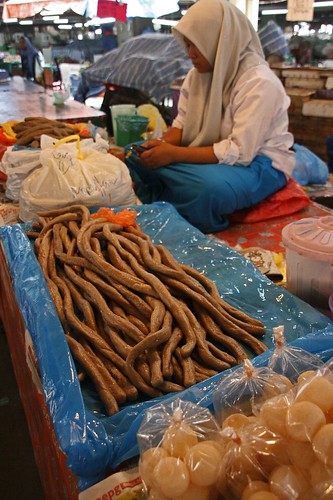
I spent the next hour wandering the aisles, asking rudimentary questions about anything that caught my eye. Most of the vendors only spoke Malay, so there was a lot of pointing and shrugging of shoulders. I was offered samples: two varieties of salak (called snake fruit in English due to it’s hard scaly skin), a tart morsel of flesh around a hard brown pip; godol, a soft, subtly sweet chewy triangle the size of a caramel, made from glutinous rice and cane sugar; and keropok keping, fish crackers spiced with red chilies. The crackers are the dry version of keropok lekor, a mixture of fish paste and sago flour molded into long grey sausages.

Keropok Lekor

Islam is the state religion of Malaysia and the residents of Kuala Terengganu reflected conservative views in the way they dressed. I changed into long pants before leaving my hotel just to feel more comfortable. Women, while active in all parts of society, wear headscarves (tudong, covering the head but not the face) and loose-fitting dresses that cover everything but the feet and hands –I’ve only seen two women wearing full veils in all my time in Malaysia. Now, after 10 days among modestly dressed women, I can understand the allure of a finely formed ankle.

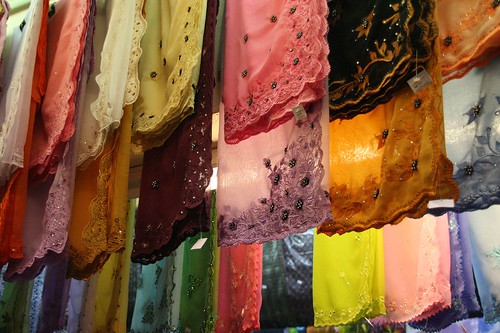
I offer this aside for a reason. On the second floor of the market, I wandered through aisles of colorful silks, marveling at the variety and quality. In a few stalls, there were swaths of woven fabric, perhaps two feet by six feet, costing RM600, close to US$200, an astounding figure in a country where a meal can be had on the street for RM4. Rows of headscarves hung overhead and on the walls of the stalls in a dizzying array of colors and designs. My first few days in Malaysia I thought all the women looked like they wore the same things. With a little market research, I know notice the subtle differences in their dress. I don’t know enough about fashion, clothing, textiles or Islam to describe this further. I wish I could.

Headscarves

The afternoon was another scorcher, with high humidity. As I wandered through the streets of Kualu Terengganu’s small Chinatown, I only had one thing on my mind: liquid. I was thirsty. I noticed a group of people sitting on the patio at a restaurant called T. Homemade Café and wandered in for a look. A woman approached me and just said “what do you want to drink?” I guess it showed on my face.

Her approach was so direct and honest I decided there was no point in arguing. I ordered a watermelon juice and grabbed the nearest seat. T. Homemade Café is not just one restaurant. There are four or five stalls in a long dining room, another two or three set up outside. What is served depends on the time of day.

By my table on the patio and man was thinly slicing roast pork for plates of mee siam, a dish of thin noodles covered in a tamarind sauce and accompanied by meat and greens. I was hungry, the pork looked good, so I ordered some. It was an unremarkable meal, but I hadn’t eaten anything since the morning (other than a few handouts at the market) and it hit the spot. The watermelon juice was fresh and cold. In 15 minutes I was refreshed and thinking of moving on.

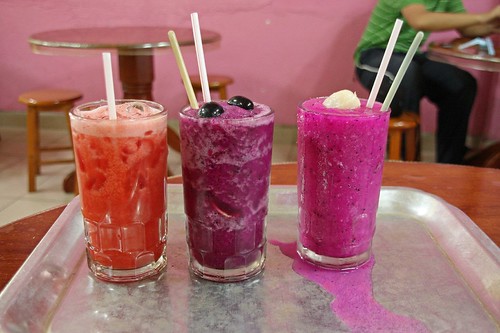
The same women who’d approached me earlier came back and said hello, asking if I wanted anything else. Out of the corner of my eye I noticed a signboard for the café that featured a glass of dragonfruit juice. I’d tried a white version of this tropical fruit in Australia and found it bland, somewhere between a watermelon and a kiwi, but without a bite. Dragonfruit also comes in a deep red variety, and I asked if this is what she served. She said yes, and I ordered a glass. What came to me was a frosty mug of purple juice, a mix of dragonfruit and lychee that was as close to a slurpee as I’d seen in months.

From left, Watermelon, Dragonfruit with Grape, Dragonfruit with Lychee

By this time I’d moved out of the heat and into the main dining room. It wasn’t much cooler, but the air was moved by a set of ceiling fans. The woman noticed as I pulled out my camera to take a picture of the juice. Then another women walked by with a tray carrying three more colorful mugs. The first woman told her to stop so I could take another photo. At this point I’d made a new friend.

The woman introduced herself as Jennifer. I’m not sure if she owned the restaurant; surely she was part of an extended family that worked there. She asked me the usual questions about my trip and then I asked where I could go for the best nasi gagang in town. She drew me a map to the real deal. She left me to my dragonfruit drink (delicious, by the way, much better than the white fruit I’d tried in Oz.

I was again about to leave when Jennifer came back. Somehow I got on to the subject of fruit and mentioned how I’d fallen in love with soursop in Singapore. “I have that too,” she said. “You want one?” With an offer of a mug of soursop juice on the table, I knew I wouldn’t be leaving anytime soon.

I finally made it out of there after three tall mugs of juice and a small plate of the Chinese version of keropok. After so much sweet juice, the fishy snack was a shock to my taste buds, especially when dipped in the spicy sambal on the side.

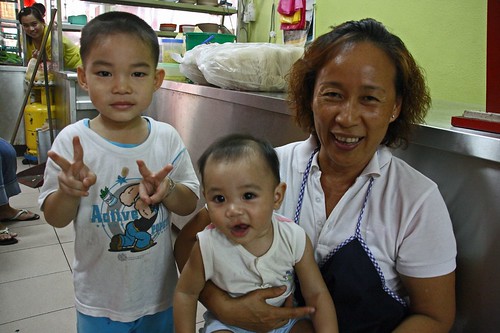
Jennifer and Kids

I said goodbye to Jennifer and her extended family, thinking I would never see them again. The plan was to wake up early, go for nasi gagang and catch a 10 am bus out of town. But I overslept and the 10 am bus broke down. I would have to wait until 11:30 to get out of town. Sometimes travelers don’t travel, they just sit and wait.

There was no question about my next move – I headed straight for T. Homemade Café. I was greeted by Jennifer, who immediately asked me if I’d like the nasi gagang. I confessed that I had overslept and she laughed, then told me she’d get me some.

“Where?” I asked.

“I will drive and pick it up,” she said.

“No, you can’t to do that.”

“Sit. What do you drink?”

I didn’t have a choice. Ten minutes later Jennifer returned with two banana leaf cones and a baggie filled with curry sauce. She fetch a small bowl for the curry and brought me a fork and spoon. Nasi gagang didn’t knock my socks off, but it is a very good breakfast food. It’s light, a bit sweet from the coconut milk and bracing from the curry. I suspect the fish at the center of the rise is last night’s leftovers.

When it came time to me to leave, for good this time, I asked Jennifer what I owed her for the food. She wouldn’t take one ringgit from me.

Kualu Terengganu didn’t exist for me before I threw that dart. Now it’s one of the highlights of my trip.

Labels: ,