Friday, July 13, 2007

2,000 Photos!

Today I uploaded my 2,000th picture to Flickr! The shots are mostly from this trip, but do include pictures from Ireland and New York City. Still, 2,000 is a milestone to celebrate. Just be happy I haven't posted all 6,000 photos I've taken since landing in Sydney in early February.

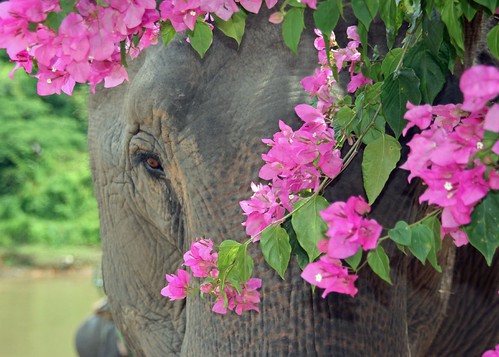
Number 2,000 is of a beautiful elephant I encountered in a town on the Mae Kok River in Northern Thailand. The elephants are there to transport tourists into the hills. They are working animals and probably not entirely happy. I bought a bag of bananas and sugar cane and fed them to this beast. I think he appreciated every bite.

Thai Elephant

Labels: , ,

Monkey Mania

It's been weeks since I was in Borneo, but it's never to late to write about monkeys. My latest dispatch for Tripmaster Monkey ("Home of Yellow Journalism") is about my stint as a Monkey Tourist. It's chock full of simian antics and heartwarming anthropomorphism. I hope you'll give it a read, and click on a few ads when you are done to support the fine folks running the show at TMM.

Previous: Singapore, Indonesia

Labels: , , ,

Thursday, June 14, 2007

Motel Hell

Ko Lanta, Thailand, is a district of 52 island in the Andaman Sea. The islands are lush, the waters clear and fine, the beaches white and wide. The land supplies rubber, cashews and bananas, the sea provides fish. But the main cash crop is tourism.

The west coast of Ko Lanta Yai is lined with beaches, with accommodation for every budget, from backpacker novels to luxury resorts. This is not a party island, like Ko Samui, and doesn’t draw the package-holiday crowds you will find in Phuket. It’s laid back. Perhaps this is because in a country that is 95 percent Buddhist, Ko Lanta is 95 percent Muslim.

There are a lot of beaches of southern Thailand and I pulled Ko Lanta out of a hat, more a choice of its convenient location than anything else. All you need to lounge on the beach is sand and surf, right? The next hurdle was deciding where to stay.

On the ride out of Hat Yai, I met a British man, mid-40s, who runs a dive shop in Phuket. I asked if he had any recommendations on Ko Lanta and he mentioned a place on a hillside, across from a five-star resort. He didn’t know the name but with the help of a guidebook we pinpointed its location. My destination was now a place called Lanta Marine Park View Resort. (Resort can mean anything in Southeast Asia – from Club Med-style digs in a private compound to a collection of tattered huts on a scabby beach.)

At the ferry terminal on Ko Lanta Yai, I was told it would cost 500 Baht to take a taxi to the resort. I balked at the price, having just paid 450 Baht for the six-hour journey from Hat Yai. I told a travel agent that I wanted to go to Lanta Marine Park View and she called the resort. A ride would be there in 30 minutes to take me 30 kilometers south.

Thirty minutes later a truck pulled up and a shaggy-haired twenty-something Thai motioned for me to hop in. George introduced himself then started talking about smoking weed and how much he loved Neil Young. But George was friendly and gregarious and I was getting a free ride. I gave him the benefit of the doubt and offered to play him some Neil Young bootlegs off my iPod.

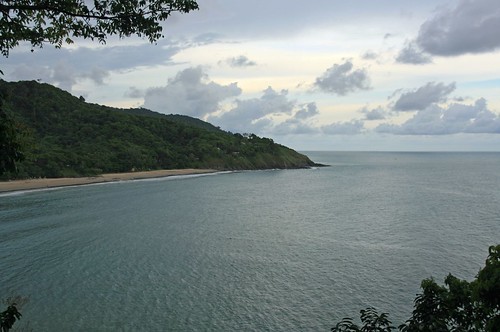
I was shown a bungalow overlooking a beautiful crescent of white sand backed by lush forest. The five-star Pimalai Resort & Spa covered a large chunk of real estate on the opposite hill. The room was clean and neat, the view spectacular and the low-season rate reasonable at US$17 a night.

View From Bungalow A-10

The staff was entirely young and Thai. They seemed slow and stoned, and not entirely interested in or accustomed to providing hospitality or comfort to their guests. I’d seen this before in Asia and wasn’t very concerned. Give me the room and I’ll take care of myself.

I drank a few Singha beers at the bar, ate a delicious dinner – prawns covered in a very spicy sauce of basil and chilies, fragrant jasmine rice on the side – then retired to my room to clean up from the long day of travel. I flipped on the lights, locked the sliding doors behind me and moved into the large tiled bathroom.

Refreshed and clean, I returned to the bedroom to find dozens of inch-long flying insects swirling through the air and converging at the light above the bed’s headboard. They were termites with wings, or a gargantuan flying ant. They swarmed, fighting to get as close as possible to the bright light. Severed wings littered the pillows; bugs that had lost their wings crawled over the bedsheets. I’d closed the door! How could this happen?

I moved to the door and looked down at a scene out of a horror movie. There were more insects crawling through a small crack between the floor and the bottom of the doors, armies of them in formation, a never-ending stream of pests come to conquer corner of Ko Lanta. I shoved a small rug into the crack but they just squeezed through. I had visions of “Night of the Living Dead,” of zombies packing into a doorway of a remote farmhouse, intent on wreaking havoc on the innocents inside. Cinematic visions of bugs large and small, real and imagined came to mind.

I need a plan, and quick. Light! They like light. If I turned off the lights inside the room and turned on the patio light they would make a U-Turn and head outside. I’d worry about the crack in the door later.

The door wouldn’t open. The lock wouldn’t budge. I turned the latch through one revolution, two, five, ten. Nothing! I was trapped with the swarm. They were landing on my head and shoulders; there was nothing I could do to keep them off me.

Could I spend a night in this room, locked in with the swarm? Could I wait for someone to notice the guest in A-10 is missing? They seemed more concerned about getting high and hanging out than the welfare of the guests. I could last a day or two with the supplies on hand, a water and half a package of chocolate wafer cookies. It would take the staff a lot longer than a day or two to find me.

Perhaps I could call the front desk. My cell phone was getting reception and I still had credit from Malaysia. I tried the resort’s number and heard various recordings in Thai, none of them intelligible to me. I swatted bugs off my head and crunched them underfoot.

Help!

I don’t know how it happened, but I tried the latch again and the lock clicked. I threw open the doors and flicked the switch for the patio light. Dead. Dark. Damn!

But I have a nifty headlamp. I set it out on the patio and the bugs flew out of the room en masse. I swept out the carcasses from the bedroom, washed down the drain the ones stuck to the wet bathroom floor.

I marched to reception and started yammering to the first person I saw, a young woman with an expression halfway between boredom and coma.

“Do you understand there are hundreds of flying insects in bungalow A-10?,” I said.

I was met with slack-jawed indifference.

“They are coming in through a crack in the door! There’s nothing I can do to stop them.”

“Insects?”

“Yes, thousands of them.”

"Do you want to change rooms?”

I noticed that other bungalows had lights on, with no swarms around them. A-10 must have been the exception to the rule. I moved to A-7, a beautiful bungalow that would fetch several hundred dollars a night in the west. It’s got an unobstructed view of the beach and I slept on clean, cotton sheets with fluffy pillows. Yes, the bugs must have been an anomaly.

I think the root of the problem is in the staffing, a group of young Thais, none of them trained in running a hotel and few of them able to communicate with the English-speaking clientele. Forget about room service or getting your room cleaned during the day.

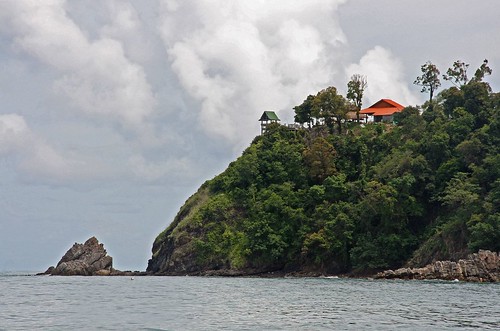
I read online that a European company recently bought the place. I think they are cutting corners, catering to the mass market but offering a product that’s really only attractive to backpackers Yes, Lanta Marine Park View turned out to be a gussied up youth hostel with a full bar and beach access. At US$17 a night I had to take what I could get, warts and all. If I wanted more, there was the Pimalai Resort for US$500 a night.

Lanta Marine Park View Resort

I awoke this morning refreshed and ready for a day at the beach. A quick pee and then I would grab a quick breakfast. I flushed and somewhere in the back of my mind registered the weak flow in the bowl. I turned on the faucet to wash my hands and nothing came out. The shower was also dry.

I marched back to reception, to the same woman from the night before.

“There’s no water in my room.” I said.

Her eyes glazed over. “Maybe later," she said. "Maybe tomorrow."

Labels: , ,

Tuesday, June 05, 2007

Welcome to the Jungle

First get yourself to Kuala Lumpur. Then fly two and half hours to Kota Kinabalu, a city on the island of Borneo, then travel for six hours by local bus to Sandakan (or fly 45 minutes, your choice). Sixteen miles outside of Sandakan, register with Uncle Tan Wildlife Adventures. After a 90-minute drive through palm oil plantations and countryside, they will deposit you on the banks of the muddy Sungai Kinabatangan. An hour of speeding downstream in a small boat overloaded with tourists and luggage will bring you to a collection of huts in the jungle. You are at Uncle Tan’s, where it’s all about nature.
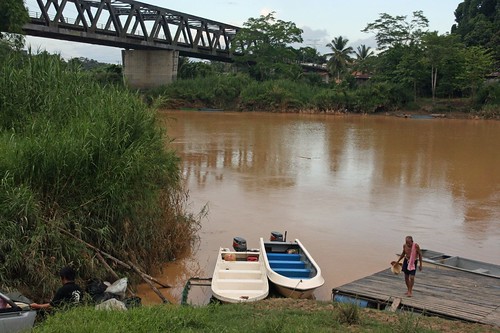
Express Boats to Uncle Tan's

I first heard about Uncle Tan’s while flipping through the pages of my Lonely Planet guidebook. “It’s not hard to spot someone who’s been to Uncle Tan’s,” says Lonely Planet, “they just can’t stop raving about the place.”

Yeah, right! Too good to be true. I made a mental note and moved on.

But when I arrive in Kota Kinabalu, I met a Frenchman at the Akinabalu hostel who had just returned from Uncle Tan’s. He had a wistful look in his eyes, a look that said you just have to experience it for yourself. So I bit.

But what did I have in store for me? What exactly is a jungle camp?

I learned a little more when I was handed a packet of information at the company’s ramshackle headquarters 16 miles outside of Sandakan.

“We would like to remind visitors that the Camp is not exactly the HILTON! Facilities are Spartan in nature, but we do our best under ‘circumstances of wilderness’ to make your visit enjoyable and comfortable. The Camp is situated in a jungle environment. It is in an old riverbed by some beautiful ox-bow lakes. Insects and mosquitoes will be there… The floodwater may rise. Part of the Camp may be under water. Toilets may be under water. It can be inconvenient.”

At least they are honest. And droll.

But I’m not about to tell you a story of hardship in the jungle, of mud, tears and bitter memories. The 38 hours I spent at Uncle Tan’s were wonderful, filled with new friendships, exotic creatures and a little bit of that thing we like to call “getting back to nature.” Yes, the conditions were spartan, there was rain, mud and mosquitoes. We slept in wooden huts on foam mattresses; generators supplied electricity in the evening hours, but there were outlets recharging batteries; water was pumped from the river to the camp, for the pit toilets (surprisingly clean and not at all stinky) and any washing campers might want to do.
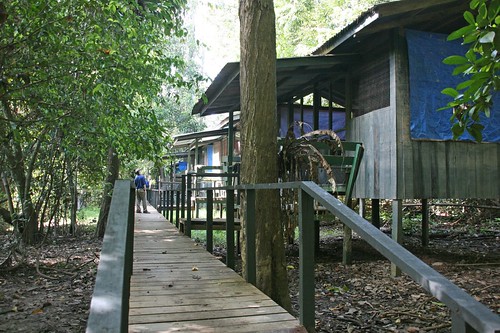
Sleeping Quarters

All supplies, including new mattresses, water, food and beer, were brought in daily by boat. There was a clean kitchen with a full-time cook who turned out an astonishing array of Malaysian dishes, all of them healthy and tasty. Every meal was augmented by slices of fresh fruit to cleanse the palette. The staff of young men, all of them healthy and strong from living in the jungle, was welcoming, friendly and enthusiastic. In the afternoons and evenings, they would lay in hammocks or lounge in the common area playing Malaysian rock songs on battered, out-of-tune guitars. Annoying at first; endearing in the long run.

Who needs the Hilton when you’ve got Uncle Tan’s?

You can stay at Uncle Tan’s for as long as you want, but the usual package is three days and two nights, which means you arrive in the afternoon on day one and leave in the morning on day three. Yes, you spend two nights sleeping in the jungle, but you are really only on site for about a day and a half.

My group of 11 was a mix of two Americans (both from California!) and nine Europeans. We met over lunch at Uncle Tan’s HQ and quickly bonded, sharing the information that is the stock and trade of travel: where are you from, where have you been, where are you going? From there connections are made and other subjects come up. It’s the same story whenever travelers get together, and it’s really the best way of getting information on the road. By the time we arrived at the camp, we were old friends.
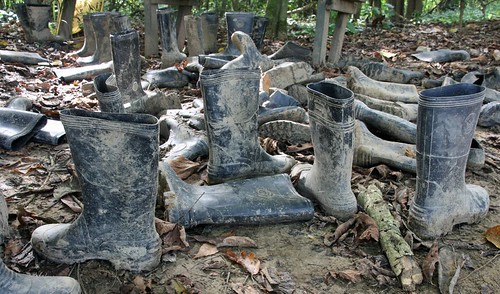
Mud Boots: A Necessity for Jungle Trekking

Over the next day and a half, we took three boat rides up and down the Kinabatangan River and through a series of ox-bow lakes, and two treks into the jungle, one during the day and one at night. The purpose of the camp is to view wildlife. Suzi, a Californian in Borneo after a stint of volunteer work in the Philippines, and Stin and Cynthia, a Belgian couple that left their kids at home, were keen on cataloging the animals, keeping a running list and hashing it out each time we returned to camp. The rest of us – a Dutch couple, Tim and Margriet, who displayed good humor and a sense of irony that I appreciated very much; professional travelers Nikki and Tom, Brits who met in India and never looked back; Angela, an ex-pat teacher living in Brunei, a land of plenty after two years in Saudi Arabia; Leah, from Ireland but living in New Zealand (she went on vacation and never went home); and Martina, a traveler from Germany – were just happy to see the creatures.

Yes, there were monkeys and apes, crocodiles, birds large and small, frogs of all colors, bugs and more bugs, scorpions venomous and harmless, monitor lizards, bearded pigs, leeches, butterflies, and a few hairy tarantulas. A mama orangutan and her baby perched in the trees above the camp, plucking fruit and dropping peels onto the huts below. Campers were atwitter over a tender moment between mother and baby, but I missed it and cannot verify this instance of animal kinship.
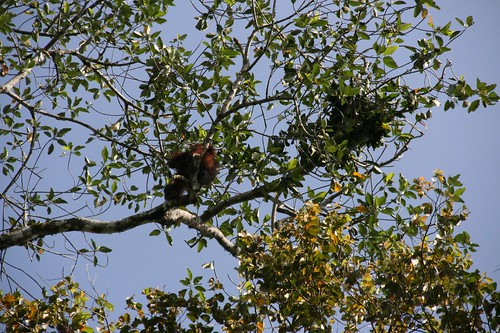
That Orange Blob? Mama Orangutan.

And we had to keep a keen eye out for the pesky macaque monkeys at mealtime – they are thieves and will take advantage of any lapse in vigilance. They had recently learned how to open the containers storing coffee, tea and sugar. It seems the macaque monkeys on the Lower Kinabatangan have a taste for Milo.

On our afternoon boat tour, our guide, Tan, who with eleven years at Uncle Tan’s has likely seen everything, stopped the boat and asked for a pair of binoculars. He scanned the trees, paused, then raised his arms and let out a whoop. “A gibbon,” he shouted. We were lucky to see this ape for a few seconds as it swung with lanky arms from one tree to another, a dark outline among the green foliage. Gibbons are rare in this part of the jungle, only appearing two or three times a year. Tan’s enthusiasm was catching and we all returned to camp full of good humor and boasting about the great gibbon in the trees.
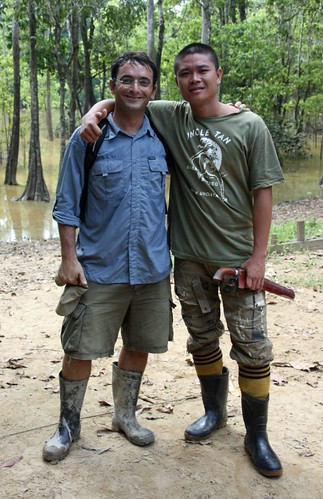
Matt and Tan

I could go on and on about all the animals, but I’d bore myself to tears. And what I'll remember about Uncle Tan’s is not really the animals. I will remember just being in the jungle, far from civilization where there are animals, yes, but also moments of utter tranquility. We woke at 6 a.m. for a boat ride to see animals, but my memories are of a rising sun obscured by heavy mist, a haze that turned an ordinary river cruise into my own (quite fictitious) journey into the heart of darkness. Imagination is a wonderful thing.
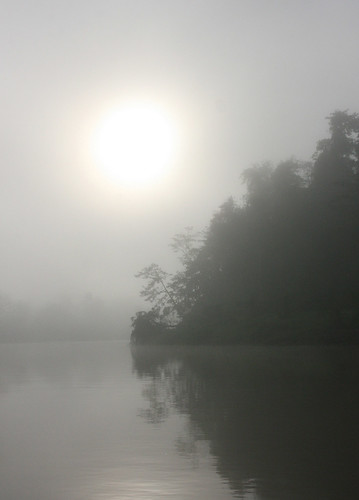
Sunrise Over Sungai Kinabatangan

A nighttime trek through swampy jungle revealed a world of nocturnal creatures – frogs and spiders mostly, but a few venomous scorpions and a hairy Blue Tarantula. At one point our guide, Loi, told us to wait as he ventured waist-deep into the swamp, the beams of his torch bouncing off the fans of the Mangrove trees. Enveloped by dark night, under a protective canopy that blocked out the light from the moon, I had a fleeting thought of nightmares, that what I was seeing is the stuff of dreams, bad dreams, and if I weren’t having such a good time I would probably cry out in terror and beg someone to take me home.

When it was time to leave Uncle Tan’s, we were given handshakes and hugs by the staff and sent on our way. We spent a minuscule amount of time in the jungle, but all of it was memorable, ranking as a highlight on this extensive tour of mine. In fact, back in Kota Kinabalu, I found myself trying to describe the place to another traveler, a wistful look in my eyes and a head full of jungle fever.
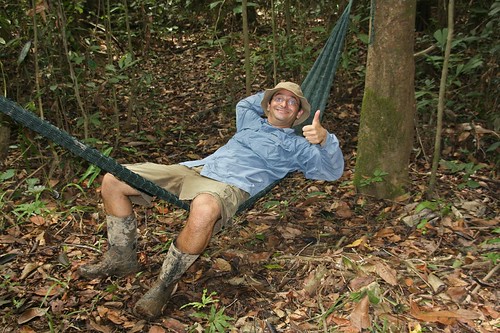
Good Times!

Labels: ,

Thursday, May 31, 2007

O-Town

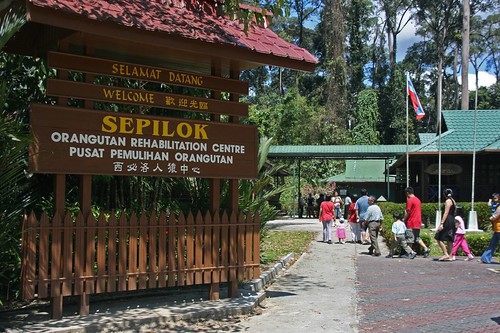
I first heard about the Sepilok Orangutan Rehabilitation Center, one of the most popular tourist attractions in Malaysian Borneo, from an episode of the television program “Globe Trekker,” a British production in which affable hosts journey to exotic locations. They show is geared toward adventurous travelers, the ones with backpacks who don’t mind public transportation and a little dirt on their dungarees. (i.e., budget) travelers. The episode included a trip to Sepilok and the host, serious Justine Shapiro, was treated to a one-on-one encounter with a young orangutan. As part of the paying public, my visit was much less personal and ultimately disappointing.

Sepilok Orangutan Rehabilitation Center

At one time, visitors to the center were allowed to interact with the orangutans. With outbreaks of SARS and the Asian Bird Flu in recent years, the apes and humans are kept apart; visitors can now only observe the apes from a short distance during twice-daily feedings.

The Sepilok Orangutan Rehabilitation Center is a stop on the tour bus circuit. You’ll know you’ve reached a tour bus destination when large groups of people are speaking the same language and are wearing clean, light-colored clothes. Also look out for a lot of sandals and compact cameras.

I don’t think there is anything wrong with tours (I spent a few weeks in Australia as part of organized tours and found it an affordable and convenient way to see the country. I even considered joining a tour of Borneo, but opted to remain independent). There are few surprises, delays or “what the?” moments. But there is also a lower probability of leaving the crowds behind, of discovering that you’ve arrived in somewhere outside your comfort zone, that time and place that makes the challenges of independent travel rewarding.

In my last post, I wrote about my visit to the Labuk Bay Proboscis Monkey Sanctuary. There were about a dozen visitors at the morning feeding, certainly more monkeys than humans. Why are people passing up the proboscis monkeys and traveling in droves to see the orangutans? Proboscis monkeys aren’t as sexy as orangutans, nor as popular in the imagination. The proboscis sanctuary is also difficult to get to – 15 kilometers on an unpaved road – and there is no public transportation to the front door. Lastly, the entrance fee is twice that of the orangutan center. The bottom line, however, is that orangutans are popular creatures, gentle, endearing and easy to love. So I was not surprised to find tour buses and a crowd of more than 100 people at the orangutan center.

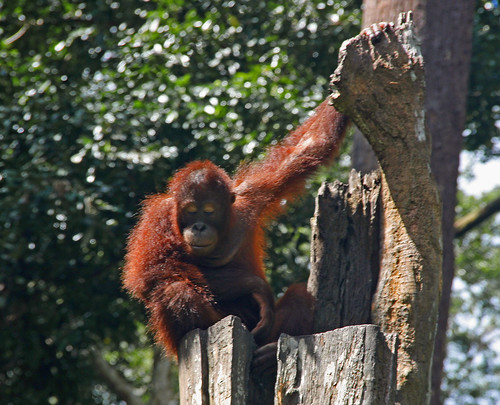
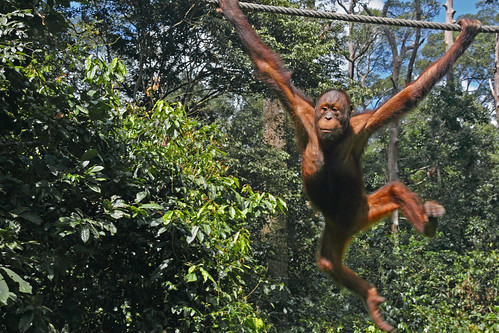
The morning feeding delivered exactly what it promised: orangutans, up-close and personal. About half a dozen creatures showed up to munch on bananas. They used hands and feet to traverse a rope to a feeding platform; they climbed pillars; they scowled, screeched, hooted and bared their teeth. One young ape hung from the rope, bucking up and down before launching himself into the foliage below. This last bit of apery elicited a great roar of approval from the crowd. The show lasted about 15 minutes before the apes withdrew into the forest.

So why did I feel the visit was a disappointment? Was it the sideshow atmosphere? The sight of intelligent and interesting animals on display? Did I expect something more personal, more serene or less orchestrated? It was a little of everything. I’m glad I went, elated that I got to see orangutans from a few feet away; I just wish it had been less of a circus and more of an education.

The orangutans were fascinating, however, and deserve a few photos. Enjoy!

What Are You Lookin' At?


Hanging Around


Old Lady Orangutan

Labels: ,

Monday, May 28, 2007

Monkeys and Mayhem

Before I hit the road, Borneo was a mystery to me. Is it a country? An island? Are there cannibals? Is it safe? Is it even possible to visit? Well, no, yes, maybe, most of the time and definitely.

Borneo, the third-largest island in the world, is not a country in and of itself. Indonesia and Malaysia share most of the real estate. The Malaysian states of Sabah and Sarawak cover the northern third of the island; the Indonesian state of Kalimantan covers the south. The tiny sultanate of Brunei has carved out of a sliver of land on the north coast roughly between Sabah and Sarawak. The name Borneo was applied by the Dutch during a period of colonization and it has stuck in Western minds.

I came to Sabah to climb Mount Kinabalu, the third-tallest mountain in Southeast Asia (13,435 feet). The parks department regulates the number of climbers who can be on the mountain at any one time, requiring climbers to reserve space in advance. I'm a fly-by-the-seat-of-his-pants traveler these days and didn't make arrangements before arriving in the city of Kota Kinabalu. Still, I was able to secure a spot on the mountain next weekend. That left me with six days to fill.

Tourists come to Sabah to climb the mountain or to see wildlife, both on land and below the sea. Probably the most famous inhabitants of the animal kingdom are the orangutans at the Sepilok Orangutan Rehabilitation Centre, 25 kilometers outside the town of Sandakan, which for me was a winding seven-hour bus ride from KK (the return trip will be by airplane). The orangutans are a must-see for me, but they will occupy one morning. A little research turned up another interesting monkey species, the Proboscis.

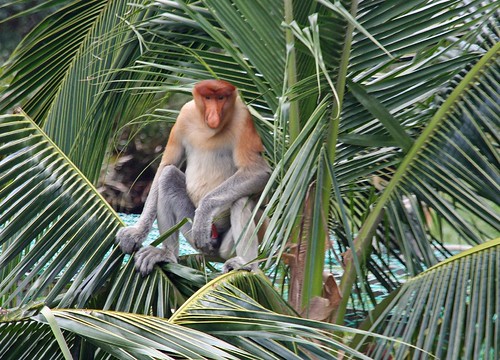
The Proboscis monkey is a an endangered species. There are only about 7,000 of them in the world and only in Borneo. As the name suggests, the monkey is distinguished by its huge schnozz. Actually, only the males have big noses. The females have dainty, pointy noses. I'm unable to decide if the creatures have unique features worthy of admiration or if they are just plain ugly. Buddy Ebsen and Mr. Magoo come to mind.

The Proboscis Monkey Sanctuary outside of Sandakan is not an easy place to get to. A visit would require either an overnight stay at an overpriced lodge in the jungle or an expensive taxi ride from the city. I settled on something in between -- I hired a driver for the day. We would visit the proboscis monkeys and then a memorial to a tragic chapter in world history.

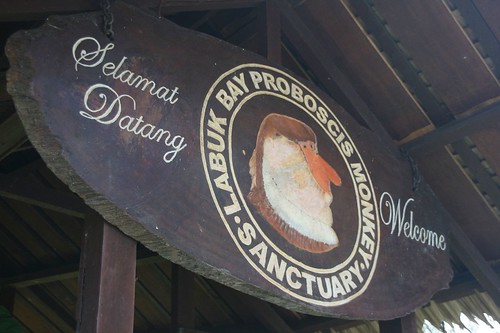
Labuk Bay Proboscis Monkey Sanctuary

Sonny, a local with little space in his brain for anything other than women, was living at the same waterfront hostel I'd booked into. We set out in the morning for the 90-minute trip. After 19 miles of paved highway, we turned onto a dirt road for a rough 15-kilometer ride into the jungle.

We arrived at the sanctuary about 45 minutes before the morning feeding. I killed the time watching a documentary about the monkeys, learning about their characteristics and behavior. Proboscis monkeys live in small groups, either based on a dominant male with a harem of females and offspring, or a bachelor group of young males who would vie for the females' attention. The

What makes this fairly common group dynamic interesting -- and if you don't find this interesting, get your head checked -- is that the size of the dominant male's nose plays some part in the attractiveness of that male monkey. The girls like the big beaks. The bigger than better.

Dominant Male

What's more, the dominant male's purpose in life, other than defending his territory (and females) is producing as many offspring as possible. To this end, the dominant male sports a constant erection, a red tower of power out there in front for all to see. This state of constant arousal is even depicted in a painting at the sanctuary. Check out that photo above one more time. Click on it to go to Flickr, then click on "All Sizes." You'll see clear evidence of his dominant stature

The proboscis monkeys in Sabah acted much like other monkeys -- fighting for scraps, leaping from trees, tumbling in the foliage and squawking and screeching at regular intervals. The addition of that fantastic nose meant I couldn't take my eyes off of them.

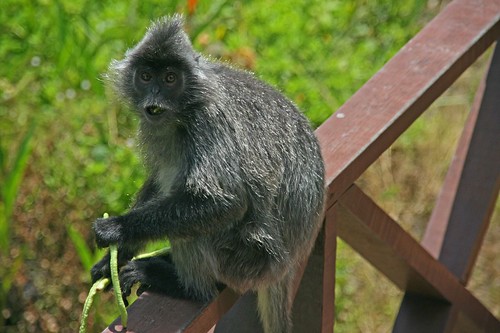
I also saw silver-leaf langurs, mudskippers and a few hornbills. None of them could compete with the proboscis monkeys.

Silver-Leaf Langur

On the way back to Sandakan, Sonny and I stopped at Sandakan Memorial Park. I realized when I read about the park that one of the unexpected themes to emerge in my travels is the Japanese presence in the south Pacific during World War II. It started when I was in Darwin, Australia, where I read about the sinking of an American warship by Japanese bombers. During a visit to a Buddhist temple in Singapore, I heard about the occupation of the city by Japanese forces. Somewhere in the back of my brain I knew Borneo played a part in the war. I just never knew how awful it was.

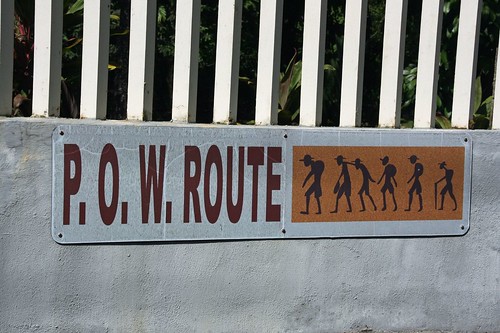
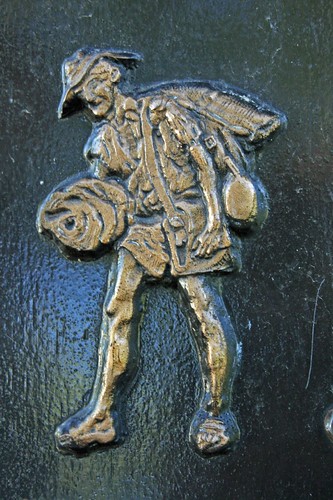
The Japanese occupied Borneo in 1941, and soon thereafter created a few camps for prisoners of war. In Sandakan, Australian and British prisoners were forced to build an airstrip. The conditions were acceptable at the beginning, as acceptable as an prison camp could be, I assume. But as the war progressed, conditions worsened and the treatment of the prisoners turned brutal. With the Allies on the offensive in 1945, the Japanese marched their prisoners 250 kilometers through the jungle. Of the 2,400 prisoners interred at the Sandakan camp, only six survived, and only those because they escaped.

Entrance to Sandakan Memorial Park

Sandakan Memorial Park is situated in a quiet grove off the main road. There is a small exhibition hall with a model of the camp and a series of panels explaining the history of the camp as well as others with heartbreaking quotes from survivors. It is a wrenching tale of cruelty and survival.

I took a short walk through the shady grounds after visiting the center, wondering how those terrible acts could have happened on this peaceful plot of land.

Plaque Detail Depicting POW on a Death March

The route from Sandakan to Ranau has been turned into a hiking trail. Tackling this trek may bring me back to Borneo someday.

I visit the orangutans tomorrow morning. I will then spend the next two nights in a jungle camp -- huts and mosquito nets, watch out for the crocodiles in the water -- next to the Kinabatangan River. I hope to see pygmy elephants and smell a rafflesia flower while I'm there.

I return to Kota Kinabalu on Friday night and will do my best to post an update before heading up the mountain.

Labels: ,

Friday, March 02, 2007

Sea Lion Party

On the second day of my trip from Adeliade to Perth, I was given the chance of a lifetime – a swim with wild sea lions and dolphins. The operators of Baird Bay Ocean Eco Experience, Allan and Trish, have been visiting the sea lions and dolphins of Baird Bay for more than ten years. Over that time, the animals have slowly come to realize the humans are not there to kill them. Unlike most wild animals, which will retreat as soon as humans approach, the sea lions and dolphins in Baird Bay accept the presence of humans and will behave in ways that could be described as playful when humans are around. The animals have never been fed, and as Allan described it, we humans were the attraction for the animals. How much time we spend in the water is determined by how much interaction the animals want to have. If they swim away, we go home.

After donning wetsuits, we boarded the boat and received our instructions from Allan and Trish. Basically, the rules were simple. Don’t touch the animals, remain calm and let them come to you.

Usually, the tours start with the sea lions. But the tide was unseasonably low so we headed into deeper water to track down the dolphins. The water is not entirely open ocean, but it is deep enough to include the local shark population, which includes great whites. With safety in mind, the guides wear electronic “shark shields” when they lead the tourists into the water. The devices emit signals that great whites and other nasties with big, sharp teeth find intolerable. Even so, the idea of jumping into water with sharks is my worst nightmare. I sucked it up and trusted the technology.

Nevertheless, our first attempt to swim with the dolphins was a bust. There were dolphins in the water, but as soon as we lumbered into the drink they took off.

Allan and Trish shifted gears to the sea lions. We motored to a secluded part of the bay, where a limestone reef protests the animals, and the humans, from predators. The water was only about 7 or 8 feet deep and no shark shields were necessary. We received out instructions again and entered the water.

Sea lions are smart mammals. When our group entered the water, it felt like they were checking us out. We’d been instructed to remain calm, to swim slowly with our arms and to not kick, and to never approach or try to touch the animals. The opening minutes of the swim were like an introduction, with each sea lion taking the time to look at the swimmers and suss out the situation. They would sit on the bottom of sea or swim slowly around us, sniffing and looking us over. The group of half a dozen sea lions was mostly made up of juvenile, (about 3 or 4 feet long) but one giant bull (8 feet long and a handful of fish fillets shy of 400 pounds) decided he’d like to play as well. Allan later said the appearance of the bull was rare.

As the humans and sea lions both became more comfortable, there was more movement on each side. Some of the humans dove to the bottom of the shallow pool and the sea lions responded, swimming faster and corkscrewing through the clear water. As I became more comfortable I would also dive, swim upside down or spiral through the water, and every time I did this I’d find a sea lion close by, often just inches away, gliding past me and checking me out.

After twenty minutes, the sea lions pickup up the pace and were showing how fast and graceful they can be underwater. Some of the younger ones would nip and each other at the bottom of the pool or avoid a human by jumping clear out of the water. At this point I would turn around to find whiskers in front of my face or look down to find a furry face gazing up at me. I would have stayed with the sea lions all day, but fatigue set in and I returned to the boat. The sea lions just kept playing.

We made a second attempt to swim with the dolphins. It was more successful – they stuck around for about one minute then bolted. It was long enough for a good look but too short to play. The sea lions made up the dolphins’ lack of interest.

My fellow Nullarbor Traveller Dawn has posted some photos of the sea lions on her Flickr site.

Labels: , ,

Monday, February 05, 2007

Bats!


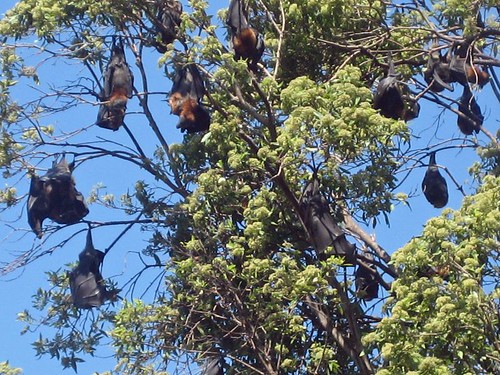
Adjacent to the Opera House are the Royal Botanic Gardens, a sprawling park in the center of the city. After about an hour, I entered an area with tall trees and thick brush and heard a terrible racket. There must be hundreds of birds here, I thought, some species you wouldn’t want to living next door. But when I looked up it wasn’t birds, it was bats. Hundreds of fat furry creatures hanging upside down in the trees, occasionally flapping their wings and screeching. It is a species called the Grey-Headed FLying Fox, or fruit bats. They are found only in Australia and are some of the largest bats in the world.

As much as I prepared for this trip, the best moments will be the ones where I’m taken by surprise. No one told me I'd see a colony of bats in the middle of a major metropolis. Great stuff.

Labels: , ,