Sunday, November 18, 2007

The End?

I’m writing this on the last day of my trip as I speed towards Tokyo on the Shinkansen, which is perhaps my favorite train in the world. I’ve spent the better part of the last 300 days traveling from Sydney to Tokyo, a total of ten countries and dozens of cities, posting more than 100 blog entries and 3,000 photographs. That I'm going home hasn’t completely sunk in. I’ve been taking this trip one day, one week, one city at a time, and the end has crept up on me. So it is with mixed feelings that I return to Tokyo, where I’ll spend one more night before boarding a trans-Pacific flight (my least favorite form of travel) back to the U.S. of A.

I’m excited to return to familiar territory, where I speak the language and I am well versed in the customs. I’m looking forward to seeing family and friends, to eat my mother’s cooking and watch late-night cable television. But I’ll miss the freedom of the open road, the expected pleasures and unexpected impediments that make for open-ended travel. I’ve got an itch (no, not that kind of itch), formed early in life, that leaves me restless. It will lead to more travel in the future. For now, it's time to reflect on 2007 and look to 2008.

As a final installment of Packmonkey: Asia (leaving the door open to Packmonkey: North America and Packmonkey: Europe), I offer a short summary of the good, the bad and the in-between. This is hardly a recap of my entire ten months on the road, merely a short trip down memory lane. I plan to offer a little more reminiscing once I'm back in Los Angeles.


Everything Australian: I spent nine weeks in Australia in February and March, traveling overland along the southern and western coasts from Sydney to Broome, then into the Outback on a 4WD trek from Adelaide to Alice Springs. Australia is a beautiful country. The interior is desolate, stark and remote, the coasts rugged and wild. As a whole, it is a challenging, rewarding and breathtaking place to travel. I will never forget sleeping under the stars in the Painted Desert or swimming in sea lions in the Eyre Peninsula. I also made some lasting friendships in Oz: Bernie and Kate, Dean, Elizabeth – keep in touch! Australia raised the bar for all subsequent destinations. The time I spent in Australia amounted to the trip of a lifetime. Had I returned home after the Outback, I would have been satisfied.

Monkeys and Mountains in Malaysian Borneo: I arrived in Malaysia with low expectations. I left in love with the country. The Malaysian people were some of the friendliest I encountered - always a smile for the wandering Jew in their midst - and the food unexpectedly satisfying. The three weeks I spent in Malaysian Borneo sealed the deal: encounters with the orangutans, proboscis and langur monkeys, Uncle Tan’s jungle camp and the trek to the summit of Mt. Kinabalu, which left me exhausted but marked two of the best days of the whole year.

Backpackers’ Laos: Backpackers flock to Southeast Asia, so it’s no surprise that there’s a backpacking culture in this part of the world. My time in Laos, from my arrival at the border with Thailand to my departure from Vientiane, was the ultimate backpacker’s experience. The country itself is wonderful, remote and rural, yet unspoiled by the tourism you encounter in Thailand and Vietnam or the tragic history of Cambodia. Laos had been described to me as Thailand of 20 or 30 years ago. Ten short days in country showed me the Southeast Asia I dreamed of visiting.

What made my time in Laos really special was the friendships I made. Two days floating down the Mekong solidified a bond with my French amis, Guillaume and Emmanuelle. We spent the evenings in Luang Prebang at a sidewalk bar laughing over glasses of cloudy pastis, the days meeting the young monks at the city’s temples or swimming at the tranquil waterfalls outside of town. In Vang Vieng I met Mitzi and her daughter, Miksa, from Hawaii. We explored caves and rented bicycles for a trip to the local market. At night we relaxed over cheap food and beer at the backpacker cafes. Miksa and I even found time for a marathon afternoon watching "The Simpsons." Traveling friendships are short and intense, and one of the joys of travel.

Food, Food, Food: Who doesn’t love to eat? Everywhere I traveled there was something new to taste: kangaroo sausages in Outback Australia, blue rice in Malayasia, chicken rice in Singapore, khao soy in Northern Thailand, even deep-fried tarantulas in Cambodia. There were also some old favorites to devour: sushi and ramen in Toyko, curry and pad thai in Thailand. Somehow, I still haven't tried durian.

Indonesia Headaches: I arrived in Indonesia with high hopes. Two weeks later I couldn’t leave get out the country fast enough. From the touts and taxi drivers oozing desperation in Bali to the scam artists in Java who took me for a ride, I was overwhelmed by the amount of ill-will I felt in Indonesia. I’ve heard reports from other travelers about good times in Bali and Java, so I will not say the country is filled with bad people and bad times. At least I left with two good memories: sunrise at Mr. Bromo and an afternoon spent wandering the ancient Buddhist temple at Borobudur. These two places almost make up for all the aggravation I experienced everywhere else in Indonesia.

Tourism in Thailand and Vietnam: Thailand and Vietnam are two of the most popular destinations in Southeast Asia. They were also, for me, two of the most disappointing destinations on my trip. In the island of Southern Thailand, I encountered hoards of westerners traveling from one beach to another. It seemed that the locals in sight were either serving the foreigners beer and food or cleaning their rooms. There was also the terror of the night of the flying termites. The beaches are nice enough, but crowded and dirty. Were it not for the energy of Bangkok or the charm of Chiang Mai, I’d have to write off Thailand as a loss.

In Vietnam, the tourism treadmill also operates at full speed. Perhaps it was because I’d been on the road for six months, or perhaps it was because I was exhausted from a whirlwind tour of Cambodia. Whatever it was, I found Vietnam to be hectic in all the wrong ways. From the overcrowded and polluted streets of Ho Chi Minh City and Hanoi, where even the act of crossing the street was hazardous, to the constant haggling over prices, Vietnam was a downer.

Life and Death in Cambodia: I only spent 10 days in Cambodia, but those days contained some of the best and worst times of my trip. On the positive side was an extraordinary tour that took me into the Cambodian countryside and introduced me to the real Cambodia of today. The tour also resulted in a few of those backpackers’ friendships that I mentioned earlier. I loved drinking late into the night at a small bar in Kampong Cham and on the beach at Sihanoukville with Sally and Renee, nurses from Adelaide, Australia. And Kathe, a university student from Holland, turned into a close and unexpected friend.

On the down side was a bus accident that left two Cambodians dead and exposed the utter corruption and poverty of Cambodian society. I refer you to the impassioned blog post I wrote on the afternoon of the accident.

Return to Tokyo: I knew that I wanted to end my trip in Japan, to return to a place I lived for 18 months in the early 1990s. I did just that and I am now reminded of that old adage about not being able to go home again. In the years since I lived in Tokyo, I’ve changed, Japan has changed and the world has changed. I love the country and the Japanese. I loved taking Japanese lessons and exploring the country again. But in the end I could have done with less. I’d been on the road for most of the year and was tired, wanted to do little more than curl up with a good book and a glass of whiskey. So I spent most of my time in Tokyo enjoying solitude and rest.

My time in Tokyo was good for the spirit, but perhaps something of a missed opportunity. Perhaps what it taught me is that the next time I take off and travel the world, I’ll impose a six-month limit. For me, that seems just right.

So on the eve of my return to the U.S., I look forward to reuniting with family and friends, to starting a new chapter in my life that builds on everything that’s come before.

Some people say travel changes you. I think that’s a big fat myth. I’m still the same person I was when I started this trip. What I have now that I didn’t have before is a greater understanding of the world and my place in it. I think I’m more humble. I’m definitely more aware of how fortunate I am. My place in this world is small, but my future is unlimited. The end? I don't think so. Just another beginning.

A HUGE thanks to everyone who checked in and supported me over the past ten months. I will see you all very soon!
Labels: , , , , , , , , , , , , , , , ,

Thursday, November 01, 2007

Benkyo Suru

One of the goals, perhaps the only goal, I set for myself before arriving in Japan was to hunker down and learn Japanese. I am one of the hundreds of million of Americans who speaks a single language. I can order a taco and and call you a bad names in Spanish, but that hardly qualifies as being bilingual. I’d like to possess at least a functional ability in a second language before I die. I love Japan and the Japanese, so this seemed like a good time to immerse myself in language lessons. To this end I signed up for 75 hours of private lessons over five weeks.

The first day I was given a level test, which I promptly failed. You can’t fail at something you know nothing about, so I'll just say I wasn’t able to complete the test. Lessons, therefore, started at the very beginning, with an introduction to Japanese sounds and one of the language’s three alphabets, hiragana. I progressed to simple declarative sentences: My name is Matt; This is a pencil; That is a cat.A few hours of homework each night strengthened my reading and writing skills.

For the two weeks, I felt like a five-year-old, struggling to read and write, tripping over words and unsure about grammar and usage. My handwriting, to my eyes at least, appeared primitive, a child’s blocky script. Reading a few lines of text required great concentration and the words came out sounding like a recording played at half speed. I struggled to understand this unfamiliar language, forcing myself to throw out literal translations and accept my ignorance. (Literal Japanese to English translations of the previous sentences might be: Me Matt am, This pencil is, That cat be.)

I persevered, aided by the patience and understanding of two of my three teachers (the third seemed incapable of understanding my confusion and would speak so rapidly I would hear sounds rather than words). Day by day, my knowledge grew. One piece fit into another, one sentence building upon the previous. Eventually, I started to fill out the simple declarative sentences with verbs and adjectives. “This is a cat” turned into “The black cat on the bed is eating fish.” “I am Matt” evolved into “My name is Matthew Klein. I’m American, from the state of California. I worked at the New York Times.”

Kanji, Hiragana and English

When I learned the verb "benkyo suru," I knew I had found something to latch on to. The word means “to study,” but the meaning goes deeper than that. It means to apply oneself academically, to delve into a subject. Watashi wa mainichi nihongo wo benkyo shimas” became something of motto ("shimas" being the present form of "suru"). The sentence translates as “I study Japanese every day,” but its meaning is broader than simple routine. Being able to identify the cat on the bed is great. Applying a language’s deeper meanings to myself is better.

So where did all this classroom learning get me? I can read some of the advertisements on the subway walls. I can write a few Kanji characters and simple sentences. I can pick up the gist of a conversation at the table next to mine in a café. I can even order food at a restaurant with something approaching confidence. I was even able to buy a train ticket from Tokyo to Kyushu and the entire transaction was conducted in Japanese. It was a small yet satisfying victory.
With only five weeks of language courses under my belt, I’m far from literate. Nevertheless, I know a lot more than I did before arriving in Tokyo.

Language is that special subject in which the more you learn, the more you realize you don’t know. Imagine that I'm a house. I’ve received my first thin layer of paint, a base coat or solid but boring white. I need another base coat, perhaps two, then a few layers of color and then all the trimming and detail work. After that I'll need touch ups and perhaps a complete remodeling at some future time.

As I write this I am no longer in Tokyo. I've traveled 1,200 kilometers (five and half hours on the shinkansen, an experience worthy of a blog post) south to Fukuoka on Kyushu, the southernmost of Japan's four main islands. Upon arrival, I checked into a hostel and asked for a dinner recommendation. I was directed to a nearby Ramen restaurant where I was told I could sample a local specialty, Hakata Ramen. (Wikipedia correctly describes Hakata Ramen as having "a rich, milky, pork-bone tonkotsu broth and rather thin, non-curly and resilient noodles.)

The ramen was delicious. I rounded out the meal with a plate of Hakata-style gyoza, which are, according to tradition, bite-sized so Hakata women would not have to open their mouths too wide and thus embarrass themselves, and an ice-cold glass of draft beer ("nama biru, iipon, oneigaishimas" - "one draft beer please"). The restaurant itself (and the hostel for that matter) is located in a nondescript part of the city. You wouldn't look twice at it if you drove by. Inside, the decor was spartan and functional, a rectangular room with a few wooden tables, a counter and an open kitchen.

The staff was young and gregarious and took an interest in this foreigner in their midst. One English-speaking waiter approached for my order and I offered a few words of Japanese. This brought another waiter over for a few questions. I was served my ramen and I augmented the soup with condiments like spicy pickled cucumbers (tsukemono: "tsukemono ga daisuki des" - "I love Japanese pickles", a very useful phrase), mung beans and strips of tangy ginger. This brought another waiter over for a quick discussion, in Japanese, about hot food and pickles. I expressed, in Japanese, my love for both.
Long story short. Soon after I'd slurped my last noodle and forced down the tenth miniature dumpling, I was deep into a conversation about Volkswagens (Beetles and Buses) with a man who spoke less English than I speak Japanese. I struggled to express myself, and the guys, I could tell, were using familiar verb forms instead of the more polite forms I'd learned in class, but I could follow them and they were patient with me. It was the first time I'd really put myself out there with a foreign language and the dividends were enormous. A little effort resulted in an encounter that would have been impossible just six weeks ago.

I paid my bill and told them, in Japanese, that I'd be back the next night for more ramen.

Labels: ,

Thursday, August 30, 2007

Tasting Menu

The moment I saw a McDonald's on Nathan Road in Hong Kong I knew that I'd arrived. It's not that I was craving a Big Mac (Happy B'day Mac!) - I haven't eaten at a McDonald's in years - it was that it had been two months since I'd seen the Golden Arches. The last time I'd set eyes on the familiar red and yellow logo was in Northern Thailand, in Chiang Mai, somewhere near the night market. All through Laos, Cambodia and Vietnam, I lived a McDonald's-free existence, a life without virtually every Western logo and brand name in the catalog of my brain.

Part of the allure of travel is getting away from the familiar. After a time, though, enough is enough. I was thrilled to be back in a city where McDonald's is part of the landscape. In Hong Kong, in fact, everything you can get in the West is part of the landscape. The stores are filled with consumer goods, the choices mind-boggling after a few months surrounding by the crumbling infrastructures and limited choices of Southeast Asia. I may have arrived in a city called Hong Kong, but in a way I'd come home. At the bottom of everything, I'm a first-world, developed nation kind of guy. I assume this could qualify as one of those eye-opening discoveries of "self" gleaned from the open road.

Now for the bad news. I'd arrived in Hong Kong feeling worse then I'd felt in years. Other than a minor cold in Bali, I'd managed to travel for close to seven months free of bugs, viruses or infection (hangovers don't count). I don't know what I picked up, or where, but the last few weeks have been a struggle. I thought it was a sinus infection, and took a course of antibiotics, but that didn't help. I now suspect it was a combination of sinus infection, cold, exhaustion and depression.

I spent the first few days in Hong Kong impersonating a tourist, visiting sights and taking a few photos, but my heart wasn't in it. I would find myself in a drippy-nosed daze, wandering unfamiliar streets and unaware of the people around me. I've spent the last few days doing absolutely nothing other than reading, watching DVDs, sleeping, drinking lots of juice and eating noodle soups (fat noodles, skinny noodles, Chinese noodles, Japanese noodles - it's a good thing I like noodles).

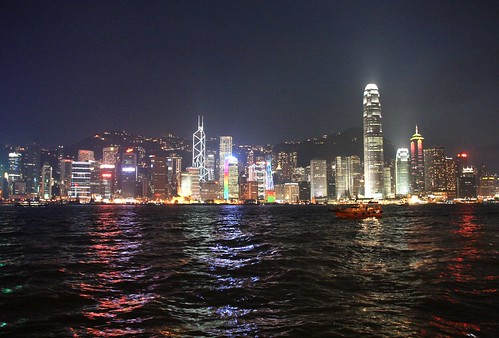
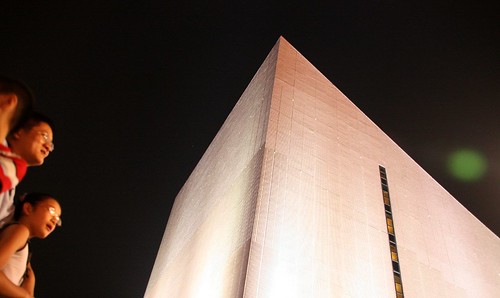
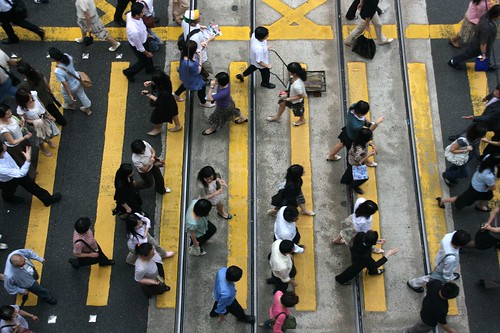
I'm feeling better today, enough to post some images to Flickr and present you with a short photo essay on Hong Kong. It's a magnificent city, a photographer's dream. I hope to get out again once I'm back to health and really document my visit. For now, enjoy these snaps.


Hong Kong Skyline


Hong Kong Cultural Center


Spitting Spreads Germs


Crossing


IFC Mall


Chinese Flag at Jardine House


Something Abstract to Match My Mind

Labels: , ,

Monday, August 27, 2007

The Dissolution of a Soluble Layer

Karst. Now there's a word I don't think I'd ever heard before arriving in Southeast Asia. It's a word that kept coming up as I traveled through the region. And in Northeastern Vietnam, at a UNESCO World Heritage site called Halong Bay, the experience is all about the karsts.

A karst, according to Wikipedia, is a geological term for a "three-dimensional landscape shaped by the dissolution of a soluble layer or layers of bedrock, usually carbonate rock such as limestone or dolomite." In layman's terms this means a natural feature such as a cave or a spire that's been whittled into shape over long years of erosion.

In Halong Bay, which is situated in the Gulf of Tonkin just south of mainland China, erosion has carved out a spectacular landscape in which nearly 2,000 small islands (more than 3,000 if you believe Lonely Planet) dot an emerald sea. Within some of these islands are extensive cave systems featuring massive stalactites. Halong Bay is one of those places that must be experienced; pictures cannot convey the majesty of the place. It is also said, at least in the tourism industry, that you cannot visit Vietnam without a night on a junk in Halong Bay.

Junks in Halong Bay

I had arrived in Hanoi tired and disgruntled, weary of the hassles that seem unavoidable in parts of Southeast Asia. I'd heard that Hanoi was a gem, a city to get lost in, the Paris of the East. When I arrived, however, it was the same old same old. "Same same," as the saying goes here.

Here's a short story to back up my position. I met an Australian on the flight from Hue to Hanoi. Terry - who so resembled Terry O'Quinn that I thought for a moment I was about to fly with a "Lost" castaway - and I chatted on the plane and then shared a taxi to the city's old quarter. We were quoted a price for the ride at the airport, but the driver doubled the figure as soon as we were on the highway (we paid the initial, fair price). We gave him a specific hotel, chosen at random from Lonely Planet, but he still took us to a hotel owned by someone he knew. We hadn't even stepped out of the taxi when a tout opened the passenger door, shoved a card into Terry's face and urged him to check out his hotel. We gathered our bags and started to walk down the street. Within 10 seconds three more touts were shoving brochures and color photographs into our faces, urging us to stay at their hotels. I ignored them, but Terry was too polite and kept saying "no, thank you" over and over. One tout was particularly persistent, and the hotel he was peddling looked nice, so we agreed to check it out. Once we arrived, however, the facade looked completely different from the facade in the picture. Terry said it wasn't the same hotel. The tout said they'd changed the name. I grabbed the brochure and checked the printed address against the address on the building. They weren't even close. Et cetera, et cetera.

Terry's time was limited and he booked a Halong Bay trip for the following day. I was still undecided and opted to explore the city instead. Twenty-four hours was all it took for me to decide to flee Hanoi for someplace more peaceful.

Halong Bay

Hanoi is a city overrun by the motorbike. As I understand it, four years ago, most of the population still used bicycles to get around. Now, cheap imports from China (US$500 will buy you a bike) have flooded the market and the streets, especially the narrow lanes of the old quarter, are choked with motorbikes. The noise of the engines, the constant honking of horns, and the din from the city itself combined with the omnipresent touts and hawkers pestering the tourists, not to mention the exhaust from all those motorbikes and the pollution and grim in general, were too much for me. What better than to end my Vietnam adventure, my entire Southeast Asia adventure in fact, than with a trip to Halong Bay?

Hanoi Motorbikes (Photo by Ian Stacey)

I signed up for a three day/two night tour with the Kangaroo Cafe, the only foreign-owned tour operator in Hanoi. (Unfortunately, there are no rules in Vietnam against copyright infringement, and Terry signed up for a Halong Bay tour with the fake Kangaroo Cafe.) The tour promised a night on a junk in Halong Bay and a night on Cat Ba Island, part of Cat Ba National Park. The third day would be spent on the road returning to Hanoi.

I think I was spoiled by my tour guides in Australia. They were personable and knowledgeable. Anything you asked them about the region, whether cultural, historic or scientific, and they had an answer. Time was spent educating their passengers about the regions we passed through. Every tour I took in Australia included information about geology, geography, history, botany, biology, meteorology, myths and legends, cultural trends, economics and other topics I just can't recall at the moment. I now believe all tours should be as much about receiving an education as traveling from point A to point B.

In Southeast Asia, the tune is different. I don't know if it's because of language barriers, cultural difference or a lack education on the part of the local guides. In Cambodia, my guide did the best he could telling us about the culture of modern Cambodia and the ancient culture of Angkor. But he seemed unable to deviate from a script when asked about industry or geography.

The guide for the trip to Halong Bay was Quy, a smiling young mother who'd been taking foreigners on this route for more than three years. Still, she chose to introduce herself and the trip with a lengthy monologue about marriage rituals in Vietnam and the importance of adhering to rituals for preserving and delivering good luck (e.g., women should only marry at 21, 23, 26 and 28).

Junks

When we arrived in Halong Bay, everyone in the group seemed overwhelmed by the beauty of the place. Despite gray skies and cloud cover the entire time we were there, we are all impressed by the natural splendor. Our guide never touched on how the bay was formed, on what natural forces were at work to create this magical landscape. Instead she told us about the local legend surrounding its creation. You see, Halong means "where the dragon descends into the sea." So the story is that a dragon flew out of the sky, flicked its tail and carved out the bay. Simple as that.

When we visited Hang Sung Sot cave, a magnificent and extensive limestone grotto, we were told nothing about cave formation, nothing about stalactites and stalagmites, nothing about conservation or preservation in the face of increased tourism. Instead, we were directed to look at different rock formations and imagine them as animals, much like you might spend a lazy summer afternoon staring at clouds in the sky. There was the monkey rock, the elephant, the laughing Buddha, the monkey with the flat head. Quy called the cavern "Surprising Cave" because of a phallus-shaped rock that, she said, we would find surprising. The rock, by the way, was impressive; stark, red porno lighting added to the "surprise." To be fair to Quy, Sung Sot means "surprise" or "awe" in Vietnamese, so she didn't make up the name.

Hang Sung Sot Cave


Monkey With Flat-Top


Cock Rock

The time I spent floating on a first-class junk in Halong Bay was relaxing and peaceful, the antithesis of the hectic streets of Hanoi. The second day of the tour was spent, unfortunately, visiting an unremarkable cave and an unremarkable island. The night was spent in the town of Cat Ba, a resort town stuffed to the gills with hotels, where there's little to do at night other than sing karaoke and avoid the touts offering "boom boom girl." The tour group did band together for a very fun night at the town's only western restaurant (where I ate the most disgusting pizza I've ever encountered), but everyone agreed that another night on the junk would have been better.

Still, the trip was everything I wanted in my final days in Vietnam and I'm glad I made the effort. But something is wrong. I don't quite know how to say this without sounding like a snob, or a judgmental foreigner. So I'm just going to say it.

I feel like the tourism industry in parts of Southeast Asia tries to give tourists what they think tourists want. But tourists want more than a night on a boat and a tour of a cave. They want to be educated about the places they visit. Why is it significant? What happened there? Did the city or town play any part in the war? What are the major industries? How many people live in the region? Is there an educational system? Are there artists? What do those weird things outside of every house?

Fun in Halong Bay

I realize this could all come across as a lecture. It doesn't have to be. Imagine if all the energy expended on haggling with tourists, on trying to extort as much money as possible from them, was spent on a dialog. I was pestered from morning to night by people trying to sell me things. If I had been engaged in conversation by just a fraction of that number and given information about their lives and their country, my impressions would be much different. I felt like i was able to engage in conversation in Malaysia and Laos, in northern Thailand and parts of Cambodia. It didn't happen in Vietnam. Maybe I was just tired of the hassles of Southeast Asia after five months of travel. (By the way, this is also why there is a dearth of photos of Hanoi. I promise a return to photography now that I'm in Hong Kong.)

If you've got any experience or insight on the subject of travel in Vietnam or the developing world, post it here! This is the perfect time to contribute to the Packmonkey experience.

Labels: ,

Sunday, August 19, 2007

Black Comedy

I'm going to vent now. What follows will make me sound narrow-minded and bitter. I'm willing to accept that. And the pictures have nothing to do with the text. They are just there to add some local color.

I've spent the last week bouncing from one central Vietnamese city to another. The names change but the scenery and the experience remain constant. There's been little to capture my attention and I believe it's time for me to leave Southeast Asia. I've been in here for nearly five months and fatigue is slipping in. What happened? Why do I suddenly have so little patience? Why am I treating the locals like lepers and scowling at children and old ladies?

My foul mood started the first day in Ho Chi Minh City, when the hotel I'd booked online, and for which I'd paid a deposit, was full. I was placed in another hotel, but it was temporarily without electricity -- "because it's Sunday," they said. I shrugged off these hiccups as the idiosyncrasies of a foreign culture. But as the days progressed, hiccups began to mount, leaving me short-tempered and craving a frosty Starbucks Frappaccino and the comfort of a multiplex. I want skyscrapers and neon, fixed prices, public transportation and overpriced accommodation.

Don't take this as an indictment of Vietnam or the Vietnamese, or of any country in Southeast Asia. It is merely my attempt to explain how another culture can provide hours, or days, of frustration.

Muc (Dried Squid)

While in Ho Chi Minh City, I decided to play tourist and booked a tour of the Cu Chi Tunnels. I was told that a bus would take me to the tunnels and the return trip would be on a boat. When I arrived the next morning, I was told that the trip to the tunnels would be by boat, the return by bus. They told me the boat trip would take about an hour and forty-five minutes. But 90 minutes into the trip we stopped at a dilapidated riverboat cafe for a 15-minute toilet break. The break turned into a 45-minute stopover so our guide, so it seemed to me, could watch television. Because of the delay, and the slow boat, it took nearly three hours to get to the tunnels. We were so late that we missed ninety percent of the introductory presentation. We also learned upon arrival that the entry cost was not included in the tour. I don't mind paying more, just tell me up front what to expect from the tour. The tour was so poorly organized and haphazard I'm surprised it continues to exist. I won't even go into the unscheduled stop at a "crafts factory" on the trip back to HCMC.

My next stop was the beach resort of Nha Trang. The trip from Ho Chi Minh City had taken 12 hours (not eight, as advertised) and I wanted nothing more than a hot shower and a comfortable bed. But that meant navigating through the pack of touts crowded around the door of the bus, then avoiding the motorbike drivers and hawkers who follow tourists as they walk down the street. I found a hotel that promised Wi-Fi in the room and settled in. The Wi-Fi signal was too weak to be of any use. "It works in the daytime," the manager told me. The foul mood invaded my dreams.

A Little TLC

It's tough making a living, especially if you are cyclo or motorbike driver. I've been told that these men, and they are always men, are usually quite poor and working just to survive. They are a constant presence in the tourist ghettos, the refrain of "motorbike" repeating itself every few minutes. The more aggressive drivers will follow you as you walk down the street. They will flash a set of postcards showing local attractions or rattle off a list of popular sights. I understand they need the money, but every time I need a motorbike, I find the nearest driver and tell him I need a ride. I've never walked down the street and suddenly realized I'd rather be on a motorbike.

Motorbike and cyclo drivers are also reliable for two more annoying questions: "Where are you going?" and "Where are you from?" I don't know why they ask the former. The latter is, I think, an attempt at being friendly. I do my best to be polite and say "No, thank you," when approached by these guys. It happens only about 100 times a day, so by the evening I end up being a jerk and just ignoring them. However, once the sun sets, they also start offering prostitutes. I don't want a ride, a one-hour tour or a hooker. No, thank you. I don't know any other way to say it.

Cham Goddess

I'm now in Hue, a city in central Vietnam. everything I experienced in HCMC and Nha Trang is being repeated here. The hotel advertises Wi-Fi in the room, but there is no signal whatsoever. They brought a cable into the room so I could connect to the LAN. It delivers unreliable service. I thought it was my computer until I came to the cafe where I am now writing and the Wi-Fi works as advertised, without interruption or complaint.

TO continue, this morning, Sunday, the staff at the hotel explained that the loud banging from the building next door, the banging that started at 7:15 a.m., was preparations for a festival next year. Really? Why not just tell me they are doing construction? When I used their tour desk to book a flight to Hanoi, the woman helping me turned the transaction into a sales pitch for their sister hotel in Hanoi. She also told me it would cost $8 to take a private car to the airport. Only after I'd pressed her did she admit that I could take a bus for half that price -- but only after telling me it was no good because I would have to leave the hotel two hours before my flight. Huh?

Eye of the Dragon

I will return to Southeast Asia someday. This region is filled with wonderful places and people. I've had adventures and experiences I will never forget, even in the locations I've mentioned in this post. It's not all bad.

I'm off to Hanoi tomorrow, where I will stay for a few days. The travel bug hasn't been beaten out of me yet and I'm not ready to come home. Next stop: Hong Kong.

Labels: ,

Thursday, August 09, 2007

24

England, the United States, Australia, Indonesia, Singapore, Malaysia, Thailand, Laos, Cambodia and now Vietnam. Ten countries in six months, eleven if you count Borneo as separate from Malaysia (there is a Sabah stamp in my passport). That’s my life in 2007. And every time I’ve entered a new country, the first 24 hours have presented me with challenges delightful and frustrating, exciting and depressing, and always enlightening.

It was with this state of mind that I disembarked from a long-distance bus in Ho Chi Minh City, Vietnam. The journey from Phnom Penh in Cambodia started at the crack of dawn and took seven long hours, including an hour to get through immigration. I’d booked a hotel in advance and was looking forward to flopping on a lumpy bed for a few hours of sleep.

More than once I’ve heard travelers refer to Vietnam (rhymes with “ham”) as Viet-scam. I filed this information in the back of my brain, between the names of the islands in the Andaman Sea and remote tracks in the Australian Outback. When I reached HCMC, the information bubbled to the surface, leading me to raise the scam-o-meter to orange.

By coincidence, the bus deposited me on the same block as my hotel. However, the motorbike driver who intercepted my passage across the busy street told me the hotel was too far too walk. Orange Alert! I shrugged him off and 20 seconds later was standing in the hotel’s lobby.

The young woman behind the reception desk, the Redsun Hotel in the backpacker mecca of Pham Ngu Lao, may or may not have received my Internet booking. I established that my name was indeed on her list of reservations, then she told me that she didn’t have a room, that a guest “has sick” and would be staying in the room I reserved. She told me she’d take me to another hotel and then pick me up in the morning and bring me back. The situation reeked of scam, but she was apologizing profusely and looked ashen and ill so I gave in.

She took me to another hotel, on a loud street about five minutes away. I was put in a room on the top floor and was even able to receive a weak Wi-Fi signal. I’d chosen the Redsun because it offered Wi-Fi in the rooms and I wanted to spend some time updating my blog. The night passed without incident, with me busting a gut while watching a bootleg DVD of "Knocked Up," and in the morning I was taken back to the Redsun.

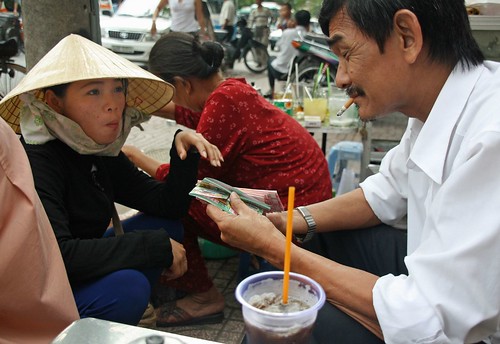
Iced Coffee and Lottery Tickets in Ho Chi Minh City

I'd love to say that everything is hunky-dory at the Redsun. I can’t. Only one of three lights in my room works. The woman who owns the place insisted on sending her 12-year-old son to dismantle the main fixture while I was in the room, despite my pleas that I wasn’t feeling well and would prefer that they fix the light the next day. Also, there is a Wi-Fi signal but it’s extremely weak and craps out every ten minutes. Remember what it was like to use a 56K modem? It’s worse. To top it off, the young woman who checked me in has checked me out and turned creepy – I think she wants to marry her for a green card.
I found another hotel today, just across the lane from the Redsun, and will be checking in tomorrow. The Redsun isn’t the worst place I’ve stayed in – that honor goes to a hostel on the beach in Perth, Australia – but it’s in the running for the top three, certainly the most frustrating in Asia. It makes the hotels in Cambodia look like well-oiled machines.

I am happy to report, however, the rest of my first 24 hours in Vietnam have been fantastic.

I bitched and moaned in Thailand about being lonely on the road, then I went to Laos and Cambodia and made some. The last four weeks brought new friendships and a boatload of hangovers. I wouldn’t trade the experiences for anything. Still, when I set out to explore HCMC on my own I was reminded of how much I enjoy the freedom inherent in traveling alone.

I like to sketch an outline of exploration when I arrive in a new city. The route will always take in a public market, a museum and a city square. I always make time to sit at a café and watch people. I will browse for hours in the bookstores. I seek out side streets and neighborhoods where there are no other tourists. In short, I clear my head and open my eyes. It’s the best way I know to orientate myself to new surroundings.
So I set out early for Ben Thanh Market, a vast complex packed to the rafters with merchandise, food and shoppers. Markets tend to look that same the more you visit, like department stores and parks, but I love them and find great pleasure in wandering the aisles. Perhaps it’s because I try to bring a photographer’s eye to each place, looking for colorful, unusual and exotic details. After 20 minutes of shutter-induced euphoria my battery ran out. My spare was dead too! Crap.

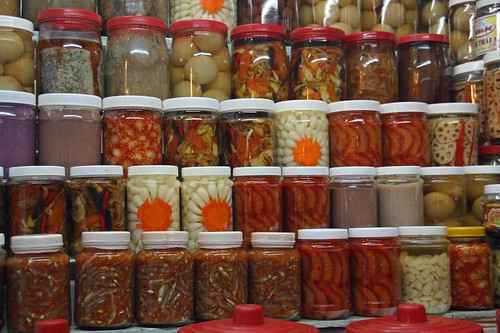
Pickled at Ben Thanh Market

My morning at the market cut short I returned to the hotel to plug in the charger for an hour. It was at this point that the woman at the hotel turned creepy. Interesting and enlightening, yes. But also quite uncomfortable. If she were attractive and sane I might give it a chance.

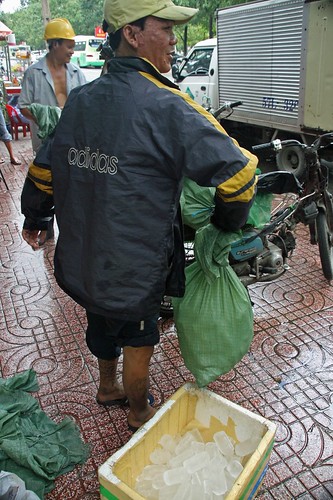
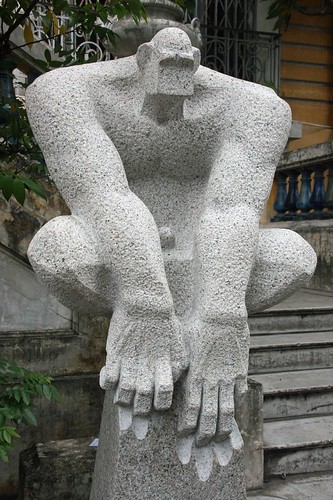
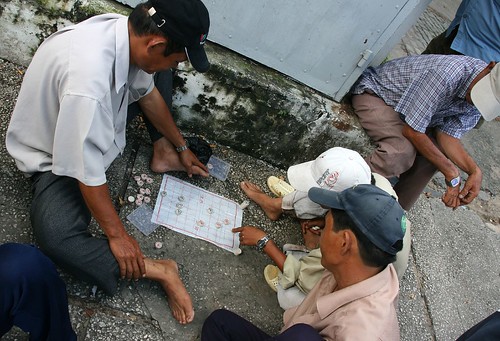
Anyway, I returned to the streets and just started walking. I passed an ice factory, stopping to stare at one man sawing blocks and another loading bags of fist-sized cubes into a truck. They seemed confused by my curiosity and pushed me into the frigid cooler to take some photos. At an intersection near the Fine Arts Museum I was nearly run over by a motorbike while crossing the street. (There are more motorbikes in Vietnam than sheep in New Zealand, I think.) The art, all of it approved by the government, wasn’t worth the fright, but I enjoyed the faded grandeur of the yellow-and-white building. On a street lined with antiques and curios, I paused to watch two men play Xiangqi, or Chinese Chess. The game is baffling and I have no desire to investigate further (I stink at regular chess, so why would I?).

Ice Man


Sculpture at Fine Arts Museum


Sidewalk Xiangqi

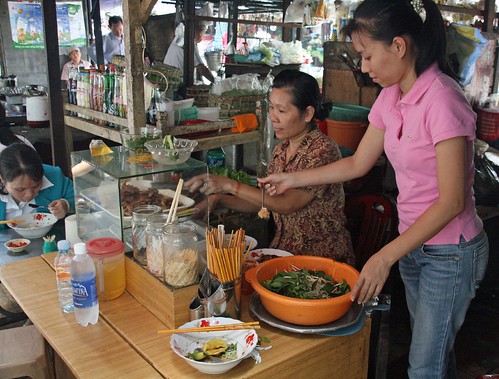
The next stop was the outdoor street market at Dong Ton That Dam. This is the real deal, a street-level affair catering to the locals, where butchers fillet on wooden boards, cigarettes are piled to the sky and packages of dried noodles are laid out in patterns rivaling the greatest mosaics in Italy.

It was at this point that my life as a traveling gourmand took a turn. No, I didn’t eat another spider> Or grubs or pig’s trotters. In fact, what I ate was rather pedestrian: vermicelli noodles with barbecued beef (bun bo?). I’ve been in Asia four months and have not suffered one bout of gastroenteritis. I’m as regular as the sun and the moon (too much information, sorry), a condition that I attribute to my healthy intake of spicy chilies. It's a state of affairs that has given me the courage to take some risks.

I wouldn’t eat street food just after getting of the plane. After four months, however, I believe all the the bugs in my stomach are locals. Lest you think I’m crazy, I still wouldn’t drink out of the tap or eat sketchy meat off of a street cart. Some people refuse ice cubes; I’d die without an iced coffee in the afternoon. In the end, I trust my instincts and I'm always thinking about what goes in, lest I'm unhappy about how it comes out.

Okay... moving on. I ate street food and hoped for the best. I've eaten a lot of food of the streets, but it's always been soup or rice, dishes cooked through and through. This was different, with fresh vegetables thrown on top of cooked ingredients. Where were those vegetables washed? That's what worried me. Twenty-four hours later, I’m feel better than I did before the meal. You only live once.

Lunch Counter

The rest of the afternoon, I played tourist. Every guidebook lists the buildings a tourist should visit. Sometimes it seems from reading recommended itineraries that cities are nothing more collections of concrete and stone, sometimes wood. I passed by the Rex Hotel, the Reunification Palace, the Hotel de Ville, the Municipal Theater, and every time there were tourists taking pictures of themselves outside the front door.

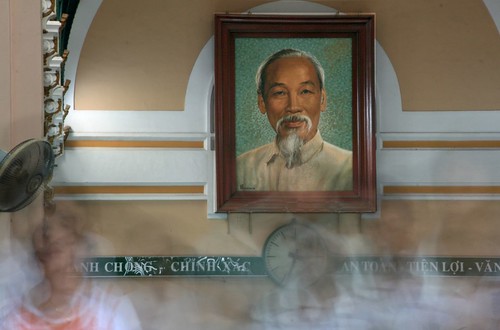
I was surprised by one building. The highlight of my architectural tour was the main post office, a grand old building with a large portrait of Ho Chi Minh at the end of a long arched interior. The building was constructed in the late 1880’s in the French style. Someone’s been taking care of it; the interior is spit-polished, bright and extremely beautiful. The last time I saw a functioning building that took my breath away was back in the middle of May in Kuala Lumpur.

Ho Chi Minh (and Ghosts)

The day ended with a steaming bowl of Pho, a noodle and beef soup that could be considered the national dish, but only if there were not so many other delicious dishes clamoring for attention. I’ve just touched the tip of the Vietnamese culinary experience. More to come, I promise.

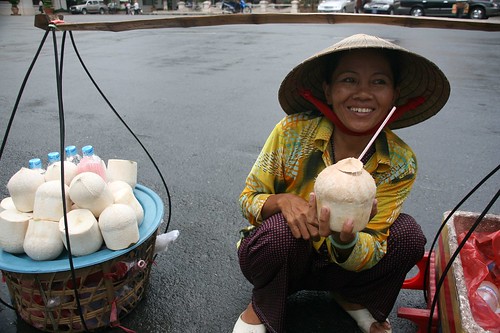
I didn’t do anything out of the ordinary on my first 24 hours in Vietnam. For me the joy of travel is accepting the unexpected, and if I’m not expecting anything then everything holds the potential for excitement. Drinking fresh coconut juice while squatting on a Ho Chi Minh City sidewalk gives me as much pleasure as seeing great art or watching a sunset. It‘s all new to me these days, and that’s what I love about life on the road.

Coconut?

Labels: , ,

Monday, August 06, 2007

Crowded House

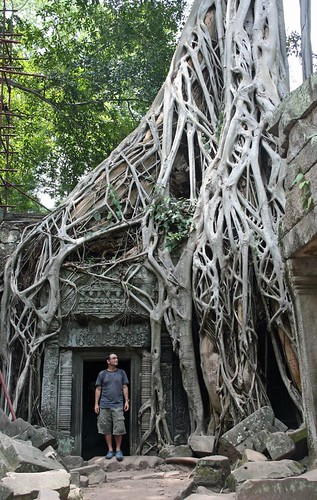
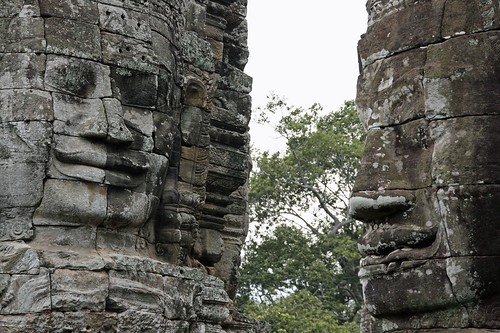
Okay, so here I am in Cambodia. And no trip to Cambodia is complete without a visit to the country’s main attraction: the Temples of Angkor. In fact, most tourists fly into Siem Reap, tour the temples and leave again without seeing any more of the country. On Intrepid Travel’s tour of Cambodia, my group spent two days exploring the temples and we only skimmed the surface.

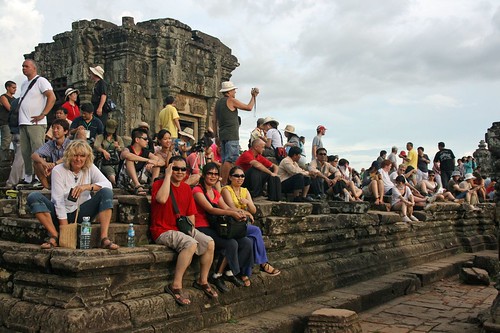
I have a theory about the world’s most famous sites. They are spectacular and deserve their fame. However, their fame is also their downfall. Legions of tourists from every corner of the world are coming to Cambodia to see the temples. They line up at Angkor Wat to watch the sunrise, climb the hill at Phnom Bahkeng for sunset, form single-file lines to weave through the narrow paths at the jungle temple of Ta Prohm and past the intricately carved stupas at Banteay Srei. They are loud, sometimes yelling and laughing or talking on cell phones (“I already paid $28 for the buffet!”). And they take a lot of bad pictures (I can tell because they never get close enough to their subjects).

But Matt, you say, you are a tourist too! Yes, I am. I’m here like all the rest to gawk and take photos. But in my mind, I approach the temples and the artwork with a degree of respect and knowledge that I just don’t see from other tourists. Perhaps the company that manages the sites is to blame. Perhaps limiting the number of people who can enter sites at any given time would alleviate the crush. As it stands, the temples have survived for a thousand years against the forces of nature. I fear they might not last another 50 against the forces of tourism.

There’s little I can say that will add to the millions of words already written about Angkor Wat and the other temples in the region. The history, the architecture, the carvings, the bas-reliefs, the intrusion of the jungle on abandoned sites – it’s enough to keep your mind busy for anywhere from an hour to a lifetime. They are piles of old stones, yes, but I felt like Indiana Jones (or Lara Croft, choose your own fantasy) exploring these ancient sites.

So here’s my plan. I’m going to become so rich and famous that I can demand/afford a private tour of the temples. I’ll gather my entourage (if you are reading this, you are invited) and tour each temple in turn, marveling at unobstructed views and soaking up the silence.

Until that day, here, for your enjoyment, are some pictures snapped by your favorite tourist.

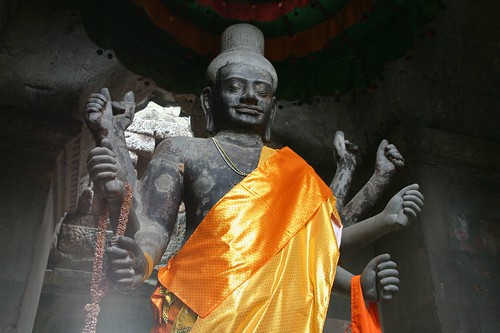
Eight-Armed Vishnu, Angkor Wat


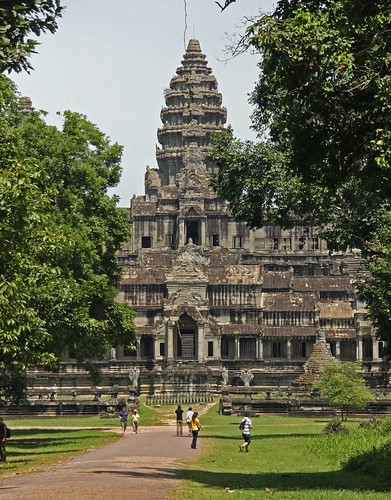
Angkor Wat


Ta Prohm


Bayon


Banteay Srei Detail


Sunset Crowds at Phnom Bahkeng


Flickr Photoset: Temples of Angkor (102 photos)

Labels: , ,

Hello! Bye Bye!

Three hundred kilometers from Phnom Phen is Cambodia’s second-largest city, Battambang. With only about 150,000 inhabitants, Battambang will never be mistaken for a world capital. As it is, one might not even recognize Battambang as a city; it is more like a very large village surrounded by fertile countryside. But no one comes to Battambang for the urban experience; people come here to see rural Cambodia.

If you’ve been following my travels, you’ll know that there have been ups and downs, and that the downs often come from the intermittent periods of loneliness that a long-distance traveler is bound to experience. When the editors of Tripmastermonkey.com asked if I would write a story about a tour company called Intrepid Travel, I knew it would be a way to see Cambodia, a fairly difficult country to begin with, and a chance to travel in a group again. What I learned early on was that traveling with a group opens up unexpected opportunities.

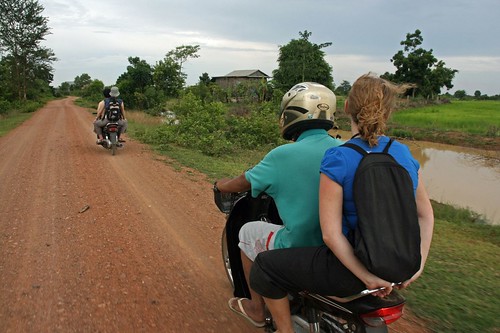
One of these opportunities came in the form of a day-long motorbike tour of the Battambang countryside. Each member of the group, seven women, our Khmer guide and myself, hired a motorbike with a driver (for safety and, more importantly, to keep the group traveling at the same speed throughout the day). We held on tight as we rolled out of town and into the country.

Battambang by Motorbike

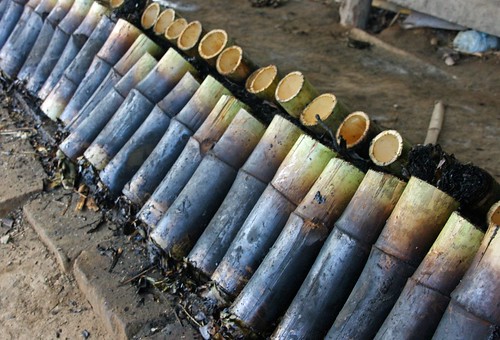
Our first two stops were, to my delight, related to food. At a roadside hut, we were introduced to sticky rice in bamboo. Sticky rice is mixed with coconut juice and packed into foot-long cylinders of bamboo. The bamboo containers are lined up next to hot coals until the mixture inside is thoroughly cooked. The resulting rice is thick, sticky and sweet, and filling enough for an entire meal.

Sticky Rice in Bamboo

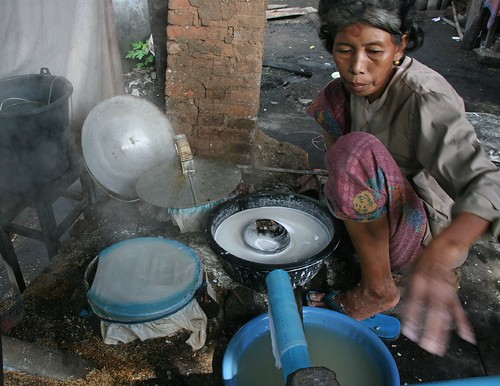
At the next stop, a house a few kilometers down the road, a family was engaged in making rice paper, not the kind for writing, but the kind used to make spring rolls. An old woman crouched in a cloud of steam mechanically spreading a mixture of rice and water on a hot plate, then transferring the wet pancake to a horizontal post. A man then snapped up the wrapper and carefully laid it out on a drying rack. We were told that the family works all day long, in shifts, turning out a few thousand wrappers. For their hard work they might earn what you or I would earn in less than an hour in America.

Making Rice Paper

There are moments when I’m on the road when I look around and know I’m in Asia. The peaceful moments fill me with joy and validate my decision to risk my career for a year on the road. (The unpleasant moments are also enlightening, but harder to swallow.) The journey through the backroads of Battambang was filled with happy visions and moments: farmers leading white oxen across a flooded rice paddy; neon-bright fields of green grasses and crops glowing in the sun; the golden spires of a Buddhist temple glowing on the horizon. However, the moments that brought the most happiness on this day, and continued to provide joy throughout the tour, were the encounters with children.

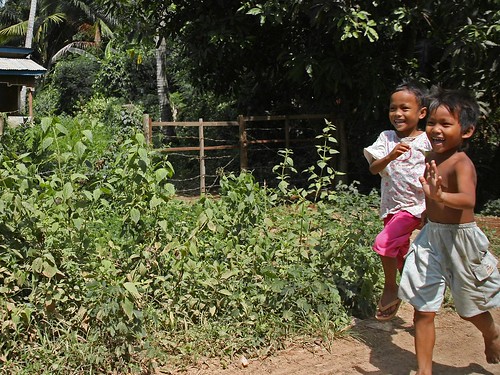
I don’t know how often foreigners appear on in rural Battambang on motorbikes. I’m sure Intrepid takes groups through there on a regular basis. However often it is, the kids were ecstatic when we’d roll by. They’d sprint out of their houses, whether tumbledown wooden shacks or more solid concrete bungalows, grinning from ear to ear and waving, shouting “Hello! Hello! Hello!” Sometimes they’d yell “Hello! Bye Bye!,” or just “Bye Bye!,” and run after the motorbikes. The enthusiasm that radiated from those children was invigorating and made all of us forget that we were a lot of hot, sweaty travelers, choked by the dust and the grime of unpaved country roads.

Hello!

Unfortunately, Cambodia has the ability to change the mood in a heartbeat. The ultimate destination of the motorbike tour was a mountain (a pimple on the landscape, really) 18 kilometers from the city where the Khmer Rouge used a small temple, Wat Phnom Sampeau, as a prison and a neighboring cave, a killing cave, as a repository for the bodies of their victims. The location is serene today, with beautiful views from the hilltop of the surrounding countryside. In the late 1970’s, however, it was another vision of hell on earth.

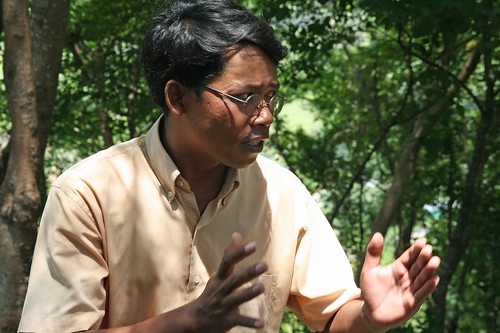
Our local guide for the day, Pau, has spent his entire life in Battambang. When he was four years old, the Khmer Rouge regime began it’s reign of terror. Pau, his mother and father and two older siblings were taken from their home and moved to a camp near Phnom Sampeau where about 300 people toiled for the Khmer Rouge. Pau’s father, brother and sister worked in the fields; Pau stayed in the camp with his mother. The whole family suffered from hunger and deprivation, but survived on subterfuge and guile. Pau’s father discovered a store of rice and buried it, cooking in the dark in the middle of the night and feeding his kids handfuls at a time. But that secret stash only lasted for a year.

Eventually, Pau’s brother and sister were taken to another site to build a dam. His father was executed by the Khmer Rouge when someone revealed that he’d once been part of the army. But Pau, his mother and his siblings survived. Hearing his story was a chilling and awful reminder of Cambodia’s recent past. It brought that history to life in a way that our visit to the genocide museum and the killing fields could not.

Pau Tells His Story

Perhaps it was Pau’s story that made those shouts of “Hello! Bye Bye!“ from the rural children so poignant. We’d been told tales of death and misery, but we also witnessed new life and genuine joy. It was an unforgettable day on the road.

+++++

Note: If you clicked Battambang link to Wikipedia at the top of this post, you would have seen two photos. One looked very familiar to me and I clicked on it. I discovered that a Wikipedia contributor has used my photo for the page! I allow non-commercial use of my pictures, so it's cool. I am surprised and flattered!

Labels: ,

Tuesday, July 31, 2007

Death on the Highway

[Warning: This post contains graphic descriptions of an accident.]

This morning my tour group boarded a bus in Kampot, on the South Coast of Cambodia, and set out on National Highway 3 for the beach resort of Sihanoukville, about 100 kilometers to the west. About 20 minutes into the trip I pulled out a novel and settled in for a good read. The bus jerked to the right. There was a loud thwack and crunch, that kind of sounds that scream collision. My seatmate, Kathe, turned to me with wide eyes and said we'd hit something. A sort of collective gasp and unease filled the cabin. But the bus continued to roll down the highway, the driver apparently unconcerned with the accident.

Two rows behind me and Kathe sat Sally and Renee, nurses from Adelaide, Australia. I heard Renee yell at the driver to stop, and only then did he pull over on the shoulder. Sally and Renee jumped off the bus and ran down the road while the rest of us tried to figure out what had happened.

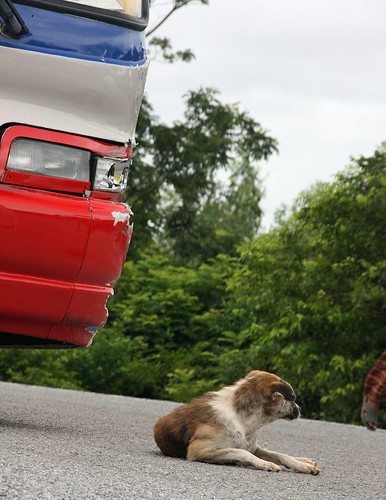
Cambodians drive on the right, like in America. But that doesn't mean people follow rules, like staying on their side of the road. On the other side of the highway, a motorbike passed a car on the left. A third motorbike, with a driver and passenger, tried to speed ahead of the car and other motorbike by passing further on the left, which put them in the path of oncoming traffic. But for a space of about a foot, they would have been successful. They tried to swerve out of the way but ran into the left front bumper of the bus, causing minimal damage to coach and catastrophic damage to the motorbike and the men.

Bus Bumper

I left the bus and walked back along the highway towards a small but growing crowd. I could see Sally and Renee standing near a body on the pavement and a mangled motorbike. As I got closer I saw something on the pavement. My brain told me with was a bit of steak, then I realized it was a golf ball-sized chuck of flesh. I then noticed the second victim, the passenger, lying in a heap on a small slope next to the road. His arms were twisted behind his back and his shirt had been lifted over a motionless torso. I assumed he was dead, then saw that the right side of his head had been crushed, a pool of blood gathering in the grass. No one could survive those injuries.

I turned back to driver and was relieved to see that he was moving and conscious. But still no one was tending to him, no one even offering an ounce of comfort. Sally and Renee are trained professionals, yet the locals told them to not touch either man. If they intervened, and the men died, there was a chance that the victims' families would blame Sally and Renee for the deaths. In fact, no one would touch the men. It's not logical, yet it's the way things work here.

Nevertheless, Sally and Renee urged out tour guide, Kevin, a Khmer from Siem Reap, to step in, and he did, at risk to himself, to comfort the survivor. The man's left wrist was shattered, his hand hanging bloody and limp, yet he was responsive and answered Kevin's questions. He was in shock, but alive.

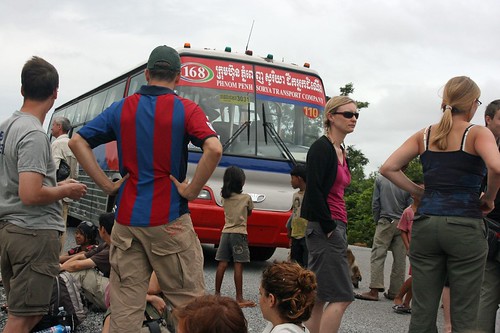
Tourists at the Scene

I wondered what would happen to the bus driver and heard that he had run into the rice fields. Even though he was not to blame, and tried to swerve out of the way of the motorbike, he would be blamed. Kevin said this blame would result in local villagers seeking vengeance and killing him on the spot. Could this be true? I then noticed a young woman lurking in the expanding crowd carrying a hatchet. Had she been working in the woodshed and come to see what happened or was she there with a more sinister purpose?

After fifteen minutes a trio of men lifted the ragged survivor into the bed of a truck and took off for the hospital in Kampot. I will never know what happened to the man, whether he survived or not. Sally and Renee said he will likely lose his left arm due to the extensive injuries and the lack of medical facilities in the region.

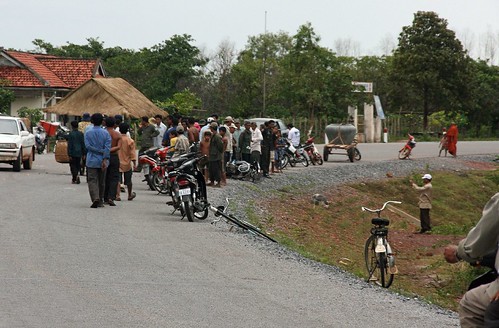
Meanwhile, the passenger, (his friend, brother, father, cousin?) lay motionless and uncovered by the side of the road. The crowd continued to grow, and included children and dogs. Gawkers roamed through the wreckage, kicking bits here and there. Young kids, four and five years old, stared at the corpse on the berm and the bits of gristle on the pavement. A pair of police officers showed up but did nothing more than spray-paint a circle around the wrecked motorbike.

My group returned to the bus. We knew there was nothing we could do but let Cambodia be Cambodia. This is not our home, things are not done the same way. Kevin told us that we should forget it, put it behind us, get back to our holiday. I felt queasy, and could see the concern in the faces of the other tourists. The Cambodians who had now gathered around the bus seemed to be unsure of whether they should check out the dead body or continue watching at the tourists. The whole scene was unreal, surreal, enlightening, frightening and disgusting.

Crowd at the Body

One man lost his life and another's life was ruined because of the space of a few inches. Perhaps a helmet would have saved the passenger's life. There are no answers; it was an accident, plain and simple. Yet, it showed me a side of Cambodian culture that no tour anywhere, anytime, would include in an itinerary. It was a reminder of the fragility of life. It was a reminder of the risks you take when traveling in developing countries. It was as eye-opening an experience as I've had these past six months. In fact, the journalist in me was thrilled to have the story. I'd go to Hell if I believed it existed.

A replacement bus arrived about thirty minutes after the collision. The somber group of foreigners filed back to their seats and the bus pulled away.

The dead man remained exposed and untouched by the side of the road.

Labels: ,

Friday, July 20, 2007

Holiday in Cambodia

Look what happens. You listen to punk rock as a kid and then you are living the title of a Dead Kennedys song. Yes, I've arrived in Cambodia, land of ancient temples and the killing fields.

I'm in Phnom Penh today and will be taking a walking tour this afternoon. Tomorrow I join an organized trip with Intrepid Travel. The two-week tour hits the country's highlights, but I'm most looking forward to a few days at Angkor Wat. I've been resting my camera the past few days knowing that it will get a workout at the ancient temples. The tour should be memorable. I'm looking forward to meeting the group and having familiar faces around me for a few weeks. I haven't been part of a group like this since my Australian Outback experience.

I'm going to try to update Packmonkey while on tour. The itinerary shows some blocks of free time, so I should be able to post along the way. If not, there will be plenty to write about in early August. I am also going to be writing an article about Intrepid for Tripmastermonkey.com.

Labels: ,

Those Crazy Kids

I’ve lost of all sense of distances and geography. I reached this epiphany upon arrival at Vang Vieng, a bend in the Nam Song river about 230 kilometers south of Luang Prabang.

I was in the back of a tuk-tuk with Mitzi, a chef from Maui, and Miksa, her 8-year-old daughter, when Mitzi said that Vang Vieng is the middle of nowhere. Vang Vieng may be in the middle of Laos, a landlocked country in the middle of Southeast Asia, but I didn’t feel any further from home than I did in Singapore, Borneo or Bangkok. These days, everywhere is the middle of nowhere, yet everywhere is home.

I’m operating under the traveler’s mindset in which home is wherever you are at the moment. One reason I wanted to take this trip was to stop thinking about my “future” and start thinking about the present. To be in Vang Vieng is to be far from home, sure. But for this traveler, for a few days this week, Vang Vieng was home. And when you are home, you are happy.

Vang Vieng Panorama

Here’s something strange. I groused about the travelers’ ghettos in Southern Thailand, those beaches where twentysomethings spend their days baking under the sun and their nights drinking themselves to oblivion. Vang Vieng is that kind of town, only it lies on a river, is surrounded by mountains and takes some serious effort to get to.

The town’s main drag, which was paved only within the last year, is lined with the usual assortment of restaurants, tour operators and Internet cafes. Menus from one establishment to the next are identical, offering the same mix of Lao and Western food. And every restaurant has wall-mounted televisions playing movies or American television shows from morning until late in the evening. It’s the perfect scenario for diversity, but someone decided at some point in time that travelers love “Friends” and there are four or five restaurants that show nothing but the defunct NBC sitcom. Also popular are “The Simpsons” and “Family Guy.”

How to explain this? Take another look at those identical menus. Some of them contain an extra page labeled “Special Menu.” Dishes include Happy Tea, Happy Pancakes, Magic Omelets and Magic Pizza. And if you just want the happy without the calories, you can order a “Bag of Weed,” “Bag of Opium” or “Bag of Mushrooms.” Perhaps stoned out of your gourd, with civilization a day away by bus, back-to-back-to-back-to-back episodes of “Friends” sounds appealing. (I avoided “Friends,” but did watch “The Simpsons” for three hours with Miksa one rainy afternoon.)

Vang Vieng operates in a bubble. It’s where backpackers are allowed to act like the adolescents they are. The government keeps an eye on the tourists, and all businesses must shut down before midnight. But it’s still a party town, and backpackers spend their nights drinking and smoking and their days floating down the river on inner tubes. It’s the kind of place that I should have hated, but I had a blast. I blame the "people matter" mantra.

I had a good time because I hung out with a pair of travelers I never expected to meet: a single mother and her young daughter. I’ve met families on the road, but these encounters were limited to a single conversation on a bus or a beach. Mitzi and Miksa, however, are the kind of people I’d be friends with at home and we spent three good days just hanging out.

Mitzi and Miksa on the Path to the Caves


Ghost Miksa

When I first met Mitzia and Miksa, I thought I might learn something profound about Laos by spending time with a child and trying to see things through her eyes. But she is a wise kid, unencumbered by the expectations adults place on themselves in a foreign country. While Mitzi and I were checking out crude thatched houses in a village outside of town, approaching them like anthropologists or visitors from another planet, Miksa was enthralled by the baby pigs squealing in a puddle of mud. It didn’t matter that we were in Laos. As long as there were puppies and kittens, Miksa was happy. The only time she wasn’t happy was when we were caving and Mitzi and I turned off the flashlights to experience total darkness. Oh, and when I slaughtered her in a game of checkers.

I never thought I’d spend time on this trip hanging out with kid. I want one of my own.

Labels: ,

Wednesday, July 18, 2007

Backpacker's Delight

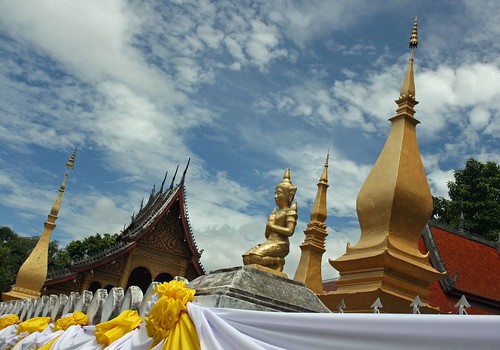
Luang Prabang, Laos, is a backpacker’s dream town. With a population of about 25,000, Luang Prabang is big enough to offer religion, architecture, culture, cuisine and natural beauty, yet small enough to allow for unscripted exploration around gilded Buddhist temples, through narrow, leafy lanes, and on the banks of the muddy Mekong River. It is one of the premiere tourist destinations in Laos, but somehow the outside world hasn’t had time to spoil the local culture. Unlike the popular islands I visited in Southern Thailand, Luang Prabang feels real. It’s the kind of place that takes hold of your imagination, where you can walk down the street and believe you are somewhere special.

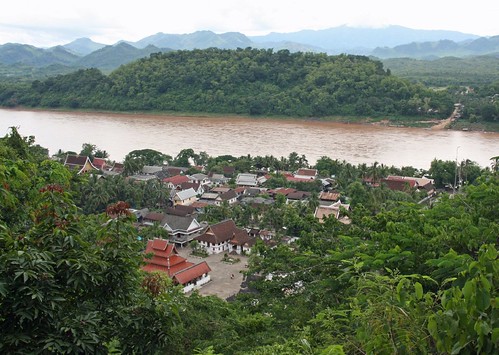
Luang Prabang is situated at the confluence of the Nam Khan and the Mekong River in Northern Laos, about 400 kilometers north of Vientiane. The town is 700 meters above sea level and surrounded by lush mountains. Twentieth-century war and revolution decimated the ancient town, but since the collapse of communism tourism and regional trade have combined to inject new life into the region.

Luang Prabang and the Mekong


Wat Saen

In the 18 years since Laos opened itself to tourism, much has changed, but to my eyes it feels like there is still more Lao culture than anything else. There are no Western franchises in Luang Prabang, no Starbucks, McDonald’s or KFC. There are no shopping centers or mini-malls. The selection of commodities is limited to food and the bare necessities. It is a quiet place; perhaps one of the last of it’s kind in Asia.

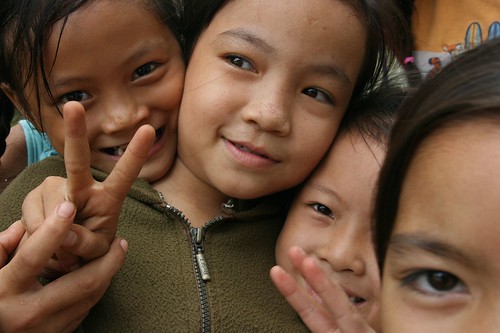
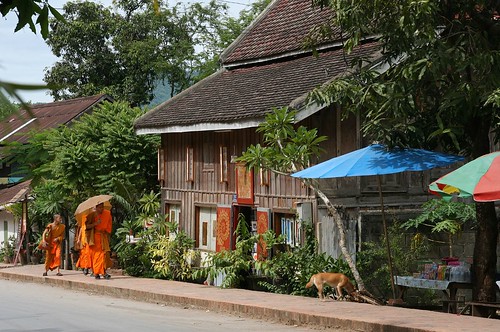
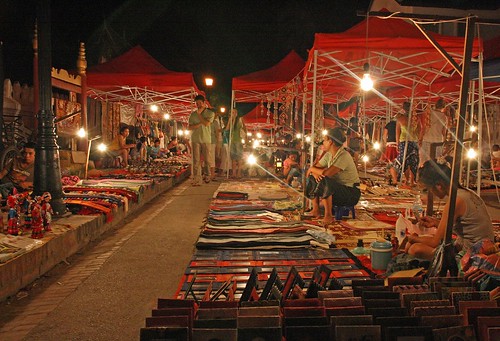
I spent three full days in Luang Prabang with my feet on the ground and my eyes wide open. I saw groups of European tourists buying crafts from women in traditional tribal clothing while orange-clad monks strolled by on their way to one of the town’s historic temples. These scenes occurred amid a stunning array of Buddhist temples, faded French colonial facades and ramshackle wooden houses. In the historic district at the north end of town, I strolled though narrow leafy lanes, the foliage shielding ornate guesthouses and modern bistros. At night, some streets were transformed into bustling marketplaces offering clothing, handicrafts, and jewelry. Other streets were devoted to food, with tables set up with heaping piles of spring rolls, bowls of spicy papaya salad, and skewered and grilled meats.

Kids


Monks


Night Market

Luang Prabang is home to many temples, and therefore many monks. I had seen monks in Thailand and had tried to smile or make eye contact, but was never able to elicit a response. However, there are novice monks in Luang Prabang who spend their free time relaxing at some of the popular tourist spots. These novices are students who spend a year or two as a monk and then move on. From what I understand it’s a way to get an education and open up future possibilities. Part of that education is learning English, and what better way to learn a language than talk to tourists?

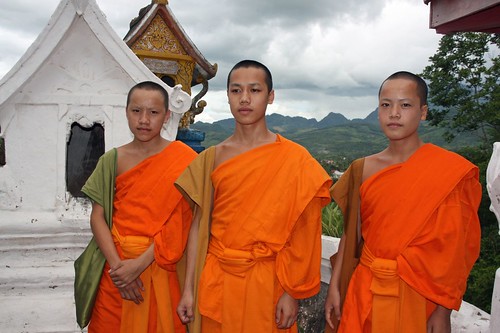
I met the first group of novice monks near the top of Phu Si, a large hill in the center of Luang Prabang. Three boys, Ken, Si and Fan, ages 15 and 16, had the afternoon off and had come to a small temple of the north slope of the hill to hang out. Conversation was limited by their skills to simple topics – where we are from, what do we do, etc. I learned they were from small villages and were in Luang Prabang to learn. They didn’t know what they wanted to do in the future, but seemed to be leaning toward teaching. I don’t think there is a lot of opportunity for these kids and hope they will find something engaging to do with their lives.

Novice Monks at Phu Si

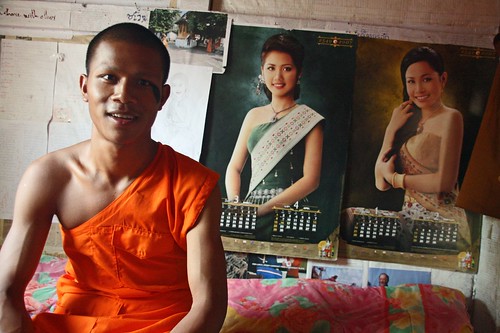
The next day I was walking by Wat Sirimungkhun. The hour was nearing 11 a.m. and the sun was strong. I’d already sweat through my shirt and was hoping to find a shady spot to get some rest. I heard a monk call out “Hello” in very clear English and decided to engage him in conversation. Somlith was a 17-year-old novice monk from a nearby village. He was passionate about learning English and was excited when I sat down to chat. We covered the usual subjects and then I ask him for a tour of the temple. It was Sunday so the schoolroom was closed, but he did show me the novice monks’ living quarters.

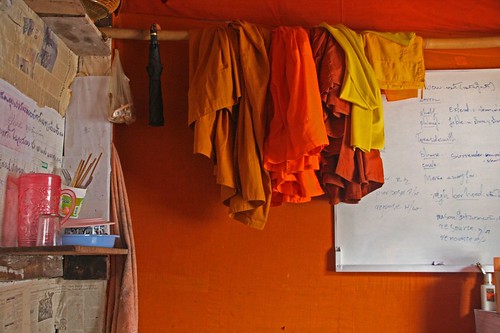
The novices live in small, spartan rooms – a bed, a window, a small desk and a rod to hang their robes. There was stack of books on Somlith’s desk, a small language dictionary at the top of the pile. His walls were covered in pencil drawings of Buddhas, a white board, lists of English words with the Lao translations and, most surprisingly, two large calendar posters featuring beauty queens. Somlith said a European visitor had given him the posters. He seemed embarrassed by their presence, but not because he was a monk, but because he was shy 17-year-old boy.

I took pictures of the boys at Phu Si and of Somlith in his room. I was surprised, again, when I was asked to send them the photos in email. Laos may be a poor country, with most of the population surviving on subsistence farming, but it’s also a company that is looking ahead. That these monks would even have email was beyond my expectations. That they want to maintain a correspondence with me is incredible. I’m sometimes asked about the friends I make on the road. I never expected those friends to include a couple of teenage monks in Northern Laos.

Novice Somlith


Somlith's Room

Luang Prabang wasn’t all about the monks, however. I’d made some good friends on the ride down the Mekong and spent a lot of time hanging out with them. The best friendship turned out to be with Guillaume and Emmanuelle, the young French couple from Amiens. In Pak Beng, Guillaume and I spoke briefly about pastis, a French aperitif that I adore. We agreed to get together in Luang Prabang at a pub owned by a French ex-pat and throw back a few glasses of the cloudy, anise-flavored elixir.

We met at the Maylek Pub at the appointed time and spent the evening at a small table on the sidewalk. The pub is outside of the main tourist area and it felt to me like one of those true travelers’ meetings, where people from different countries just enjoy the short time they have together. Perhaps I was romanticizing the situation, adding significance to the fact that I was in a former French colony enjoying French liquor with a French couple.

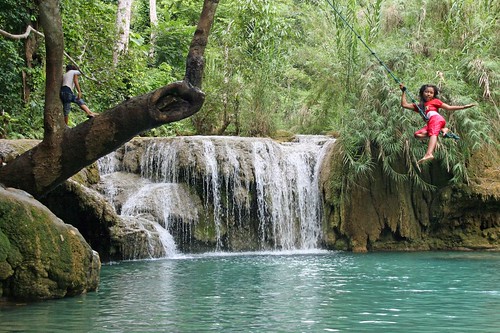
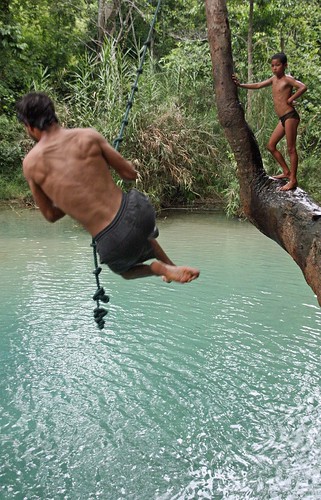
Guillaume and Emmanuelle had been to Tat Kkuang Si, a series of waterfalls and swimming holes 32 kilometers south of the city, that afternoon and wanted to return the next day. We met outside the post office (La Poste) and hired a tuk-tuk to take us to the falls. Once again, Luang Prabang surprised me. I imagined the falls would be overrun with tourists, but it was Saturday and we spent our time hanging out by a turquoise swimming hole (complete with rope swing) where Lao families were gathering for weekend picnics. It was another moment of Laos just being itself.

Girl on Rope Swing


Guillaume Takes Off

Flickr Photoset: Luang Prabang to Vientiane

Labels: ,