Art Smart
Cities all look the same after a while. There are exceptions on the world stage; Paris, New York and Rome will never be mistaken for anything other than the singular creations that they are. But most cities are interchangeable; you’ve seen one you’ve seen them all.
This may be especially true of Japanese cities, where concrete is the order of the day and logic a byproduct of urban planning. A Japanese city may have a few major thoroughfares, but mostly it’s a collection of dreary, functional architecture haphazardly assembled into an urban sprawl. Nobody comes to Japan to gaze at the architecture. Leave that to the Parisians.
This leaves someone like myself at a disadvantage. I’m an inveterate wanderer, happy to leave my map behind and let my feet lead the way. In Japan this can result in walking through miles and miles of forlorn industrial landscape. This truth hit me hard when I arrived in Fukuoka, the largest city on the island of Kyushu. This is a city on the rise, though I think it’s still got a ways to go. There’s a bid to host the 201 Olympic Games, which would give the city a boost. For now, however, this city of 1.5 million strikes me as indistinct from other Japanese metropolises.
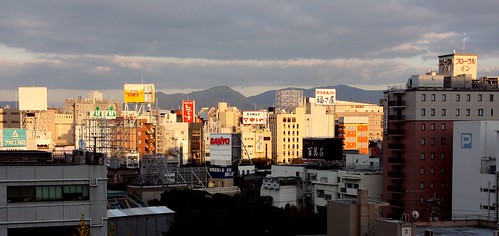
Fukuoka Skyline
Nevertheless, Fukuoka does have a few attractions to recommend. After months in Southeast Asia, I was itching for some culture. I first hit the Fukuoka Art Museum, where visitors can indulge in either ancient Japanese art or a gallery of modern paintings and sculpture. Given the choice, I always lean towards modern art.
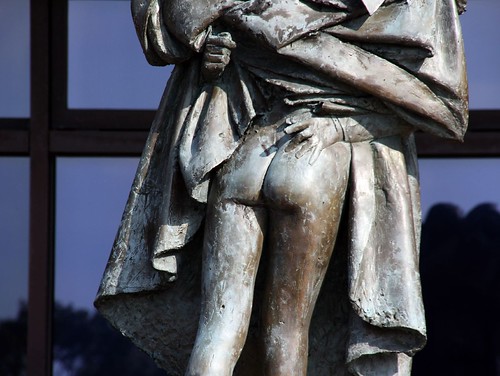
The Fukuoka Art Museum’s modern art collection includes pieces by Miro, Warhol, Rothko, Chagall, Basquiat and other famous names. What distinguishes it from other modern art collections I’ve seen, however, is the tone of the work. As I wandered the galleries, I realized that I was smiling and chuckling much more than I usually do in museums. Somewhere in the Fukuoka Art Museum is a curator with either a gleeful sense of humor or a sunny outlook on life. Even the sculptures in the plaza outside the museum – a giant yellow pumpkin and two figures with bare bottoms – seemed lighthearted.
Cheeky
I’d been reading Claire Messud’s “The Emperor’s Children” and was curious about the museum's Rothko. One of the characters in the book finds solace in the Rothko reproductions that decorate her small studio. Rothko is an artist who, for me at least, is synonymous with the dreary and the desolate. But the Fukuoka Art Museum’s piece, a two-tone square of color, magenta and white, both colors bleeding at the edges as if damaged by a heavy rain, struck me cheerful and vibrant. The magenta glowed with a vibrancy I hadn’t recognized before in Rothko. The closest analogy I can offer is the manufactured color of canned beets – a rich blend of red and purple. I spent ten good minutes in front of the canvas and came away with a better understanding of the artist and my own sensibilities.
The museum offered another surprise – prints from the "Diary" series by the Japanese printmaker Tetsuya Noda. The subjects were simple: portraits of friends and family and domestic scenes. Like the pieces in the modern art gallery, these were filled with humor and hummed with the stuff of life. A stencil of a young boy throwing a tantrum at a kitchen table was more funny than sad, the child’s face screwed up in a recognizable ball of fury. (Some good examples on this page.)
I skipped the gallery of ancient Japanese art altogether.
The next day I traveled 30 minutes south of the city center to a small town called Dazaifu, where a cluster of temples attracts a steady stream of tourists. It is also the site of the Kyushu National Museum, Japan’s fourth national museum. This modern museum, which opened in 2005, is located in the hills above the town and is reached via a steep escalator and a colorful tunnel. The building itself reminded me of a rolltop desk or one of those hardshell backpacks. It is a stunning building, but it still struck me boxy and akin to a fancy warehouse.

Kyushu National Museum
It’s a good thing, then, that the museum’s galleries are impeccable and that the permanent exhibits are educational without being overwhelming. With the help of a free audio tour, I wandered from prehistoric times (obsidian spearheads), through the advent of writing and currency to more modern examples of sculpture and religious worship. The museum has been attracting a million visitors a year – no small feat considering its remote location. I highly recommend a visit if you ever find yourself in Fukuoka (perhaps as a break from the 2016 Olympics).
I didn’t expect much from Fukuoka, least of all two enriching museums. It only reinforces how much I enjoy these outings, and how much I look forward to returning to the U.S., where I can gorge myself on art anytime I want.
This may be especially true of Japanese cities, where concrete is the order of the day and logic a byproduct of urban planning. A Japanese city may have a few major thoroughfares, but mostly it’s a collection of dreary, functional architecture haphazardly assembled into an urban sprawl. Nobody comes to Japan to gaze at the architecture. Leave that to the Parisians.
This leaves someone like myself at a disadvantage. I’m an inveterate wanderer, happy to leave my map behind and let my feet lead the way. In Japan this can result in walking through miles and miles of forlorn industrial landscape. This truth hit me hard when I arrived in Fukuoka, the largest city on the island of Kyushu. This is a city on the rise, though I think it’s still got a ways to go. There’s a bid to host the 201 Olympic Games, which would give the city a boost. For now, however, this city of 1.5 million strikes me as indistinct from other Japanese metropolises.
Nevertheless, Fukuoka does have a few attractions to recommend. After months in Southeast Asia, I was itching for some culture. I first hit the Fukuoka Art Museum, where visitors can indulge in either ancient Japanese art or a gallery of modern paintings and sculpture. Given the choice, I always lean towards modern art.
The Fukuoka Art Museum’s modern art collection includes pieces by Miro, Warhol, Rothko, Chagall, Basquiat and other famous names. What distinguishes it from other modern art collections I’ve seen, however, is the tone of the work. As I wandered the galleries, I realized that I was smiling and chuckling much more than I usually do in museums. Somewhere in the Fukuoka Art Museum is a curator with either a gleeful sense of humor or a sunny outlook on life. Even the sculptures in the plaza outside the museum – a giant yellow pumpkin and two figures with bare bottoms – seemed lighthearted.
I’d been reading Claire Messud’s “The Emperor’s Children” and was curious about the museum's Rothko. One of the characters in the book finds solace in the Rothko reproductions that decorate her small studio. Rothko is an artist who, for me at least, is synonymous with the dreary and the desolate. But the Fukuoka Art Museum’s piece, a two-tone square of color, magenta and white, both colors bleeding at the edges as if damaged by a heavy rain, struck me cheerful and vibrant. The magenta glowed with a vibrancy I hadn’t recognized before in Rothko. The closest analogy I can offer is the manufactured color of canned beets – a rich blend of red and purple. I spent ten good minutes in front of the canvas and came away with a better understanding of the artist and my own sensibilities.
The museum offered another surprise – prints from the "Diary" series by the Japanese printmaker Tetsuya Noda. The subjects were simple: portraits of friends and family and domestic scenes. Like the pieces in the modern art gallery, these were filled with humor and hummed with the stuff of life. A stencil of a young boy throwing a tantrum at a kitchen table was more funny than sad, the child’s face screwed up in a recognizable ball of fury. (Some good examples on this page.)
I skipped the gallery of ancient Japanese art altogether.
The next day I traveled 30 minutes south of the city center to a small town called Dazaifu, where a cluster of temples attracts a steady stream of tourists. It is also the site of the Kyushu National Museum, Japan’s fourth national museum. This modern museum, which opened in 2005, is located in the hills above the town and is reached via a steep escalator and a colorful tunnel. The building itself reminded me of a rolltop desk or one of those hardshell backpacks. It is a stunning building, but it still struck me boxy and akin to a fancy warehouse.
It’s a good thing, then, that the museum’s galleries are impeccable and that the permanent exhibits are educational without being overwhelming. With the help of a free audio tour, I wandered from prehistoric times (obsidian spearheads), through the advent of writing and currency to more modern examples of sculpture and religious worship. The museum has been attracting a million visitors a year – no small feat considering its remote location. I highly recommend a visit if you ever find yourself in Fukuoka (perhaps as a break from the 2016 Olympics).
I didn’t expect much from Fukuoka, least of all two enriching museums. It only reinforces how much I enjoy these outings, and how much I look forward to returning to the U.S., where I can gorge myself on art anytime I want.
Labels: Architecture, Art, Cities, Japan, Museums
posted by Matthew Klein at 1:52 PM
2 comments