Sunday, November 18, 2007

The End?

I’m writing this on the last day of my trip as I speed towards Tokyo on the Shinkansen, which is perhaps my favorite train in the world. I’ve spent the better part of the last 300 days traveling from Sydney to Tokyo, a total of ten countries and dozens of cities, posting more than 100 blog entries and 3,000 photographs. That I'm going home hasn’t completely sunk in. I’ve been taking this trip one day, one week, one city at a time, and the end has crept up on me. So it is with mixed feelings that I return to Tokyo, where I’ll spend one more night before boarding a trans-Pacific flight (my least favorite form of travel) back to the U.S. of A.

I’m excited to return to familiar territory, where I speak the language and I am well versed in the customs. I’m looking forward to seeing family and friends, to eat my mother’s cooking and watch late-night cable television. But I’ll miss the freedom of the open road, the expected pleasures and unexpected impediments that make for open-ended travel. I’ve got an itch (no, not that kind of itch), formed early in life, that leaves me restless. It will lead to more travel in the future. For now, it's time to reflect on 2007 and look to 2008.

As a final installment of Packmonkey: Asia (leaving the door open to Packmonkey: North America and Packmonkey: Europe), I offer a short summary of the good, the bad and the in-between. This is hardly a recap of my entire ten months on the road, merely a short trip down memory lane. I plan to offer a little more reminiscing once I'm back in Los Angeles.


Everything Australian: I spent nine weeks in Australia in February and March, traveling overland along the southern and western coasts from Sydney to Broome, then into the Outback on a 4WD trek from Adelaide to Alice Springs. Australia is a beautiful country. The interior is desolate, stark and remote, the coasts rugged and wild. As a whole, it is a challenging, rewarding and breathtaking place to travel. I will never forget sleeping under the stars in the Painted Desert or swimming in sea lions in the Eyre Peninsula. I also made some lasting friendships in Oz: Bernie and Kate, Dean, Elizabeth – keep in touch! Australia raised the bar for all subsequent destinations. The time I spent in Australia amounted to the trip of a lifetime. Had I returned home after the Outback, I would have been satisfied.

Monkeys and Mountains in Malaysian Borneo: I arrived in Malaysia with low expectations. I left in love with the country. The Malaysian people were some of the friendliest I encountered - always a smile for the wandering Jew in their midst - and the food unexpectedly satisfying. The three weeks I spent in Malaysian Borneo sealed the deal: encounters with the orangutans, proboscis and langur monkeys, Uncle Tan’s jungle camp and the trek to the summit of Mt. Kinabalu, which left me exhausted but marked two of the best days of the whole year.

Backpackers’ Laos: Backpackers flock to Southeast Asia, so it’s no surprise that there’s a backpacking culture in this part of the world. My time in Laos, from my arrival at the border with Thailand to my departure from Vientiane, was the ultimate backpacker’s experience. The country itself is wonderful, remote and rural, yet unspoiled by the tourism you encounter in Thailand and Vietnam or the tragic history of Cambodia. Laos had been described to me as Thailand of 20 or 30 years ago. Ten short days in country showed me the Southeast Asia I dreamed of visiting.

What made my time in Laos really special was the friendships I made. Two days floating down the Mekong solidified a bond with my French amis, Guillaume and Emmanuelle. We spent the evenings in Luang Prebang at a sidewalk bar laughing over glasses of cloudy pastis, the days meeting the young monks at the city’s temples or swimming at the tranquil waterfalls outside of town. In Vang Vieng I met Mitzi and her daughter, Miksa, from Hawaii. We explored caves and rented bicycles for a trip to the local market. At night we relaxed over cheap food and beer at the backpacker cafes. Miksa and I even found time for a marathon afternoon watching "The Simpsons." Traveling friendships are short and intense, and one of the joys of travel.

Food, Food, Food: Who doesn’t love to eat? Everywhere I traveled there was something new to taste: kangaroo sausages in Outback Australia, blue rice in Malayasia, chicken rice in Singapore, khao soy in Northern Thailand, even deep-fried tarantulas in Cambodia. There were also some old favorites to devour: sushi and ramen in Toyko, curry and pad thai in Thailand. Somehow, I still haven't tried durian.

Indonesia Headaches: I arrived in Indonesia with high hopes. Two weeks later I couldn’t leave get out the country fast enough. From the touts and taxi drivers oozing desperation in Bali to the scam artists in Java who took me for a ride, I was overwhelmed by the amount of ill-will I felt in Indonesia. I’ve heard reports from other travelers about good times in Bali and Java, so I will not say the country is filled with bad people and bad times. At least I left with two good memories: sunrise at Mr. Bromo and an afternoon spent wandering the ancient Buddhist temple at Borobudur. These two places almost make up for all the aggravation I experienced everywhere else in Indonesia.

Tourism in Thailand and Vietnam: Thailand and Vietnam are two of the most popular destinations in Southeast Asia. They were also, for me, two of the most disappointing destinations on my trip. In the island of Southern Thailand, I encountered hoards of westerners traveling from one beach to another. It seemed that the locals in sight were either serving the foreigners beer and food or cleaning their rooms. There was also the terror of the night of the flying termites. The beaches are nice enough, but crowded and dirty. Were it not for the energy of Bangkok or the charm of Chiang Mai, I’d have to write off Thailand as a loss.

In Vietnam, the tourism treadmill also operates at full speed. Perhaps it was because I’d been on the road for six months, or perhaps it was because I was exhausted from a whirlwind tour of Cambodia. Whatever it was, I found Vietnam to be hectic in all the wrong ways. From the overcrowded and polluted streets of Ho Chi Minh City and Hanoi, where even the act of crossing the street was hazardous, to the constant haggling over prices, Vietnam was a downer.

Life and Death in Cambodia: I only spent 10 days in Cambodia, but those days contained some of the best and worst times of my trip. On the positive side was an extraordinary tour that took me into the Cambodian countryside and introduced me to the real Cambodia of today. The tour also resulted in a few of those backpackers’ friendships that I mentioned earlier. I loved drinking late into the night at a small bar in Kampong Cham and on the beach at Sihanoukville with Sally and Renee, nurses from Adelaide, Australia. And Kathe, a university student from Holland, turned into a close and unexpected friend.

On the down side was a bus accident that left two Cambodians dead and exposed the utter corruption and poverty of Cambodian society. I refer you to the impassioned blog post I wrote on the afternoon of the accident.

Return to Tokyo: I knew that I wanted to end my trip in Japan, to return to a place I lived for 18 months in the early 1990s. I did just that and I am now reminded of that old adage about not being able to go home again. In the years since I lived in Tokyo, I’ve changed, Japan has changed and the world has changed. I love the country and the Japanese. I loved taking Japanese lessons and exploring the country again. But in the end I could have done with less. I’d been on the road for most of the year and was tired, wanted to do little more than curl up with a good book and a glass of whiskey. So I spent most of my time in Tokyo enjoying solitude and rest.

My time in Tokyo was good for the spirit, but perhaps something of a missed opportunity. Perhaps what it taught me is that the next time I take off and travel the world, I’ll impose a six-month limit. For me, that seems just right.

So on the eve of my return to the U.S., I look forward to reuniting with family and friends, to starting a new chapter in my life that builds on everything that’s come before.

Some people say travel changes you. I think that’s a big fat myth. I’m still the same person I was when I started this trip. What I have now that I didn’t have before is a greater understanding of the world and my place in it. I think I’m more humble. I’m definitely more aware of how fortunate I am. My place in this world is small, but my future is unlimited. The end? I don't think so. Just another beginning.

A HUGE thanks to everyone who checked in and supported me over the past ten months. I will see you all very soon!

Labels: , , , , , , , , , , , , , , , ,

Wednesday, November 07, 2007

Slurp

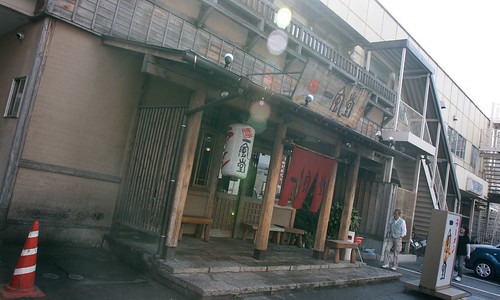
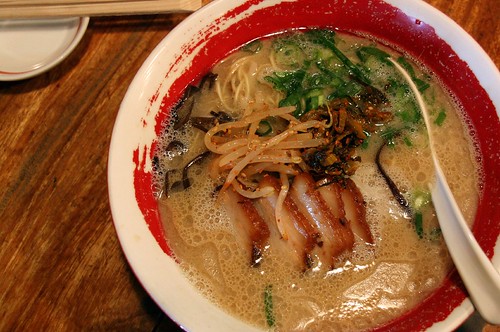
In my last post I wrote about eating at a ramen joint in Fukuoka. I said that I would return and I did, slurping up more delicious ramen. This time I ordered a type of Hakata Ramen that I later learned was favored by "women and the elderly." It was milder than the type I'd had a few days earlier, but just as delicious. I could, however, go for a plate of pasta or a burger after all this ramen.

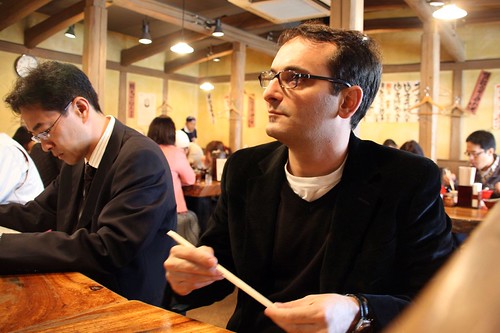
Here are a few photos for a bit of, uhhh..., local flavor.

Hakata Ippudo Ramen, Fukuoka


Fake Candid


Mmmm... Noodle Soup

Labels: ,

Monday, August 06, 2007

Crunch Time, Part II

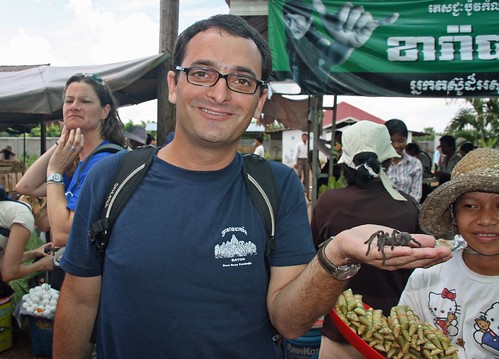
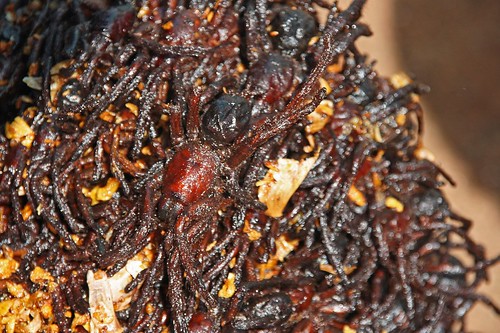
On every bus ride there are rest stops. There is always food for sale, from cooked meals to prepackaged snacks. On the ride from Kampong Cham to Kampot, in a small town called Skuon in Eastern Cambodia, we were treated to a unique snack, a Cambodia delicacy if you will: the fried spider. I’d already eaten crickets, grasshoppers and termites, and I’d promised someone during a night of drinking that I’d eat a spider, so my time had come. There was no avoiding the inevitable; I was going to eat an arachnid.

Lonely Planet says locals hunt the spiders, a species of tarantula called an "a-ping" in Khmer, in the surrounding hills. According to legend, the villagers started eating the spiders during the Khmer Rouge regime, when food was scarce. The locals have developed a taste for hairy creatures, however, and I’m sure a steady stream of tourists injects a bit of revenue into the economy.

By the time I’d disembarked from the bus, our tour leader, Kevin, had already found a live specimen and was posing for photographs with the creature. He handed it to me and I let it crawl up my arm. It was ugly as sin, but harmless. I then bought one of the cooked spiders, for 500 riel or twelve and a half U.S. cents, and prepared to eat my mid-morning “snack.”

Live Tarantula


Dead Tarantula

The bugs I’d eaten in Phnom Penh were tasteless; any flavor came from the oil they were fried in. The spider, however, was a little meaty. The method for eating a deep-friend spider is to pluck the legs off one by one and pop them into your mouth. Each leg, when separated from the body, includes a tiny piece of white flesh, a morsel with the consistency of crab and the taste of chicken. Just kidding. There is a hint of sweetness to the flesh, but mostly it’s flavorless. The rest of the leg is crunchy and tastes of oil.

Doesn't Taste Like Chicken

When I’d polished off the eight legs (okay, I only ate six, giving two of the legs to some children), I broke the body in half, separating the torso from the abdomen. Kevin told me abdomen is nasty, and Lonely Planet concurred, describing a morsel “which seems to be filled with some pretty nasty-tasting brown sludge, which could be anything from eggs to excrement.” I passed on the abdomen, but ate the rest of the bug, including the head. It was no better than the legs, and took a long time to chew. I should have known that an exoskeleton would require extra effort to get down. Still, I persevered and ended up spitting out only the small bits that got stuck in my teeth.

Postcard Moment

Will I eat another deep-fried spider? I can’t say. All I know is that a week later, at another rest stop during another bus ride, I jumped at the chance to sample a dish of sautéed red ants. This time, unlike the crickets, grasshoppers and spiders, there was a distinct and pleasant flavor. I ate three heaping spoonfuls.

Labels: , ,

Sunday, July 22, 2007

Crunch Time

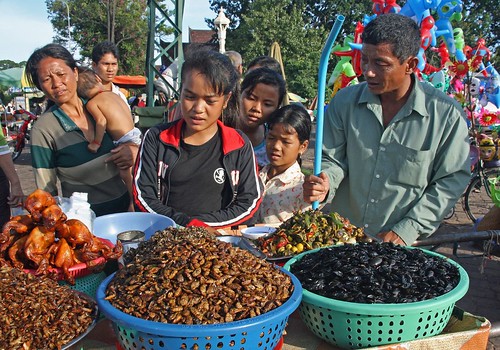
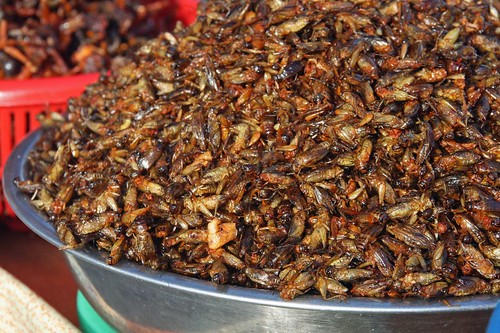
It was late afternoon on my first day in Phnom Penh. I was wandering around outside the Royal Palace when I noticed a few carts piled with baskets of something edible. Never one to pass up a chance to inspect the local cuisine, I moved closer. It didn't take long to realize the baskets contained piles of fried insects. There were beetles, crickets and grasshoppers. There was a pile of green things that looked like large ants and another pile of something that I assumed was still in its larval stage. There were also small frogs and deep-fried baby birds. But who cares about frogs and birds when you are staring at a basket of fried bugs?

Bug Cart

The girl selling the snacks told me I could take as many pictures as I wanted for $1 (Cambodia uses U.S. currency). My instinct was to take the photos and move on. Wrong. I'm traveling to experience local culture, bugs and all. So I sampled the product.

I started with the smallest cricket, ignoring as much as I could the beady eyes and broken legs. I was expecting something mushy, perhaps with a bitter aftertaste of internal goo. What I tasted, however, resembled an oily tidbit of deep-friend charcoal. Ok, maybe the crickets don't retain their natural flavors, their essence lost when they are plunged into a vat of bubbling oil. I moved to the larger grasshoppers (locusts? large crickets? who knows). Crunchier, but still like eating the shavings from a piece of burnt toast. Perhaps the green ants and spring onions was what I was looking for? Better, with a hint of sweetness, but still unremarkable. Where does a guy have to go to get a plate of tasty bugs around here? Jeez!

Crickets


Beetles

I passed on beetles, pupae and frogs. But in a drunken state last night I promised two of the women on my tour that the next time we encounter bugs I will eat a beetle. I think I even promised to eat a hairy spider. When in Rome...

Labels: ,

Thursday, July 05, 2007

The Charms of Chiang Mai

I have a new favorite Thai dish. I'd thought I'd tried them all, but when you travel to the source something new is bound to present itself. The dish is Khao Soy (or Khao Sawy), a straightforward blend of red curry, noodles and chicken. But like everything delicious, the simplicity hides something satisfyingly complex.

I discovered Khao Soy through my new Bangkok-based friend Linnea (of the banana and cheese ice cream expedition), who suggested that while in Chaiang Mai I try the local specialty, Khao Soy. She also said she is especially fond of the "crunchy noodles on top." Crunchy noodles? In Thai food? I was intrigued.

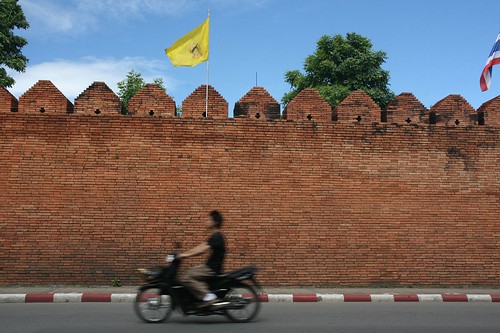
Chiang Mai is a small but significant city in Northern Thailand. It is a highlight on the tourist trail, so like the rest of the country (in my experience, at least) it is overrun with foreigners. But the locals are friendly, the temples are magnificent, and the food is delicious. The old city, which is enclosed by a moat and still has portions of the ancient city walls, is small enough that a tourist like myself can walk for hours and discover hidden nooks removed from the hustle and bustle of the tourist districts.

Ancient Wall at Tapae Gate


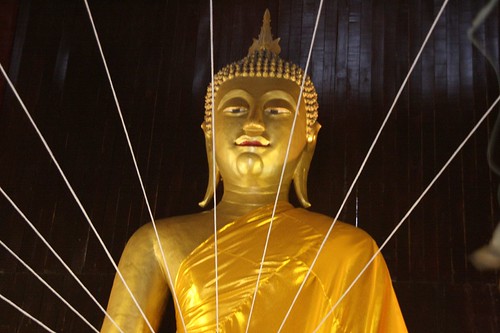
Buddha at Wat Pho

Chiang Mai also boasts the best collection of used bookstores that I've seen in Southeast Asia. There are cafes offering organic food and free Wi-Fi, a bustling night market and rugged trekking in the surrounding mountains. It's the kind of place that Thailand is famous for, and deservedly so.

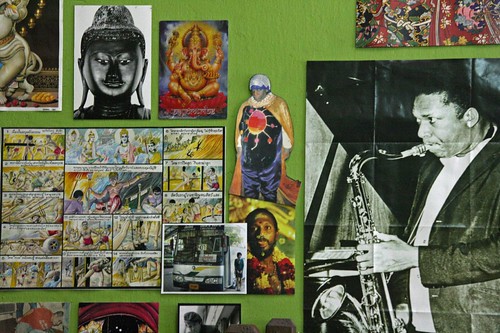
I spent my first morning wandering around town, gazing at gilded wats and contemplating the universe in front of golden Buddhas. I particularly enjoyed browsing in a shop called Noah's Ark, which sells an eclectic range of "T-Shirts, Music and Whatnot." The owner, a smiling young Thai with a taste for the exotic, put on a CD of jazz-tinged pop from South Africa and both of us bounced to the beat. I bought a T-shirt, partly because I wanted one but mostly because I wanted to support this affable entrepreneur.

Wall at Noah's Ark

When lunchtime rolled around, I stopped by a restaurant that looked promising and asked the owner is she served Khao Soy. To tell the truth, I was more concerned about my impending state of dehydration, but that was quickly remedied with a tall glass of watermelon juice and a bottle of extra-fizzy soda water. (The Thais make an excellent soda water.)

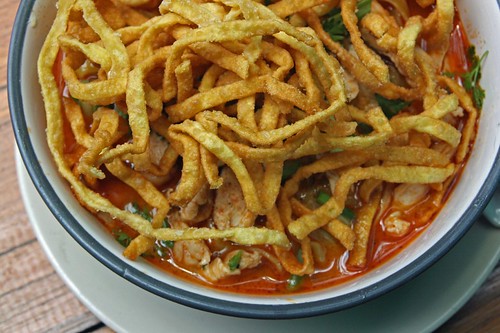
I didn't know what I was expecting from Khao Soy, perhaps just another curry-based dish. But it's so much more. Instead of a thin base of curry covering the main ingredients, Khao Soy is a more like a soup, a self-contained dish served in one big bowl. Another surprise, perhaps the biggest for me, was that in a land of rice noodles, Khao Soy used flat yellow egg noodles. There's a hint of fettuccine in the blend of egg noodles and creamy curry. There was also a moment of Proust-like sense memory when I tasted the egg noodles - kugel came to mind, and everything associated with the dish. The Kaho Soy was indeed topped with "crunchy noodles," very similar to what you'd be served in a Chinese restaurant.

Khao Soy

Spicy curry, slippery egg noodles and crispy noodle topping - I have a new favorite Thai dish. I liked it so much that that same night I decided to go out in search of another bowl. I didn't know where to go, so approached a tuk-tuk driver and asked him to take me to someplace local, where Thais would go for Khao Soy. He promised me that he understood and we took off.

He took me somewhere local only in that it is within the Chiang Mai city limits. He didn't take me to a stall where a grandmother sweats over a wok, or every a storefront emitting the scent of steaming vats of curry. No, he took me to a place called "Just Khao Soy," a theme-restaurant where everything is in English and the prices are triple what you'd pay anywhere else. According to Lonely Planet, however, Just Khao Soy "lives up to it's name by serving nothing but the local specialty. This is the grand, gourmet version."

I stood outside Just Khao Soy debating whether to go in. I was angry at myself for not being more specific with the tuk-tuk driver. I should know by now that one of the rules of travel is that locals assume you want to go places where you will be comfortable, where you will be among your own kind and language differences will not be an obstacle to enjoying yourself.

This was not the kind of experience I was looking for. Still, in my quest to experience culture both high and low, I decided to check it out. Which was mistake number two. Another rule of travel is that the locals always assume you cannot handle the spiciness of the cuisine. Thai food is often rated according to the number of chilies in a dish. If the Thais eat Pad Kra Prow with eight chilies, they will serve it to you with one or two. Just Khao Soy offered its signature dish in three levels of spiciness, mild, medium of spicy. I asked if spicy meant spicy and was told it did. So I ordered it medium. Mistake number three.

What came to the table was a bland imitation of the Khoa Soy from lunch. Luckily, this gourmet version was served with an array of condiments -- coconut cream to thicken the broth, fish sauce to add saltiness, bananas to sooth the taste buds, pickles and shallots for crunch, and chili paste for burn. I add a healthy dollop of chili paste and was satisfied with the heat level.
Nothing beats authenticity. Vegas New York will never be New York, New York. The Matterhorn at Disneyland cannot compete with the mountain itself. And Just Khao Soy will never live up to the standards set by a nondescript restaurant somewhere in the heart of Chiang Mai.

Labels: ,

Tuesday, June 19, 2007

My Compliments to the Chef
I worked late every Thursday night at my last job, and was famous for ordering Thai. I called it Thai Food Thursdays. It became a sort of running joke that when Matt was working late, there would be a Thai delivery. Do I have to spell it out? I love Thai food.

I arrived in Thailand geared up to eat authentic Thai cuisine. I’ve been disappointed by the selection so far. I blame it on the tourist ghettos, where cooks dial down the spice to bland and then take it a few steps further. Perhaps I could learn to cook Thai food and set my own spice levels.

I emailed a cooking school when I was in Ko Lanta, but it was closed for the season. When I spied a brochure for a cooking school in Ao Nang, I jumped. Here was a chance for me to learn a few tricks.

I enjoy cooking. I believe that if you can read and follow directions, you can cook. There are variables to cooking well, of course, but the basics are quite easy. Follow the steps, don’t let anything burn and adjust for taste. Easy peasy.

Nevertheless, I haven’t cooked anything more complicated than pasta and steamed vegetables in the last five months. Could I handle five courses of Thai food?

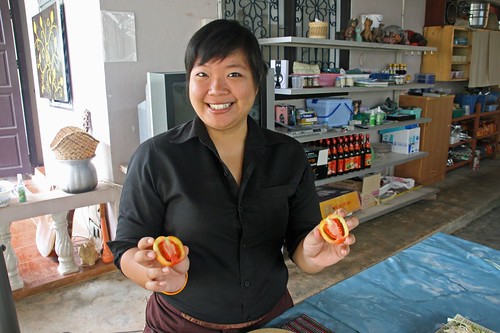
I took at long boat from the beach at Railay to the town of Ao Nang and was greeted by a silent man with a sign reading “Smart Cook.” He chauffeured me for fifteen minutes through town, past more travel agencies and resorts than one place should be able to support, to a nondescript house on a quiet residential street. I was beginning to doubt my decision to enroll in a cooking class, but was greeted with a big smile by a young woman named Mark (confusing, I know). This is the low season in southern Thailand (i.e., the rainy season) and I was the only student. Private cooking lessons? Okay by me.

Mark Believes in Fresh Ingredients

Mark handed me a recipe book and we quickly got down to business. She told me we’d be cooking six dishes, each one a staple of Thai cuisine. I had been given the choice of four different menus when I signed up for the class, so I was familiar with the day's program. On the menu were some of my favorites – pat thai, tom yam soup, papaya salad, green curry – and some dishes I was vaguely familiar with – chicken with cashews and banana in coconut milk.

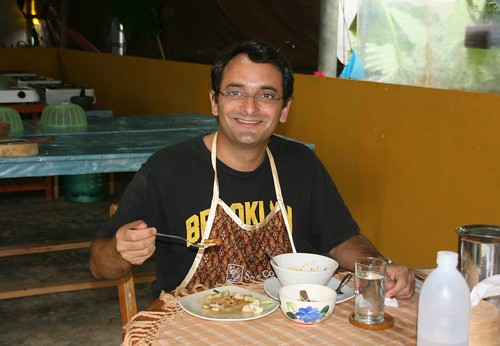
I donned an apron and we got to work. Mark introduced the basic ingredients of Thai cuisine – garlic, lemongrass, onions, galangal (a relative of ginger), chilies – and walked me through the first two dishes, Tom Yam Kung (hot and sour soup with prawns) and Pat Thai (fried noodles). She also told me that if I wanted more meat in any dish, chopping off a finger was not the way to go. It was barely past 9 a.m. and I was getting hungry thinking about the end product.
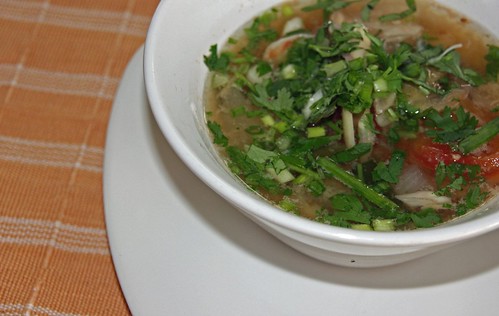
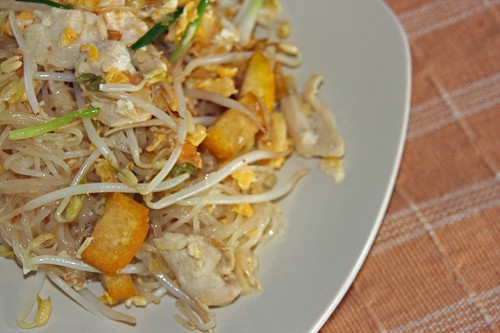
Tom Yam Kung and Pat Thai require little more than the blending and simple heating of very basic, fresh ingredients. The Tom Yam (my Tom Yam!) was perfect, the galangal, lemongrass and kaffir lime leaves supplying the distinct flavors of Thailand. The whole dish took no more than 10 minutes to prepare. The Pat Thai, I’m sorry to say, was not the best I’ve ever had (the noodles clumped together, it was too dry), but I got the gist of it and will do better the second time around.

Tom Yam Kung


Pat Thai

The next challenge was a curry paste. Somewhere in my past there was an episode in which I tried to make Indian curry from scratch. I recall being overwhelmed by the number of ingredients, the blending of the spices and a complicated round robin of heating, mixing and reheating. I’ve always assumed Thai curries would also be beyond my abilities as a cook. Perhaps I’d fooled myself into believing a delicious cuisine like Thai would have to be complicated. Of everything I learned at Smart Cook, the most important was that Thai food is not complicated. Even curry paste.

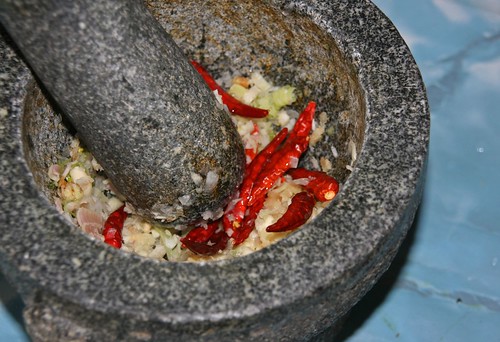
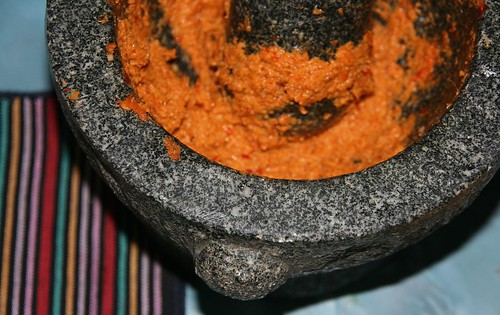
Once again, it came down to a few fresh ingredients. We were going to make green curry, but I told Mark about my passion for Penang curry and she offered to show me how to make that instead. It only required that we change a few ingredients – for example, dried chilies instead of fresh. She set me to smashing the ingredients in a stone mortar, telling me how old Thai women have very strong arms from a lifetime of mixing their own curry paste. Then she let on that most people use a blender these days. I was happy to be traditional about the whole thing and worked up a sweat smashing the chilies.

Smashing Chilies for Curry Paste


Ten Minutes Later... Curry Paste

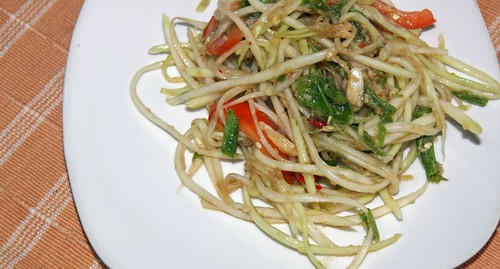
We set the paste to one side and moved to the next dish, Som Tam (papaya salad). I love papaya salad, a spicy mix of unripe papaya, chilies and lime, but the unripe papaya has always been a mystery to me. I asked Mark about it and she led me into the backyard and pointed at a tree with a bunch of cucumber-looking bulbs growing like bananas. Mystery solved. She also pointed out long beans growing in the front yard. Fresh ingredients were sprouting in every corner of the yard. What had at first been a nondescript house was shaping up to be a self-contained center for Thai cookery.

There’s no bite to a dish without that one magic ingredient: the chili. Mark told me green chilies are the hottest, then red, and that the younger and smaller the chili the hotter it is. She also listened to me gripe about the lack of heat in the food I’d eaten lately and told me I could request a dish at a restaurant with a specific number of chilies. She then asked me how many chilies I wanted in my papaya salad. I chose two small green, one red and one that was half and half.

My Som Tam was spicy! My mouth was scalded, my nose running, sweat trickling off my brow. I say this with full awareness of the boasting I’ve done in the past about my tolerance for spicy food. With humble heart I admit I have a three-chili limit when it comes to Som Tam. Nevertheless, I ate most of the dish and savored every bite.

Papaya Salad

Halfway through the menu, I was starting to feel full. I’ve been eating well these past few months, but I’ve also been eating with moderation. The gargantuan portions of American eateries don’t exist in this part of the world. I eat a plate of food and feel fed, not stuffed. Three dishes before 10 a.m. is unheard of for me. I think Mark sensed this because she sat down with me and we talked for the next 20 minutes. We covered the role of food in Thai culture, the superiority of a thin over a thick crust in a pizza, and the ubiquity of processed foods in western diets.

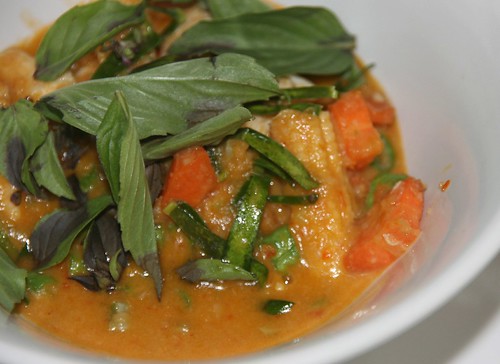
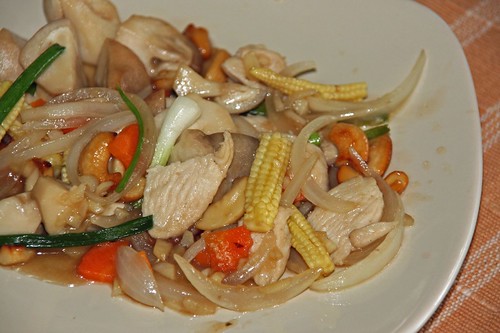
Penang Curry and Kai Pat Med Ma Maung (fried cashew nuts with chicken) may sound like difficult dishes to prepare, but they were both, again, a matter of blending fresh ingredients and cooking them for a few short minutes in a hot wok. Mark was there to regulate the heat and keep me on track. I think the regulation of the heat and the timing of the mixing will be most difficult when I set out on my own. She put both dishes to the side and in we took the next few minutes to prepare dessert, bananas in coconut milk.

Penang Curry


Fried Cashew Nuts With Chicken


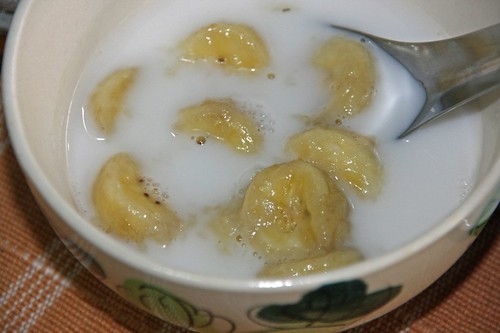
Bananas in Coconut Milk

I sat down and ate every delicious bite. When the food’s this good, there’s no such thing as full.

Not too shabby for my first attempt as a Thai chef. I was astonished that such simple dishes could yield such distinct and strong flavors. As far as I can tell, the secret seems to be fresh, local ingredients. Ginger is just not the same as galanga. Lime juice cannot be substituted for kaffir lime leaves. Dried chilies don’t yield the same heat as fresh chilies.

With the popularity of Thai food in America, I’m sure I can get what I need, at least in New York or Los Angeles. So here’s an offer: I’m cooking Thai food for anyone who wants it when I return home. Just drop by any Thursday night.

My Compliments to the Chef

Labels: ,

Thursday, May 31, 2007

Monkey Eat, Monkey Do

My second piece for Tripmaster Monkey ("Home of Yellow Journalism") went live this week. It is a short version of my culinary tour of Singapore. If you've been reading Packmonkey you know I went overboard on the food. What can I say? I get excited sometimes by new flavors. Click through if you care to revisit chili crab, chicken rice, grilled stingray and the deliciousness known as fish head curry.

Previous: Indonesia

Labels: , ,

Thursday, May 24, 2007

Joy Juice Deconstructed

Sometimes when I'm browsing in a grocery store (or a 7-Eleven even) I stumble on a product that stops me in my tracks. It can be something utterly unappealing (see: Sweet Corn Ice Cream), a product so mysterious I'm unable to begin to guess what it is, or, as was the case today, something that brings a huge smile to my face.

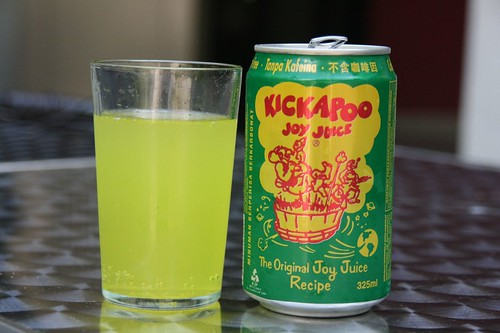
I was checking out the selection of cold drinks at the Japanese superstore Isetan this afternoon. What I really wanted was a can of soursop juice, but when I saw the words "Kickapoo Joy Juice" I knew I'd found something special. The can even said it was "The Original Joy Juice Recipe." I didn't know there was more than one.

I had to try it. How bad could something called "Joy Juice" be? I know, it could have been truly terrible, a blend of unknown ingredients aimed squarely at the Asian palette.

The Original Joy Juice Recipe

As you can see from this photo, Kickapoo Joy Juice is the color of radiator fluid. It is a carbonated citrus drink that contains a hint of ginger. It's sweet and syrupy, but I was quite happy to drink the whole can.

Where did this beverage come from? And why is it called "Joy Juice"? A quick Google search provided some answers. (What did we do in the days before Google?)

Kickapoo Joy Juice is manufactured by the Monarch Beverage Company, based in Atlanta, Georgia. The drink is only distributed in Malaysia, Brunei and Bangladesh -- talk about niche marketing!

I dug a little deeper and found a connection to American cultural history. In the comic strip world of Dogpatch, home of Al Capp's "Li'l Abner," there was a concoction called "Kickapoo Joy Juice," a "liquor of such stupefying potency that the hardiest citizens of Dogpatch, after the first burning sip, rose into the air, stiff as frozen codfish."

It gets even better. Another search revealed that Capp probably based Kickapoo Joy Juice on a nineteenth century patent medicine called "Kickapoo Indian Sagwa," the product of a snake oil manufacturer Kickapoo Indian Medicine Company of Connecticut. According to Bottlebooks.com, the concoction was a mixture of "Soda Bicarb, Gentian Root, Mandrake Root, Cubebs Rubarb Root, Senna Leaves, Aniseed Red Cinchona Bark, Yellow Dock Root Dandelion Root, Burdock Root, Sacred Bark, Licorice Root, Aloes, Alcohol Glycerine, and Water." Mmmm.... alcohol glycerine.

That's a long way from the ingredients of "Kickapoo Joy Juice," which, according to Bevnet.com, are "carbonated water, sugar, permitted food conditioners, flavoring, perrservative and color (tartrazine)." Mmmmm.... tartrazine.

What a long strange journey! Who knew a can of soda could bring so much joy?

Labels: ,

Friday, May 18, 2007

A Kualu to Remember

Throw a dart at a map of the world and it will likely land somewhere in the middle of an ocean. Throw it again. If it strikes land, chances are it will be someplace you’ve never heard of. Before I arrived in Malaysia, I’d heard of Kuala Lumpur, Penang and Borneo. Everywhere else was just a name on a map.

I left Singapore with the goal of traveling way up the east coast of Peninsular Malaysia, moving slowly, no more than a few hours at a time. The coast is not that long and I planned to cover the distance from Singapore to the Thai border in about ten leisurely days. My first stop was Pulau Tioman, then to the beach town of Cherating. Pulau Perhentian, a destination other travelers swore I could not miss, was still seven hours north. I threw a dart at a map and it landed in Kuala Terengganu.

Kuala Terengganu is the capital of Terengganu, one of the richest states in Malaysia. Once a fishing village, oil revenue has transformed the town into a bustling small city with 250,000 residents. There is nothing a visitor has to see, no significant architecture or historical sites. I arrived in the early afternoon and as I walked the city’s streets, along its broad beaches, through the colorful central market and finally in and out of narrow alleys in Chinatown, I was struck by its accessibility and the openness of the locals.

Entrance to Sultan's Palace, Kuala Terengganu

There are many reasons to travel. Some people seek out cultural attractions or natural wonders; some are fascinated by a region’s history, favoring trips to the past over living the present. A well-rounded journey takes in all these things. I’ve found since arriving in Asia, however, that I’m often led by something more primal: hunger. My stomach guides me. Or is it the taste buds?

The Lonely Planet entry for Kuala Terengganu says it’s a good place to sample some regional specialties. My goal for the 18 hours I would spend there was to try nasi gagang, a breakfast dish of rice and glutinous rice sweetened with coconut milk and wrapped around a morsel of fish. The whole thing is then enclosed in a banana leaf and served with a side of fish curry. In Japan I ate onigiri, triangles of rice in a seaweed wrapper. Nasi gagang sounded like the Malay version. But what would I do with so much time to kill before breakfast?

Anyone who is led by the stomach will eventually find his way to the central market, along with local buses a sure source of local color and flavor. A brisk walk along the waterfront and past the sultan’s palace brought me to the market, a split-level building divided into sections based on the goods for sale, from fruits and vegetables and fish on the street level to fabrics and housewares in the crowded aisles on the second floor.

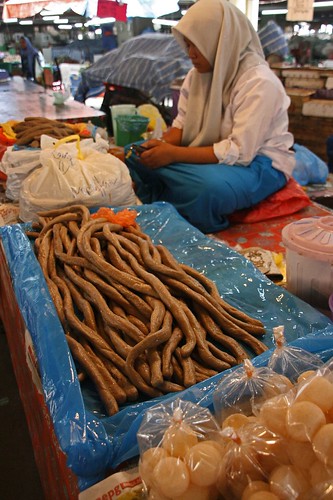
I spent the next hour wandering the aisles, asking rudimentary questions about anything that caught my eye. Most of the vendors only spoke Malay, so there was a lot of pointing and shrugging of shoulders. I was offered samples: two varieties of salak (called snake fruit in English due to it’s hard scaly skin), a tart morsel of flesh around a hard brown pip; godol, a soft, subtly sweet chewy triangle the size of a caramel, made from glutinous rice and cane sugar; and keropok keping, fish crackers spiced with red chilies. The crackers are the dry version of keropok lekor, a mixture of fish paste and sago flour molded into long grey sausages.

Keropok Lekor

Islam is the state religion of Malaysia and the residents of Kuala Terengganu reflected conservative views in the way they dressed. I changed into long pants before leaving my hotel just to feel more comfortable. Women, while active in all parts of society, wear headscarves (tudong, covering the head but not the face) and loose-fitting dresses that cover everything but the feet and hands –I’ve only seen two women wearing full veils in all my time in Malaysia. Now, after 10 days among modestly dressed women, I can understand the allure of a finely formed ankle.

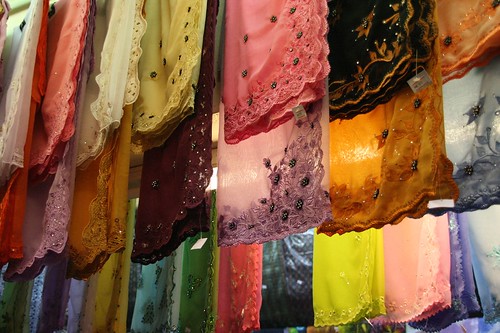
I offer this aside for a reason. On the second floor of the market, I wandered through aisles of colorful silks, marveling at the variety and quality. In a few stalls, there were swaths of woven fabric, perhaps two feet by six feet, costing RM600, close to US$200, an astounding figure in a country where a meal can be had on the street for RM4. Rows of headscarves hung overhead and on the walls of the stalls in a dizzying array of colors and designs. My first few days in Malaysia I thought all the women looked like they wore the same things. With a little market research, I know notice the subtle differences in their dress. I don’t know enough about fashion, clothing, textiles or Islam to describe this further. I wish I could.

Headscarves

The afternoon was another scorcher, with high humidity. As I wandered through the streets of Kualu Terengganu’s small Chinatown, I only had one thing on my mind: liquid. I was thirsty. I noticed a group of people sitting on the patio at a restaurant called T. Homemade Café and wandered in for a look. A woman approached me and just said “what do you want to drink?” I guess it showed on my face.

Her approach was so direct and honest I decided there was no point in arguing. I ordered a watermelon juice and grabbed the nearest seat. T. Homemade Café is not just one restaurant. There are four or five stalls in a long dining room, another two or three set up outside. What is served depends on the time of day.

By my table on the patio and man was thinly slicing roast pork for plates of mee siam, a dish of thin noodles covered in a tamarind sauce and accompanied by meat and greens. I was hungry, the pork looked good, so I ordered some. It was an unremarkable meal, but I hadn’t eaten anything since the morning (other than a few handouts at the market) and it hit the spot. The watermelon juice was fresh and cold. In 15 minutes I was refreshed and thinking of moving on.

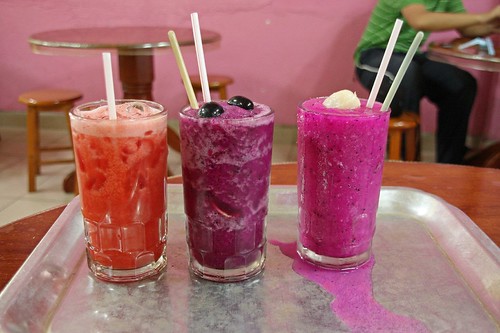
The same women who’d approached me earlier came back and said hello, asking if I wanted anything else. Out of the corner of my eye I noticed a signboard for the café that featured a glass of dragonfruit juice. I’d tried a white version of this tropical fruit in Australia and found it bland, somewhere between a watermelon and a kiwi, but without a bite. Dragonfruit also comes in a deep red variety, and I asked if this is what she served. She said yes, and I ordered a glass. What came to me was a frosty mug of purple juice, a mix of dragonfruit and lychee that was as close to a slurpee as I’d seen in months.

From left, Watermelon, Dragonfruit with Grape, Dragonfruit with Lychee

By this time I’d moved out of the heat and into the main dining room. It wasn’t much cooler, but the air was moved by a set of ceiling fans. The woman noticed as I pulled out my camera to take a picture of the juice. Then another women walked by with a tray carrying three more colorful mugs. The first woman told her to stop so I could take another photo. At this point I’d made a new friend.

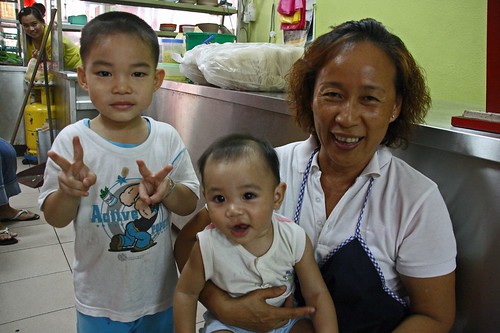
The woman introduced herself as Jennifer. I’m not sure if she owned the restaurant; surely she was part of an extended family that worked there. She asked me the usual questions about my trip and then I asked where I could go for the best nasi gagang in town. She drew me a map to the real deal. She left me to my dragonfruit drink (delicious, by the way, much better than the white fruit I’d tried in Oz.

I was again about to leave when Jennifer came back. Somehow I got on to the subject of fruit and mentioned how I’d fallen in love with soursop in Singapore. “I have that too,” she said. “You want one?” With an offer of a mug of soursop juice on the table, I knew I wouldn’t be leaving anytime soon.

I finally made it out of there after three tall mugs of juice and a small plate of the Chinese version of keropok. After so much sweet juice, the fishy snack was a shock to my taste buds, especially when dipped in the spicy sambal on the side.

Jennifer and Kids

I said goodbye to Jennifer and her extended family, thinking I would never see them again. The plan was to wake up early, go for nasi gagang and catch a 10 am bus out of town. But I overslept and the 10 am bus broke down. I would have to wait until 11:30 to get out of town. Sometimes travelers don’t travel, they just sit and wait.

There was no question about my next move – I headed straight for T. Homemade Café. I was greeted by Jennifer, who immediately asked me if I’d like the nasi gagang. I confessed that I had overslept and she laughed, then told me she’d get me some.

“Where?” I asked.

“I will drive and pick it up,” she said.

“No, you can’t to do that.”

“Sit. What do you drink?”

I didn’t have a choice. Ten minutes later Jennifer returned with two banana leaf cones and a baggie filled with curry sauce. She fetch a small bowl for the curry and brought me a fork and spoon. Nasi gagang didn’t knock my socks off, but it is a very good breakfast food. It’s light, a bit sweet from the coconut milk and bracing from the curry. I suspect the fish at the center of the rise is last night’s leftovers.

When it came time to me to leave, for good this time, I asked Jennifer what I owed her for the food. She wouldn’t take one ringgit from me.

Kualu Terengganu didn’t exist for me before I threw that dart. Now it’s one of the highlights of my trip.

Labels: ,

Friday, May 04, 2007

Shiok!

Shiok: Singapore slang for “great/excellent/superb.”

I’m whole again, thanks for the superhuman, make that supercorporate, efforts of Sony Singapore. I spilled beer on my laptop on Monday night, brought it in for repair on Tuesday morning (a national holiday, no less) and picked it up – complete with a shiny new keyboard – on Thursday afternoon. In my experience computer repair takes a minimum of one millennium; a 53-hour turnaround boggles my mind. Pinch me. Customer service departments of the world, take note.

But I'm not in Singapore to talk about customer service. I'm here to eat. And eating is what I've been about this week, with both Makansutra and a few locals as guides. I’m not going to chronologically rehash everything I’ve shoveled into my maw. Highlights will have to suffice.

I wrote last weekend about an attempt to track down Tian Tian Hainanese Chicken Rice, only to discover that the hawker stall had decamped for a week for a trip to New York. Tian Tian is back, and the chicken rice was worth the wait. Some cooks just have a knack for blending ingredients, lulling diners into a flavor-fueled trance. A huge plate of Tian Tian chicken rice disappeared as I scooped mouthful after mouthful into my face. I snapped out it in time to recognize that I was about to eat the last bite, paused for dramatic effect, said thanks to the food gods and closed the book on my Singapore chicken rice experience. I’ve paid homage to the dish with a Packmonkey banner, above. The complete meal is picture below.

Tian Tian Hainanese Chicken Rice

Food experiences are great. Shared food experiences are better. I’d been talking at length at my hostel about my love for the local cuisine, and the folks who work there were happy to throw out recommendations. I was intrigued by something Karen said I must try: Steamboat. Is this the name of a dish or a type of cuisine? Do I need to be in a boat to eat it? Will it fog up my glasses? She offered to lead a steamboat expedition the following night. Trusting that I would not be led into the heart of darkness, I quickly signed on.

Makansutra explains steamboat: “Cook-it-yourself hotpot, with a whole spread of raw sliced meats, vegetables, eggs, vermicelli, seafood, etc. The broth takes on the essence of all the ingredients and is at its richest at the end of the meal.”

Four of us met Karen the next night, where she led us to a sprawling, outdoor complex by the harbor. A propane tank under each table delivered heat to a hotpot filled with water and an outer ring for tabletop grilling. A large buffet in the center of the restaurant was piled with raw seafood, marinated meats and raw vegetables. I was able to identify most of the offerings; I accept the mystery surrounding everything else.

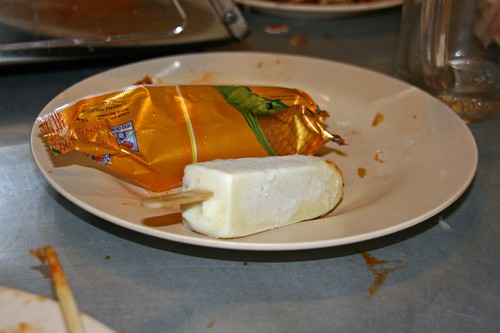
Karen handed out plates and assignments. I was to gather seafood, Paul from Australia would collect the meat and a pair of Englishmen, Mat and Tom, were sent for vegetables. We each returned with plates piled high. The next 90 minutes were spent boiling, grilling and eating. There was nothing spectacular about the food; it’s the communal steamboat experience that made the meal memorable. Once we’d stuffed ourselves, Karen took off to pick up some ice cream. She returned with three flavors: durian, red bean and sweet corn. I chose the sweet corn. It should be called creamed corn from a can ice cream. It was the most disgusting thing I’ve eaten on this trip, worse than Vegemite. Worse even than the diesel fumes I choked down at the Yogyakarta bus station. The poo-poo aftertaste of the durian ice cream provided a pleasant alternative.

Sweet Corn Ice Cream... Yuck

Like Holden Caulfield on a quest for the truth, I continued my Singapore eating spree. I ate fragrant biryani at the Tekka Centre in Little India, where stall after stall serves up Muslim and Indian food. Off the beaten track, in a housing complex in Bedok, I tried Char Kway Teow, a heavy, fried noodle dish sprinkled with briny cockles and chewy Chinese sausage. I washed down meals with fresh soursop juice (move over mangosteen, soursop's the new sheriff in town).

The Indonesian dessert Chendol was an intriguing blend of coconut and caramel – dulce de leche in a cup! – but the green slivers of rice jelly kept rising through my straw and reminding me or worms (ok, maggots) and I threw it out. On a lark, I tried a prawn vadai, a fried donut with an unshelled prawn embedded in the center, a fresh green chili providing a contrast to the lump of greasy dough.

Before arriving in Singapore I’d been told I had to try stingray. I was immediately intrigued. Perhaps I was still hooked on Australia and was seeking a little revenge for the death of Steve Irwin. Again, the crew at the Inn Crowd hostel came through. Karen was busy, but she enlisted Marcus as my guide and translator.

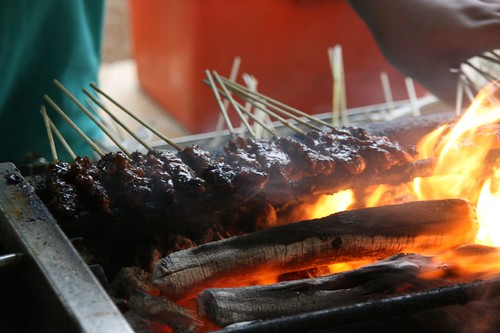
Satay at East Coast Lagoon

Marcus took me out of the city center to East Coast Lagoon, a food center on the eastern side of the island. The east coast is an upscale district, and the food center was built to resemble a tropical food court, complete with palm trees and thatched roofs. The proximity to the shore, even if the view was of dozens of cargo ships anchored in the channel, allowed me to accept this fabrication. The clientele included many smiling ex pats, all of them looking like they put in some hard hours at banks and other financial institutions.

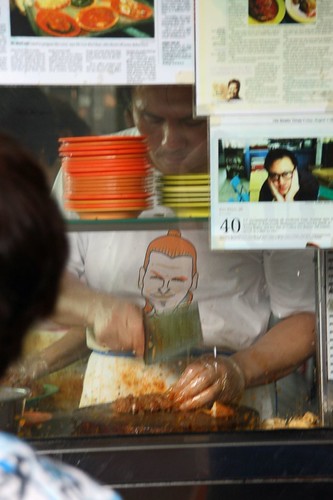
Marcus led me around the food center, explaining the choices and answering some lingering questions about Singapore cuisine. From one stall we ordered stingray grilled on a banana leaf. From another, tiger prawn imported from Thailand. We added a plate of steamed green vegetables called kang kong, hallow stalks with attached leafy greens, and a plate of rojak, assorted wedges – tofu, fried flour bits called yew tiao, turnip, pineapple and cucumber – covered in a sweet black sauce and chopped peanuts. We ordered a few glasses of fresh sugar cane juice to wash it all down. The stingray, prawn and kang kong were served with thick and pungent chili sauce called sambal. The whole meal cost about U.S.$20, on the steep side for Singapore. But you get what you pay for. Everything was delicious except the rojak, which tasted fishy to me and which Marcus confirmed was “off.”

Grilled Stingray

It’s now Friday afternoon. I’ve been in Singapore almost two full weeks and don’t feel like moving on. There’s still plenty of food to taste – laksa has been on my list for a week – but I know there’s much more to Southeast Asia. I expect I’ll leave on Monday or Tuesday, either for Kuala Lumpur or direct to Borneo. A friend says I cannot miss Penang, where, he swears, the food is even better than in Singapore. Some research is in order. Any suggestions? Send them my way.

Labels: ,

Sunday, April 29, 2007

Going Glutton

Singapore is for Foodies. I’m no a professional, but I know what tastes good. And for me, Asian food is at the top of the heap. If naturally follows that Singapore would give me culinary opportunities I could not pass up.

I’ve already written about my chili crab experience, a night of fine dining that delivered a great introduction to local cuisine. But the real deal, the tried and true, the nitty and the gritty, is the street food. Scattered across Singapore are food courts called hawker centers, where stall after stall delivers fresh flavors from around the world. I’m staying in Little India, where the Tekka Centre serves up a hectic mix of Indian and Muslim dishes. The Maxwell Road Food Centre in Chinatown is the place for Chicken Rice (not Chicken and Rice, just Chicken Rice). There’s also the Adam Road Food Centre, Chomp Chomp and Lau Pa Sat. This doesn’t even take into account food courts in the basement of every shopping mall and the restaurants tucked into residential neighborhoods and lining the ground floors of housing complexes.

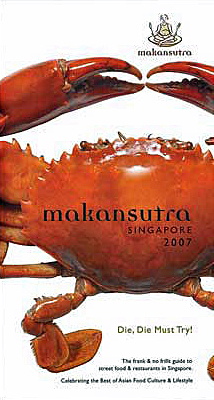
How am I, a stranger to this country, supposed to navigate this cornucopia of cuisine? That’s where Makansutra comes in. Think Zagat, same basic shape and size, but instead of restaurants, Makansutra points diners toward street food. At less than $10 U.S., the guide is a worthy investment even for a short stay in Singapore. The book contain an alphabetical list of dishes, from Abacus Seeds (“yam flour cakes”) to Yong Tau Foo (“a Hakka meal of tofu stuffed with mixed meat or fish patties”), with short descriptions of each dish followed by the best places to consume them. Each eatery is graded on a chopstick scale: one pair is “Good,” three pairs “Die, die must try!” The book even tags local specialties with a blue dot and the text “Popular Local Favorite.”

I’m a slave to guidebooks. I like orderly sources of information, anything that can send me in the right direction, and in the past few days Makansutra has become a vital tool, almost a trusted friend.

But let me back up a step. After gorging on Chili Crab, and still undecided on the Makansutra guide, I did a little online research and decided my next meal had to be Chicken Rice, considered to be Singapore’s national dish. From Makansutra: “Rice grains are fried in garlic, sesame and chicken oils before boiling in chicken stock. The fowl is boiled, then dunked in cold water or ice to smoothen out the skin and gelatinize the oils. The sliced chicken is served with a plate of tasty rice with cucumbers and a tangy chili dip, ginger sauce and dark soy sauce.” Sounds delicious, no?

Two more trusted sources, Anthony Bourdain and Michael Y. Park, agreed that the best place for Chicken Rice is in the Maxwell Road Food Centre, stall number 10, Tian Tian Hainanese Chicken Rice. To my astonishment, the stall was closed when I arrived, a note tacked to the shutter announcing that Tian Tian was in New York City to serve Chicken Rice at Singapore Day. The irony was not lost on me. (They are open again for business and I will try Tian Tian Chicken Rice before I leave.) I ended up the dish at another stall and found the cold chicken refreshing given Singapore’s hot and humid climate. The tangy ginger and the spicy chilies complemented the plain strips of boiled fowl.

Chicken Rice was my last meal without a guide. Armed with Makansutra, I set out the next day determined to try as many local favorites as possible.

My first stop, on Friday, was Chap Chye Rice at Loo’s Hainanese Curry Rice. There’s not much to curry rice. You slop some rice on plate, choose from an assortment of meat and vegetable dishes and slather it all with starchy curry gravy.

I quickly discovered that while English is the official language of Singapore, my culinary travels were going to take me into neighborhoods where English is the second, even third or fourth, language. I would have to rely on pointing and nodding. At Loo’s, I waited in line (if there’s a line at a food stall, eat there, say the locals) and when my turn came I pieced together meal of steamed rice, fried tofu, stringy greens and a breaded pork cutlet, all topped with a tangy curry gravy. The plate contained more grease than I wanted, but the gravy was spicy and thick, the pork juicy on the inside with a flaky crust. I don’t think I’d rate it three chopsticks. Still, I’m an amateur and accepted my meal with grace.

The Counter at Loo's

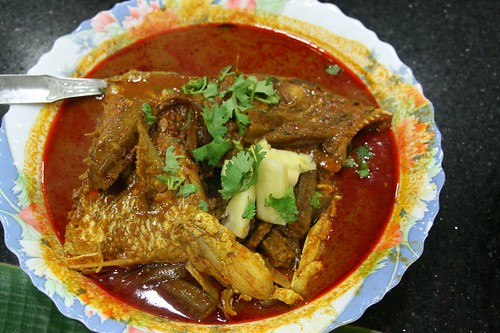
Next, I decided next to branch out, to take a risk, to face a dish that in most circumstances would elicit a long, drawn out “eewwwwww” at the mention of its name: Fish Head Curry. Makansutra: “A whole huge snapper head, complete with lips, eyes and cheeks is cooked in a spicy, tangy, tamarind curry with okra and tomatoes. Some say it is a uniquely Singaporean creation, when Gomez, an Indian cook decided to cook the fishheads which were thrown away.” Apart from the tortured punctuation, this is an accurate description of the dish.

Most street food in Singapore will set you back no more than five bucks (current exchange rate is about U.S$1 to S$1.50). Fish Head Curry is another matter – at the Banana Leaf Apollo in Little India I paid S$18 for a small fish head. Nevertheless, I was served a massive snapper head drowning in a sea of delicious curry, with steamed rice, a pile of steamed cabbage, chutney and papadum on the side. The dish should be called Fish Head and Neck Curry because the majority of the edible white flesh comes from what would be the neck and shoulders if fish had necks and shoulders. I was surprised by the amount of meat in the dish. And hidden in the curry sauce were tender stalks of okra and sweet chunks of pineapple.

Fish Head Curry

Remember my description of eating Chili Crab? Repeat, substituting Fish Head Curry for Chili Crab. The Banana Leaf is an Indian restaurant, so I ate with my right hand, shoveling morsel after morsel of fish into my mouth until there was nothing left but a carcass, one eyeball falling out of the socket. I’m sure some people eat the eyes; I’ll climb that mountain another day.

Saturday dawned and with an empty stomach I wanted to eat through the weekend. But I had made plans with Margie, an eclectic Australian (and self-proclaimed dreamer and visualization acrobat), to spend the afternoon at the Singapore Botanic Gardens. We had fun with the flowers, especially those at the National Orchid Garden, but you can’t eat orchids and I didn’t get back on the Makansutra trail until dinner.

I chose a South Chinese Teochoew dish called Bak Chor Mee: “Minced pork, sliced mushrooms, fishcakes and meat dumplings sit on top of noodles tossed in a special chili sauce with a hint of vinegar. You can order it ‘dry,’ with the noodles and soup segregated, or get the all-in-one meaty soup version.”

At this point you are saying, “Matt doesn’t know a thing about South Chinese Teochow cuisine.” Guilty as charged. I’m an ignoramus. I chose Bak Chor Mee because it is a local favorite and would take me into a part of town where I would see no other tourists. One of the joys of travel for me is nosing around where the locals live. Loo’s, where I ate Curry Rice, is in a residential neighborhood of modest apartment buildings (80 percent of Singaporeans live in government subsidizes housing) outside of the area covered by my tourist map. Bak Chow Mee would take me into a real neighborhood once again.

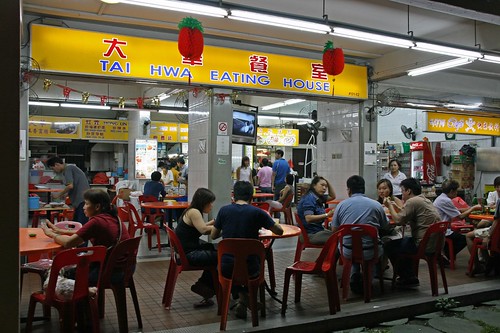
Tai Hwa Eating House

I was not only the only white guy at Hill Street Tai Hwa Pork Noodles off North Bridge Road, it seemed like I was the only white guy in town. Tai Haw is one stall in a tiny “Eating House” in a housing complex. Finding the address, “Block 466, #01-12,” was a challenge. But I’m persistent and once I arrived I knew I was in the right place because of the line snaking from the counter. Again, trust the locals.

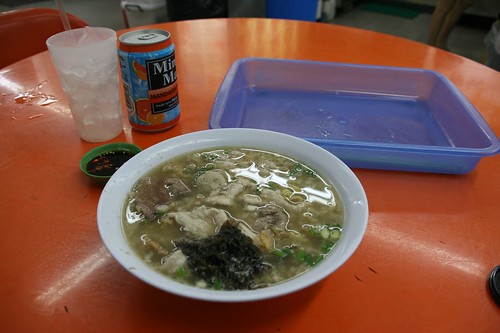
I queued up, waited for an eternity, and was offered translation services by a nice elderly woman at the front of the line. I wanted the “dry” version of Bak Chor Mee, but ended up with the soup. Think ramen, with flat noodles and a stock made from vinegar and soy. Sprinkled throughout were bits of meat: minced pork, liver slices, a meatball from an unknown animal and fingernail-sized bits of dried fish, each ingredient added raw to the bowl and cooked by the boiling broth. There was also a mass of fungus I assumed to be the sliced mushrooms. An earthy odor arose from the bowl, the fungus and liver most prominent, but with a hint of the sweet vinegar and chilies.

The Bak Chor Mee was exquisite. And I had the realization while slurping the noodles and gingerly testing a fish bit, that often the difference between good food and excellent food is often nothing more than a clean feeling while I’m eating. This dish could have been oily, it could have been overpowered by the meat, the flavor of the tender noodles pummeled by the stronger ingredients, but the flavors were in perfect harmony, each nugget delivering a unique taste while the subtle broth unified the dish into something whole.

Bak Chor Mee, the Wet Version

I am not a food writer. I would prefer to write about the experience of eating than the flavors I encounter. How do I explain what’s it like to taste a new mushroom? Are there words to describe a fishball (spongy and delicious don’t cut it)? As I continue to eat my way through Singapore, I’ll share my impressions. I hope you’ll enjoy this food for thought (bad pun, I’m sorry), but recommend you get your empty stomach to Singapore and try it yourself.

Labels: ,

Wednesday, April 25, 2007

Singapore Spree, Burger Time and a Chili Crab

I arrived in Singapore with a shopping list and the knowledge that this may be my last chance to choose among a variety of goods and services for a few months. At the top of the list was a new backpack. My 50-liter Kelty was fine for ten days in Ireland and held up for the first two months of Australia. But the zippers started acting up and it just wasn’t big enough to carry everything. Despite my best intentions to travel light, I needed more space.

Also on the list were a pair of shorts, swimming trunks, new books and a few small items like a padlock and a tube of toothpaste.

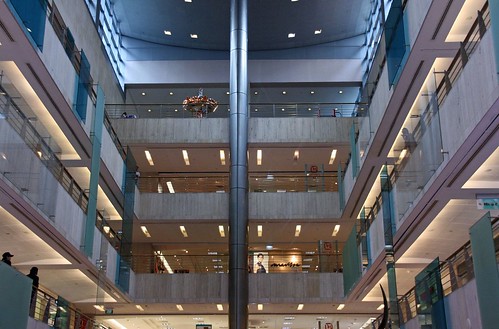
Singapore is a shopper's paradise, especially a long stretch called Orchard Road. Orchard road is comprised of mall after mall after mall. You don’t just walk down the street and enter one mall after another. The area is a complex collection of escalators, underground passageways, staircases, elevators and elevated walkways. One mall leads to another, or to a movie theater, or a food court or an outdoor café. You could spend an eternity on Orchard Road and never see daylight.

Orchard Road Shopping Mall

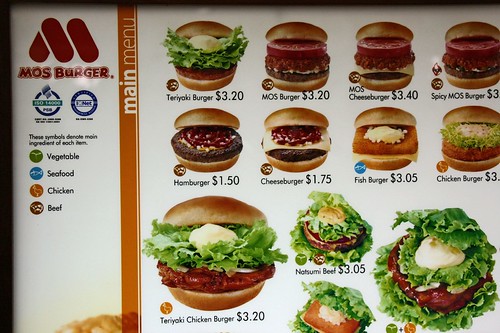
As I was walking from one mall to another, with food on my mind, I was stopped in my tracks by the site of a Japanese fast food chain called MOS Burger (Mountain Ocean Sun Burger, very Japanese).

Before I explain the significance of this discovery, I have to admit that I made a promise to a friend in New York that I had to break. On one of my last nights in Brooklyn, I was eating dinner with my upstairs neighbors, Michael and Carmiya, and discussing the food in Asia. The conversation somehow turned to the fact that there are McDonald’s and KFCs everywhere. I promised Carmiya that I would abstain from eating any fast food while on the road.

I’ve been good to my word, using fast food restaurants only for their restrooms. But a MOS Burger turned me into a liar.

When I lived in Japan in the early 1990s, my girlfriend Rachel and I would make regular trip to MOS Burger for generous helpings of MOS Spicy Burgers and fries. The burgers are topped with a watery chili, diced onion and a thick slice of tomato. There's also a mysterious white sauce that binds it all together into a sticky goo. They provided a taste of the west while preserving our Asian lifestyle. We loved MOS Burger, and when I left Japan I thought I’d never have another for as long as I live.

Who knew Singapore had MOS Burger too? So I apologized to Carmiya, stepped up to the counter and placed an order. My burger arrived soon after I chose a seat. How was it after all these years? The Coke was syrupy sweet, the fries undercooked and the burger as void of nutrition as it was full of tasty goodness. Empty calories never tasted so good.

MOS Burger Menu

My belly full of crap, I returned to shopping. If everything under the sun is available on Orchard Road, why did I have to look high and low for a new backpack? After a frustrating search, I found an Osprey Atmos 65 at a store on the fifth floor of Lucky Plaza. Or was it Golden Plaza? Lucky Village? Golden Lucky Village Plaza?

Obtaining a new pair of shorts was just as difficult. I brought a pair of cargo shorts from the U.S., a beloved olive green number from J. Crew. The pants started to fray at the end of my trip through Outback Australia. In Indonesia, I twice resorted to needle and thread to keep the seams from ripping. By the time I arrived in Singapore, they were soft and ultra-comfy, but on the verge of showing more than the Singaporean government allows in public.

I’ve want to believe I’ve never been choosy about my clothing (not true at all, so I’m delusional). Since hitting the road, however, I’ve become a huge fan of cargo pants. The more pockets the better. And I found a winner. My new pair sports not the usual four pockets, nor six, but a total of ten pockets for all the assorted items I carry on a daily basis. From lens cap and notepad to extra cash, a pen and complimentary city map, I’ve got it covered.

Where did I buy this magical pair of pantaloons? I’m almost embarrassed to say. Ok, I traveled halfway around the world to buy a pair of shorts at The Gap. Sue me.

Singapore is also known for it’s food, which I’m happy to report is of a much higher quality and offers more variation than MOS Burger. While buying a polarized filter for my camera, I was told that for a real Singapore delicacy I should go to a place called Jumbo Seafood for the chili crab. I also had to make sure to get some little buns on the side to dip into the sauce.

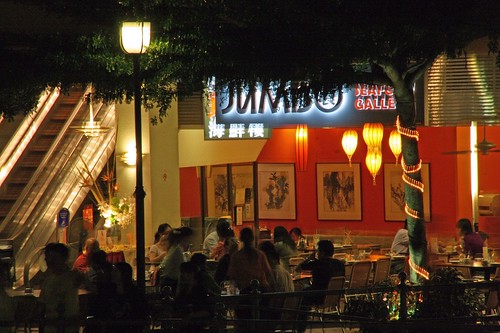
I assumed Jumbo Seafood was a ramshackle outfit on the waterside where I would sit at a creaky table with a paper napkin stuffed into my shirt. Well, Jumbo Seafood is a proper restaurant across from one of the main tourist areas of the city. My cheapo crab dinner was going to cost me considerably more than I had assumed. But I’m here for experience and a few extra Singapore dollars weren’t going to keep me from digging into some crab.

The extra cash was worth it. A two-pound crab arrived at my table, steaming in a read chili sauce. I looked around at the well-dressed crowd, down at the crab, back and the crowd, and said “whatever.” There was no way to eat this bad boy but with my hands. The crab was cooked just right, not one bit chewy, retaining all it’s flavor without tasting fishy. The chili sauce packed the perfect amount of heat, never overpowering the crab or overwhelming the palate.

Jumbo Seafood

I spent the next thirty minutes cracking, sucking, picking and slurping, my fingers as pruned as if I'd spent an hour at the local swimming pool. That poor little crab never had a chance. I left nothing but splinters of empty shell amid broken legs and shattered claws. The buns were the finishing touch, small nuggets of dough deep-fried to a golden perfection and suitable for eating on their own, but even better when dipped in the chili sauce. I washed it all down with a Tiger beer (unremarkable but local and cold). It was the best meal I’ve had in a while. And it was easily the best crab I’ve had in my life.

When traveling, listen to the locals. Rachael Ray says it all the time.

Labels: ,

Wednesday, February 14, 2007

Eating Well

Thanks to everyone who send me suggestions on healthy eating while on the road. The consensus is fresh veggies sautéed in garlic with a grain or pasta. There's no shortage of delicious fresh vegetables in Australia so I’ll give it a go. Any more ideas? Send them on. I’m limited by the fact that I can only buy what I can eat in one to three days.

Labels:

Saturday, February 10, 2007

Salty Yeast Extract

Anyone who visits Australia will sooner or later encounter Vegemite, a spreadable yeast extract that is a national obesssion. Not one to shy away from a culinary challenge, I took the plunge this morning at breakfast at the Canberra hostel. Ingredients: one piece of toast, a mini-pack of vegemite and strawberry jam. The vegemite itself is a dark brown with the consistency of creamy fudge. I had been told people eat it on toast by itself, with butter or cheese or with a little jam (perhaps I dreamed that part). And I'm sure some folks scoop it out of the jar with a spoon and eat it like I would eat peanut butter.

The verdict: take a leather shoe, walk for about 100 miles without changing socks or washing feet so the sweat and stink seeps deep into the leather. Cut into small pieces and boil down to extract the essence. Add heaps of salt and package. Spread on bread. Chew. Grimace. Swallow. Repeat. They say it's an acquired taste. I may try again tomorrow, but the first time did not convert me.

Labels: ,