The Bomb
I didn’t come to Nagasaki for the temples. There are plenty of temples, all of them very beautiful. But really, who comes to Nagasaki for the temples? Most visitors come to Nagasaki to learn about the atomic bomb.
It’s true that this port city on the western edge of Kyushu has a long and vibrant history, that it was once the most international of Japan’s cities, open to trade with China and Holland when the rest of the country was closed to the outside world. What brought me here is the day in Nagasaki’s history, August 9, 1945, when the United States dropped an atomic bomb on the unsuspecting populace. Historians argue that the bombs dropped on Hiroshima and Nagasaki forced the capitulation of the Japanese and hastened the end of World War II, saving more lives then they took. Whatever the case may be, the loss of life was substantial and the results horrific. (The Wikipedia entry on the atomic bombings of Hiroshima and Nagasaki is very informative, and a shorter read than Richard Rhodes' "The Making of the Atomic Bomb." I also recommend John Hershy's "Hiroshima."
A visit to the site of an atomic bomb detonation is a surreal experience. A black monolith in a small public park marks the site of the explosion, dubbed the “hypocenter.” The monolith points to the sky, to the spot 500 meters above ground level where the bomb (nicknamed “Fat Man”) detonated, instantly killing 75,000 people.
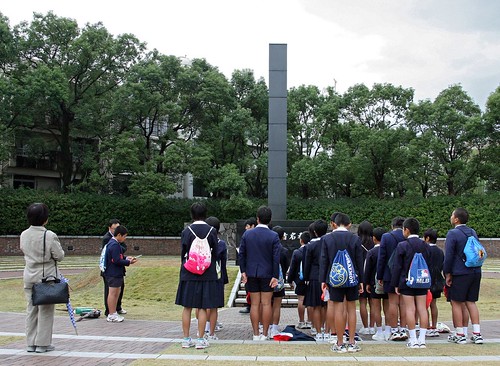
The Memorial at Atomic Bomb Hypocenter Park
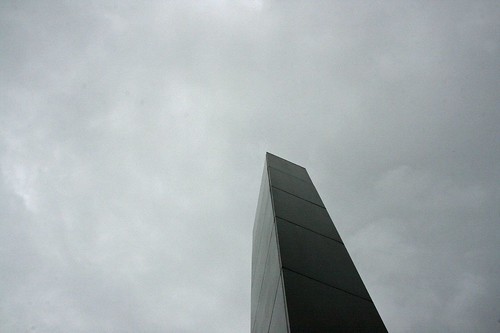
Hypocenter
It’s a normal place today, serene even, surrounded by houses and shops, a sports complex to the west and a baseball stadium to the north. I tried as best I could to imagine what it was like when the bomb exploded. I’m afraid my mind isn’t capable of that level of imagination.
As of today, the Japanese government has verified the names of more than 143,000 victims of the bomb. It’s not an insignificant figure, but compare it to the six million Jews killed by the Nazis, the quarter of a million Indonesians wiped out by the tsunami of 2005, or even the hundreds of thousands of Iraqis who’ve died in the past few years. The horror of the atomic bomb, therefore, comes not from the numbers killed, but from its ferocity, its ability to incinerate and destroy in the blink of an eye. This power is documented at the Nagasaki Atomic Bomb Museum, a valuable repository of artifacts and information related to both the bombing of Nagasaki and the larger subject of nuclear weapons.
The museum seems to be a requirement of the Japanese educational system. On the day I visited, a Tuesday afternoon in November, a steady stream of school groups marched from the hypocenter to the museum. The galleries were packed with teenagers, which left me feeling like an interloper on their field trip. Nevertheless, I was able to take my time and view the twisted relics and the photographs of the leveled city.
After so much destruction and death, it was a relief to enter the memorial for the victims of the bomb. The memorial hall is not on the itinerary of the school groups, which means it remains empty and quiet. It is a chamber designed for contemplation and prayer. In contrast to the museum, the memorial works through understatement and simplicity, with a single small room where images of the dead are shown on three wall-mounted monitors. In the “Remembrance Hall,” twelve pillars of light lead to a registry containing the names of the dead.
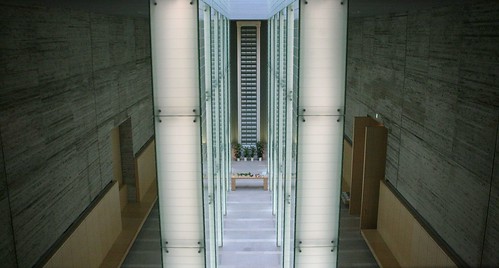
Nagasaki National Peace Memorial Hall for the Atomic Bomb Victims
I don’t want to get political here. But this visit reminded me that there are still tens of thousands of nuclear weapons in the world today. It’s a wonder that not a single one has been used since August 9, 1945.
It’s true that this port city on the western edge of Kyushu has a long and vibrant history, that it was once the most international of Japan’s cities, open to trade with China and Holland when the rest of the country was closed to the outside world. What brought me here is the day in Nagasaki’s history, August 9, 1945, when the United States dropped an atomic bomb on the unsuspecting populace. Historians argue that the bombs dropped on Hiroshima and Nagasaki forced the capitulation of the Japanese and hastened the end of World War II, saving more lives then they took. Whatever the case may be, the loss of life was substantial and the results horrific. (The Wikipedia entry on the atomic bombings of Hiroshima and Nagasaki is very informative, and a shorter read than Richard Rhodes' "The Making of the Atomic Bomb." I also recommend John Hershy's "Hiroshima."
A visit to the site of an atomic bomb detonation is a surreal experience. A black monolith in a small public park marks the site of the explosion, dubbed the “hypocenter.” The monolith points to the sky, to the spot 500 meters above ground level where the bomb (nicknamed “Fat Man”) detonated, instantly killing 75,000 people.
It’s a normal place today, serene even, surrounded by houses and shops, a sports complex to the west and a baseball stadium to the north. I tried as best I could to imagine what it was like when the bomb exploded. I’m afraid my mind isn’t capable of that level of imagination.
As of today, the Japanese government has verified the names of more than 143,000 victims of the bomb. It’s not an insignificant figure, but compare it to the six million Jews killed by the Nazis, the quarter of a million Indonesians wiped out by the tsunami of 2005, or even the hundreds of thousands of Iraqis who’ve died in the past few years. The horror of the atomic bomb, therefore, comes not from the numbers killed, but from its ferocity, its ability to incinerate and destroy in the blink of an eye. This power is documented at the Nagasaki Atomic Bomb Museum, a valuable repository of artifacts and information related to both the bombing of Nagasaki and the larger subject of nuclear weapons.
The museum seems to be a requirement of the Japanese educational system. On the day I visited, a Tuesday afternoon in November, a steady stream of school groups marched from the hypocenter to the museum. The galleries were packed with teenagers, which left me feeling like an interloper on their field trip. Nevertheless, I was able to take my time and view the twisted relics and the photographs of the leveled city.
After so much destruction and death, it was a relief to enter the memorial for the victims of the bomb. The memorial hall is not on the itinerary of the school groups, which means it remains empty and quiet. It is a chamber designed for contemplation and prayer. In contrast to the museum, the memorial works through understatement and simplicity, with a single small room where images of the dead are shown on three wall-mounted monitors. In the “Remembrance Hall,” twelve pillars of light lead to a registry containing the names of the dead.
I don’t want to get political here. But this visit reminded me that there are still tens of thousands of nuclear weapons in the world today. It’s a wonder that not a single one has been used since August 9, 1945.
posted by Matthew Klein at 12:28 AM
1 comments